Alexander the Great Quotes
Our enemies are Medes and Persians, men who for centuries have lived soft and luxurious lives; we of Macedon for generations past have been trained in the hard school of danger and war. Above all, we are free men, and they are slaves. There are Greek troops, to be sure, in Persian service — but how different is their cause from ours! They will be fighting for pay — and not much of at that; we, on the contrary, shall fight for Greece, and our hearts will be in it.
Alexander III (‘The Great’) 356-323 BC, King of Macedonia, Speech to his Soldiers prior to the Battle at Issus, Anatolia, 333 BC
Sourced by: Eigen's Political and Historical Quotations


Alexander and his army were approaching the city of Persian King Darius. The King asked for a truce assuming that a settlement of treasure and land could be worked out as war was usually fought in those days. However, Alexander had led a punitive war where revenge was the major objective. Alexander rejected a truce and chased Darius to his death.


See Noah Webster and Timothy Pickering for similar positions. The War of 1812 was very unpopular with the New England states. They had the most developed trade with England and were economically injured by the curtailment of that trade. The citizens of Essex wanted to give the State Legislature the most possible moral and political power to negotiate an end to the war.


Eisenhower was then Supreme Allied Commander.


Most Canadians supported the English despite the letter.

South America, invaded and colonized by Spain was a brutal combination of slavery and repression. Even the European colonists suffered under the terrible combination of exploitation, militarism and religious dictatorship. Independence from Spain was equally bloody as unlike in North America where the fight was against British rule, in South America the black slaves, the indigenous Indians and the white colonists all had scores to settle with the Spanish rulers. And the Spanish in turn realized that and brutally repressed all rebellion attempts. Atrocities were common, and committed by almost all, including even idealists like Bolivar.


Hunton was an old West Point classmate of Sherman’s and was also a Tennessee slave holder, who wanted his escaped slaves back under the Fugitive Slave Act. Actually, Army Commander McClellan had issued an order just a few days before, prohibiting the Army of returning fugitive slaves to their rebel owners who were guilty of treason. See {619337} Sherman however wrote his friend and made a moral and ethical argument that transcended the law and at the same time pointed out the ethical hypocrisy of the treasonous Confederates.

Ultranationalist Secret Organization. Unlike the Italian Black hand for whom it was named, the Serbs were not interested in money. The were a right wing death squad that assassinated all who opposed a single, unitary, Serbian nation. Dimitrijevic was executed in 1917.

“Volk” loosely translated means “the people.” However it carries the connotation of a unity that “the people” does not.
The resolution was transmitted to the Provincial Congress on June 6, 1775 where it was tabled. Essentially this position was taken by the Continental Congress and General Washington—See {614018}—and then Washington reversed himself, {614220}

The motto was worn on their uniforms which unlike the blue of the rest of the American army was white as can be seen in the famous paining by muralist David R. Wagner. Rhode Island offered freedom to all slaves who would enlist. It not only included Negroes but Indian slaves as well. See {613949} and {614120} for details. The motto itself is interesting in that there was little concept of a country then as most Americans identified themselves as Virginians, New Yorkers or Rhode Islanders. There was no Constitution—only a confederation of States. But the former slaves joining the regiment had never voluntarily associated themselves with Rhode Island, and the first free decision they made was to join the regiment and have a new country.


He drove the British into the sea when no one expected that outcome.

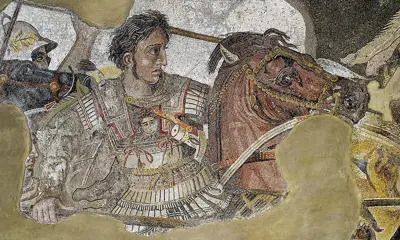
Alexander III of Macedon, commonly known as Alexander the Great, was a king (basileus) of the ancient Greek kingdom of Macedon and a member of the Argead dynasty. He was born in Pella in 356 BC and succeeded his father Philip II to the throne at the age of 20. He spent most of his ruling years on an unprecedented military campaign through Western Asia and Northeastern Africa, and by the age of thirty, he had created one of the largest empires in history, stretching from Greece to northwestern India. He was undefeated in battle and is widely considered one of history's most successful military commanders.
