William Tecumseh Sherman Quotes
I know it is no use for us now to discuss this–war is on us. We are Enemies, still private friends. In the one Capacity I will do you all the harm I can, yet on the other if here. you may have as of old my last Cent, my last shirt and pants, You ask of me of your negroes. and I will immediately ascertain if they be under my Military Control and I will moreover see that they are one and all told what is true of all– ‘Boys if you want to go to your master, Go– You are free to choose, You must now think for yourselves. Your Master has seceded from his Parent Government and you have seceded from him–both wrong by law–but both exercising an undoubted natural Right to rebel, If your boys want to go, I will enable them to go, but I won’t advise, persuade or force them–‘
Hunton was an old West Point classmate of Sherman’s and was also a Tennessee slave holder, who wanted his escaped slaves back under the Fugitive Slave Act. Actually, Army Commander McClellan had issued an order just a few days before, prohibiting the Army of returning fugitive slaves to their rebel owners who were guilty of treason. See {619337} Sherman however wrote his friend and made a moral and ethical argument that transcended the law and at the same time pointed out the ethical hypocrisy of the treasonous Confederates.
William Tecumseh Sherman, 1820-1891, General of the Army, Letter to Thomas Hunton, August 24, 1862
Sourced by: Eigen's Political and Historical Quotations


This is a wonderful quotation which illustrates the polarization which had taken place in America as a result of the slavery issue. Lincoln’s address—which history and most people have adjudged to be such a moderate attempt to find common ground, and which offended many of his constituents because he was compromising and temporizing on the slavery issue—was seen as the radical attacks of a “fanatic”. There is probably no policy that Lincoln or any other President could have followed that would be even marginally acceptable to the slave owners and their economies and the abolitionists and their economies. In the final analysis, slavery was the kind of issue that is not susceptible to compromise. No nation can exist half slave and half free. The Civil War was inevitable unless the South would give up slavery or the North would accept it.

His prediction would come true 72 years later. He was a slave trader and a strong supporter of the institution. See {624060}. However unlike most slave supporting Southerners, he came from one of the richest families of New England. His own brother Moses Brown was an ardent abolitionist and John was able to see the arguments and forces lined up against slavery. He saw that abolitionists as the trouble makers because they were trying to change the status quo. Having much experience with Southerners and selling them many slaves, he realized early how the South was totally dependent on slavery for its economic and social way of life. Few Americans had that broad a perspective.


Committee of the Congress. This was the prevailing Congressional and public view except for the South which had coalesced around an intellectual rationalization. See {618013}.

There was little thought of emancipating slaves or their value to the South by the senior officers of the Union Army at the beginning of the war. The Secretary of War changed that. See {629183}for a typical Union General’s view at the beginning of the war.


President Lincoln and Several of the Commanding Union Generals had declared that black slaves were free during the midst of the Civil War under the legal theory that if the slaves were property of the rebels, then they cold be seized as “contraband” and removed from the control of those who had committed treason. The question was, what would happen to those now free Negroes after the war? Many Negro leaders were anxious that if there were surrender, then the status quo ante might prevail and the Negroes—many have who had fought for the Union might be returned to slavery. This speech by the Secretary of State alarmed them further. This is why the Emancipation Proclamation was so important and even that might have been overturned by a subsequent President. This is why Lincoln, the white radical Republicans and the Black leadership placed so much emphasis on passing the 13th Amendment.
After the Civil War and Reconstruction, the American nation was still bitterly divided intelelctually, socially, emotionally and poliotically. In an effort to bring more unity to America, most of the power stucture and the influentials of the nation began to avoid those issues that would divide North and South and try and promote a narrative that both sides might be able to live with. And this is what Zeitz describes in this quotation. America went through a period of Revisionist History that even in the 21st century was held by many people. It wasn't until the middle of the 20th century that the real history and narrative of the Civil War and Reconstrution emerged from the few academics who had all along criticized the fabricated narritive that did unify the country at the cost of historical accuracy and truth. Many scholars point out that the price that America paid for this unity was the Jim Crow era and a century of legalized racism. Much of the nation was built on the labor of Negro slaves and the victims of the slavery era, also bore the brunt of American unity and reconcilliation.


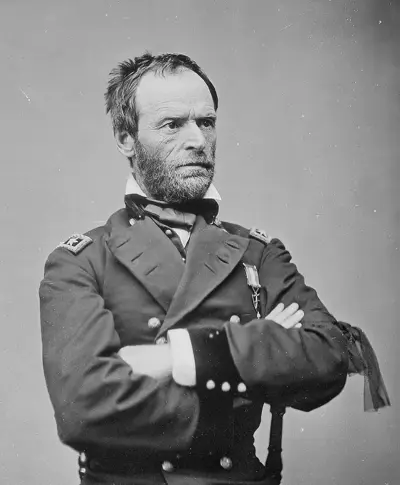
- Born: February 8, 1820
- Died: February 14, 1891
- Nationality: American
- Profession: Soldier
William Tecumseh Sherman was an American soldier, businessman, educator, and author. He served as a general in the Union Army during the American Civil War (1861–1865), receiving recognition for his command of military strategy as well as criticism for the harshness of the scorched earth policies he implemented in conducting total war against the Confederate States. British military theorist and historian B. H. Liddell Hart declared that Sherman was "the first modern general".
