STEPHEN DOUGLAS
(Stephen Arnold Douglas)

At the time the Republican party was a minor, third party and Douglas was disparaging that. While Douglas' general point has held true, the Republicans supplanted the Whigs as the second major party shortly thereafter.
Essentially similar ideas were expressed earlier by George Washington and in antiquity by Vegetius and Horace.
Accusing a candidate who opposed a particular war effort as a traitor and collaborator with the enemy in a campaign worked very well in the 2004 Presidential race where the Republicans painted John Kerry, a war hero, as a traitor and collaborator for opposing the Vietnam War. However, the Republicans had learned the dirty trick in middle of the 19th century from the Democrats when Stephen Douglas accused Abraham Lincoln of selling out his country because Lincoln had opposed the Mexican War. Just as Kerry lost, so did Lincoln in this Senate race, but Lincoln better armed to deal with the attacks, ran for the Presidency two years later.
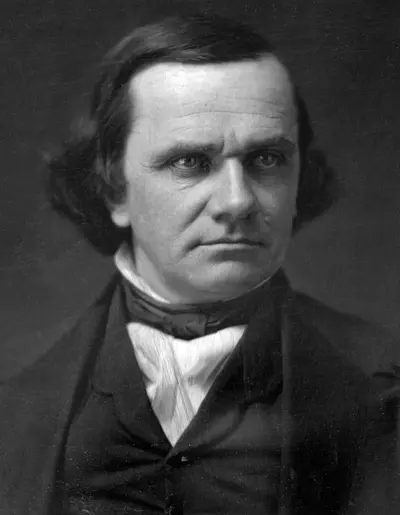
Stephen Arnold Douglas was an American politician and lawyer from Illinois. He was one of two Democratic Party nominees for president in the 1860 presidential election, which was won by Republican Abraham Lincoln. Douglas had previously defeated Lincoln in the 1858 United States Senate election in Illinois, known for the Lincoln–Douglas debates. During the 1850s, Douglas was one of the foremost advocates of popular sovereignty, which held that each territory should be allowed to determine whether to permit slavery within its borders. Douglas was nicknamed the "Little Giant" and "Stevie D" because he was short in physical stature but a forceful and dominant figure in politics.
