Stephen Douglas Quotes
He distinguished himself by his opposition to the Mexican war, taking the side of the common enemy against his own country; and when he returned home he found that the indignation of the people followed him everywhere and he was again submerged or obliged to retire into private life, forgotten by his former friends. He came up again in 1854, just in time to make his Abolition or Black Republican platform, in company with Giddings, Lovejoy, Chase and Fred Douglas for the Republican party to stand upon.
Accusing a candidate who opposed a particular war effort as a traitor and collaborator with the enemy in a campaign worked very well in the 2004 Presidential race where the Republicans painted John Kerry, a war hero, as a traitor and collaborator for opposing the Vietnam War. However, the Republicans had learned the dirty trick in middle of the 19th century from the Democrats when Stephen Douglas accused Abraham Lincoln of selling out his country because Lincoln had opposed the Mexican War. Just as Kerry lost, so did Lincoln in this Senate race, but Lincoln better armed to deal with the attacks, ran for the Presidency two years later.
Stephen Douglas, 1813-1861, Illinois Senator, Describing Lincoln’s political journey, 1858
Sourced by: Eigen's Political and Historical Quotations


The nation in 1848 was very polarized over the issue of slavery. Taylor, never even mentioned the subject in his speeches and writings. He reused to answer any questions about the subject or indicate his own views. His strategy worked as the other politicians who took a stand—either way—alienated a large number of voters.

While Douglas and Lincoln were political opponents with little love lost between them, both were patriots. And Douglas was committed to seeing that Lincoln was inaugurated and the Union preserved, if Lincoln won the election. When Lincoln did so, Douglas traveled throughout the South trying to persuade Southerners to stay in the Union. See {584870}.


The amendments failed as did the compromise.

First Irish Bishop in the United States. American Catholic bishops were divided during the Civil War over the slavery question. For a bishop’s view opposing slavery, see Purcell {612351}.

In modern times, many have complained at the disrespectful way critics refer to the president of the United States. The long for the civility of the past. As this editorial shows, uncivil criticism of the president is nothing new.
This newspaper editorial has historical importance for two reasons. First, it is yet another proof that the sole reason for southern secession was slavery. Second, note the implication that Lincoln had Negro ancestry. As that could be the only reason that he would hold his views on slavery. This disreputable tactic of slandering opponents who hold different views have extended to German ancestry in WWI, Catholic religion, communist affiliation, and in one of the more recent examples, the accusation—believed by a number of Americans, that President Obama was a secret Muslim.
When the first Southern States seceded, each appointed a whose job it was to persuade the other Southern States to also secede. In this case Hale was marketing secession to Kentucky which with Maryland were the only two Southern States to reject what they regarded as treason and rebellion. The importance of the quotation however is in his argument which was all based on enmity to racial equality and abolition. Later Southern apologists would argue that the Civil War was fought, not about slavery and racism butt about different philosophies of government. See {623715} .


The reason for secession was the threat to slavery, which was a great threat to the slave-owners of the South. However, the non slave-owners had a very strong vested interest in maintaining slavery in that most Southerners had been brought up with such a negative view of Blacks that they were paranoid of Black equality or even worse some Blacks in positions of authority over whites. At the time, it was the Republican Party that was the advocate for minority equality and the Democratic Party embraced the racists. The parties would flip flop after the Civil Rights Act of 1964 ending legal segregation was passed by a Democratic President and a Democratic Majority Congress.


One of the puzzles of American Civil War history has been how the poor whites of the South (who provided most of the military manpower that fought and died in the Civil War) were persuaded to fight against a much stronger, more highly industrialized, and more affluent few, that had many more soldiers. One of the main reasons, though difficult for us to understand today, was that the Southern leadership actually persuaded the Southerners that men from the North were cowards and lacked the character, virtue or will to fight. The general “party line” of the South was that one Southern solder was worth more than 5 Northern Soldiers,


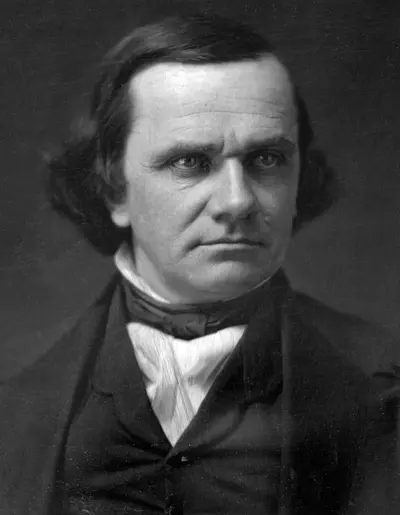
Stephen Arnold Douglas was an American politician and lawyer from Illinois. He was one of two Democratic Party nominees for president in the 1860 presidential election, which was won by Republican Abraham Lincoln. Douglas had previously defeated Lincoln in the 1858 United States Senate election in Illinois, known for the Lincoln–Douglas debates. During the 1850s, Douglas was one of the foremost advocates of popular sovereignty, which held that each territory should be allowed to determine whether to permit slavery within its borders. Douglas was nicknamed the "Little Giant" and "Stevie D" because he was short in physical stature but a forceful and dominant figure in politics.
