Ulysses S. Grant Quotes
There would never have been secession if demagogues had not swayed non-slaveholding voters and naïve young soldiers to believe that the North was filled with cowards, poltroons, and negro-worshippers.
One of the puzzles of American Civil War history has been how the poor whites of the South (who provided most of the military manpower that fought and died in the Civil War) were persuaded to fight against a much stronger, more highly industrialized, and more affluent few, that had many more soldiers. One of the main reasons, though difficult for us to understand today, was that the Southern leadership actually persuaded the Southerners that men from the North were cowards and lacked the character, virtue or will to fight. The general “party line” of the South was that one Southern solder was worth more than 5 Northern Soldiers,
Ulysses S. Grant Memoirs
Sourced by: Eigen's Political and Historical Quotations

Like many war leaders, Davis tried to dehumanize the Northerners, against whom the Confederates were fighting. His “”theory” was that The Southerners were the good and upright sons of the Founding Fathers but the Northerners were the “degenerate” sons.

As just one example of Southern States' reasons, see {583044}. Many of the Northern States had passed laws declaring everyone in the state was free and making it illegal to return or assist in the returning of escaped slaves. The Southerners got the Federal Fugitive Slave Act passed which required all Americans to assist in recapturing escaped slaves. It was the Northern States who claimed states' rights were being trampled. The South was vehemently opposed to States' Rights when it came to allowing individual states to decide who was free and who was not. The Southerners had only one fundamental reason for secession—the maintenance of the Negro slavery system on which much of their economy depended as did their sociology, culture, and way of life.

This quotation is very important for in the 20th century Southern revisionists made a major effort to ennoble the Confederate cause by claiming that Slavery and the desire to keep Blacks in bondage and unequal was just of byproduct of the reason for secession—States Rights and the decentralization of government. Many of the school history books were changed to reflect this claim. However, each of the seceding states left a legislative record of secession and the reasons for it. In all cases, Slavery and the preservation of Slavery in the South was the central and in most cases the only reason stated. In this case, Texas made its reasons clear. There was nothing noble therein but racism and racial exploitation.
When the first Southern States seceded, each appointed a whose job it was to persuade the other Southern States to also secede. In this case Hale was marketing secession to Kentucky which with Maryland were the only two Southern States to reject what they regarded as treason and rebellion. The importance of the quotation however is in his argument which was all based on enmity to racial equality and abolition. Later Southern apologists would argue that the Civil War was fought, not about slavery and racism butt about different philosophies of government. See {623715} .


He was a realist who foresaw that even though the South had been militarily defeated, there were those who would persist in their efforts to retain slavery or a de facto form where freedom is the form but subjugation was the substance. It would be Jim Crowe and terrorism in the form of the KKK and a successor to Lincoln who was very sympathetic to the aims and culture of the Southern Rebels.

The reason for secession was the threat to slavery, which was a great threat to the slave-owners of the South. However, the non slave-owners had a very strong vested interest in maintaining slavery in that most Southerners had been brought up with such a negative view of Blacks that they were paranoid of Black equality or even worse some Blacks in positions of authority over whites. At the time, it was the Republican Party that was the advocate for minority equality and the Democratic Party embraced the racists. The parties would flip flop after the Civil Rights Act of 1964 ending legal segregation was passed by a Democratic President and a Democratic Majority Congress.

She was one of the first prominent white southerners to denounce racial segregation.

Some Southerners, in order to obtain support in England for the Confederate cause claimed in their propaganda that slavery was not the issue but their issue with the Union was just one of local and regional autonomy. The British and most Europeans at that time were strongly against slavery so this “spin” might have gotten some support. Stowe and others put the lie to this, and the Confederacy never did get any significant material support from any country in Europe. The secession resolutions of the Southern States all state that Slavery was the cause (and often the ONLY cause stated) of secession. Also Southern General Mosby, called the spin for what it was. See {584991}.

Much of the South was so insular that people knew nothing about the notion of abolition and just assumed that no one would ever consider freeing the slaves. Many never knew that it was the South that first fired on the Union troops and flag. If the North won the war, the assumption was that Northerners would then own the plantations and the valuable slaves. In reality, while all slaves were emancipated in the South, very few plantations and farms were confiscated from their Southern owners by Northerners despite the fact that there was political pressure in the North to confiscate the land of all rebels who had committed treason and use the value to repay the Union bonds and care for the wounded Union veterans and the widows of dead Union Soldiers. Eggleston was an accomplished writer who had served in the Confederate army of the Civil War. 20 year after the war he wrote a series of articles for the prestigious Northern Atlantic Monthly trying to convey the war from the Southerner’s point of view.
After the Civil War and Reconstruction, the American nation was still bitterly divided intelelctually, socially, emotionally and poliotically. In an effort to bring more unity to America, most of the power stucture and the influentials of the nation began to avoid those issues that would divide North and South and try and promote a narrative that both sides might be able to live with. And this is what Zeitz describes in this quotation. America went through a period of Revisionist History that even in the 21st century was held by many people. It wasn't until the middle of the 20th century that the real history and narrative of the Civil War and Reconstrution emerged from the few academics who had all along criticized the fabricated narritive that did unify the country at the cost of historical accuracy and truth. Many scholars point out that the price that America paid for this unity was the Jim Crow era and a century of legalized racism. Much of the nation was built on the labor of Negro slaves and the victims of the slavery era, also bore the brunt of American unity and reconcilliation.

The South had attacked Fort Sumter
The writer was a free Black minister in Maryland. Maryland was a slave state, and the whites were very anti-Lincoln. The free Blacks were under constant scrutiny as there were rumors that the election of Lincoln would be the instigation of a free Black and slave revolt.

Newsletter of the United Sons of Confederate Veterans


There were some Southern Apologists who during the Jim Crow era and even into modern times, argued that slavery and the desire to maintain that was a minor cause of the Civil War but succession came about over differences in philosophy of government. This document by Mississippi made it perfectly clear why they favored succession: Slavery and their desire to maintain that institution.

While this assessment was true up until the 1980s. By the 21st century there were almost no serious historians who thought that the motivation of the Confederate States for the Civil War was anything but slavery and the economic impact that abolition might bring. However, one of your advantages having this collection of historical quotations is that you can see for yourself why the Southern states say they were seceding. This following are four of the official secession resolution documents. Read these and you will see that all the claims that there were other major reasons for secession are just attempts to make the Confederacy a little less brutal and greedy. See {621371}, {619793}, {621372}, {621375}

Phelps was a Copperhead Democrat who was a virulent racist, an enemy of Lincoln and supported McClellan against Lincoln in 1864. His extreme disrespect for the President and his racism was not appreciated in Vermont, and Phelps not only failed to help McClellan but destroyed his own credibility in his home state of Vermont. Phelps had been practicing law in New York City where there was a large Copperhead, racist and anti-Lincoln part of the population there.

Robert Allen Zimmerman

Although escaped slaves could not fight for the North, they could be very useful on road building and other military engineering projects needing labor. Every time a slave escaped, it diminished the military engineering labor of the Confederates by one but added to that of the Union. Pinkerton and others however engaged many escaped slaves who volunteered for an incredibly dangerous mission. They returned back to the Southern lines into the slave work gangs, and organized slave escapes of groups of Blacks. In addition, many of them, by observing and overhearing the Confederate soldiers gained information regarding supply and troop levels and movements, and this they brought back to the Union officers. Those that were caught were executed as spies. Escaped slaves were espionage and covert operations agents before they were allowed to be soldiers.
Oates was a Confederate Colonel during the Civil War. His statement almost started a brawl as the Memorial Dedication was a joint North-South participation event. Northern politicians, officers and men were outraged and rose to their feet with several mounting the rostrum to refute Oates intemperate remarks. However, like Southern politicians of the 1960s, they produced a lot of redneck support with such extreme statements. The main reason this quotation is important is that most politicians of North and South wanted to get the animosity of the Civil War over with and to do so sponsored these memorial events where both sides could celebrate and remember the bravery of men fighting and dying for their cause. The photographs of former enemies shaking hands which the newspapers ran frequently, would give the impression that by the 1880s the hatred and animosity of the Civil War was behind the nation. However, that was not at all true. Most veterans of both sides maintained their hatreds throughout their entire lives. Even their children carried the hatred into the next generation. Politicians were expected to not open the scabs of the old wounds in public, but many like Oates found political utility in not doing so. The moral outrage of many in the North remained until WWII when regional unity genuinely transcended the Civil War. See {639364} for a Northern example with no political motive but with uncontrollable moral outrage.

The Confederates were very clear that slavery was the cause of the war. Revisionists later tried to add other motives to the Southern cause, but Grant and all the contemporaries on both sides knew slavery was the crux of the matter. So the Confederate cause was the right to brutalize, torture, and even kill an unwilling labor force that was unpaid. No war in history had ever been fought for such a lowly cause and the Confederate leadership skills were amazing in keeping up morale without a decent cause to fight for.

The Southern states were illegal rebels. A confederacy had always meant a voluntary association of otherwise independent entities. However technically the Southern states were not independent but in a state of illegal rebellion against the United States. Lincoln, a lawyer, could not being himself to refer to the South by their preferred name—the Confederacy. So this was how he and many in his administration referred to the South.

This Civil War recruiting poster was described by the Free Library of Philadelphia as “Civil War recruitment print targeting African Americans by evoking the freedoms granted by the Emancipation Proclamation. Depicts a montage of symbolic scenes centered around an African American Union soldier triumphantly holding up a sword and an American flag with the banner "Freedom to the Slave." He stands near broken shackles upon a tri-color flag adorned with a coiled snake. The flag is tugged upon by one of three joyous slaves freed by an African American soldier. Other scenes depict an African American man reading a newspaper on a rocking chair near a plow and child, African American children entering a "Public School" near a church, and a regiment of "U.S. Colored Troops" marching across a battlefield strewn with dead bodies.”
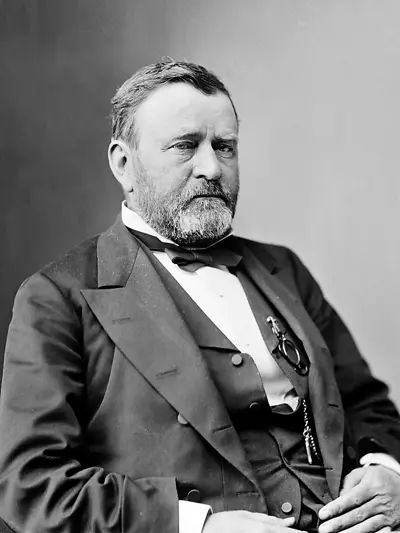
- Born: April 27, 1822
- Died: July 23, 1885
- Nationality: American
- Profession: Soldier, Politician
Ulysses S. Grant was an American military leader who served as the 18th president of the United States from 1869 to 1877. As president, Grant was an effective civil rights executive who created the Justice Department and worked with the Radical Republicans during Reconstruction to protect African Americans. As Commanding General, he led the Union Army to victory in the American Civil War in 1865 and thereafter briefly served as Secretary of War.
