Samuel Freeman Miller Quotes
The institution of African slavery, as it existed in about half the States of the Union, and the contests pervading the public mind for many years, between those who desired its curtailment and ultimate extinction and those who desired additional safeguards for its security and perpetuation, culminated in the effort, on the part of most of the States in which slavery existed, to separate from the Federal government, and to resist its authority. This constituted the war of rebellion, and whatever auxiliary causes may have contributed to bring about this war, undoubtedly the overshadowing and efficient cause was African slavery.
Samuel Freeman Miller, 1816-1890, U. S. Supreme Court Justice, Majority Opinion, Slaughter-House Cases 1873
Sourced by: Eigen's Political and Historical Quotations

This quotation is very important for in the 20th century Southern revisionists made a major effort to ennoble the Confederate cause by claiming that Slavery and the desire to keep Blacks in bondage and unequal was just of byproduct of the reason for secession—States Rights and the decentralization of government. Many of the school history books were changed to reflect this claim. However, each of the seceding states left a legislative record of secession and the reasons for it. In all cases, Slavery and the preservation of Slavery in the South was the central and in most cases the only reason stated. In this case, Texas made its reasons clear. There was nothing noble therein but racism and racial exploitation.

When the first Southern States seceded, each appointed a whose job it was to persuade the other Southern States to also secede. In this case Hale was marketing secession to Kentucky which with Maryland were the only two Southern States to reject what they regarded as treason and rebellion. The importance of the quotation however is in his argument which was all based on enmity to racial equality and abolition. Later Southern apologists would argue that the Civil War was fought, not about slavery and racism butt about different philosophies of government. See {623715} .
As just one example of Southern States' reasons, see {583044}. Many of the Northern States had passed laws declaring everyone in the state was free and making it illegal to return or assist in the returning of escaped slaves. The Southerners got the Federal Fugitive Slave Act passed which required all Americans to assist in recapturing escaped slaves. It was the Northern States who claimed states' rights were being trampled. The South was vehemently opposed to States' Rights when it came to allowing individual states to decide who was free and who was not. The Southerners had only one fundamental reason for secession—the maintenance of the Negro slavery system on which much of their economy depended as did their sociology, culture, and way of life.

Although escaped slaves could not fight for the North, they could be very useful on road building and other military engineering projects needing labor. Every time a slave escaped, it diminished the military engineering labor of the Confederates by one but added to that of the Union. Pinkerton and others however engaged many escaped slaves who volunteered for an incredibly dangerous mission. They returned back to the Southern lines into the slave work gangs, and organized slave escapes of groups of Blacks. In addition, many of them, by observing and overhearing the Confederate soldiers gained information regarding supply and troop levels and movements, and this they brought back to the Union officers. Those that were caught were executed as spies. Escaped slaves were espionage and covert operations agents before they were allowed to be soldiers.

Much of the South was so insular that people knew nothing about the notion of abolition and just assumed that no one would ever consider freeing the slaves. Many never knew that it was the South that first fired on the Union troops and flag. If the North won the war, the assumption was that Northerners would then own the plantations and the valuable slaves. In reality, while all slaves were emancipated in the South, very few plantations and farms were confiscated from their Southern owners by Northerners despite the fact that there was political pressure in the North to confiscate the land of all rebels who had committed treason and use the value to repay the Union bonds and care for the wounded Union veterans and the widows of dead Union Soldiers. Eggleston was an accomplished writer who had served in the Confederate army of the Civil War. 20 year after the war he wrote a series of articles for the prestigious Northern Atlantic Monthly trying to convey the war from the Southerner’s point of view.

One of the puzzles of American Civil War history has been how the poor whites of the South (who provided most of the military manpower that fought and died in the Civil War) were persuaded to fight against a much stronger, more highly industrialized, and more affluent few, that had many more soldiers. One of the main reasons, though difficult for us to understand today, was that the Southern leadership actually persuaded the Southerners that men from the North were cowards and lacked the character, virtue or will to fight. The general “party line” of the South was that one Southern solder was worth more than 5 Northern Soldiers,
This letter was signed by a local white Priest and two other leading planters. This quotation gives us a marvelous feeling for what occurred when parts of the South was occupied by the Union Army shortly after the Emancipation Proclamation was issued. Minor and his fellows just did not “get it.” The concept of freedom of the slaves was intellectually so foreign to them, that they wanted the Union Army to “compel” the freed slaves to work. They were horrified that slaves went wherever they wanted, and they were most outraged when former slaves who had enlisted in the Army, would “visit” their old plantation setting such a terrible example. The letter gives us a perspective on how difficult it was to change the mental set of Southern Whites and why Reconstruction was so difficult. The year of the letter is somewhat uncertain as the original letter appears to be dated 1862 but the writing is not clear and that date does not comport with the history of the era and we believe 1863 was the correct year. The photograph is of the first official colored troops mustered into the Union Army. They were called the Louisiana Native Guards and contained the ex slaves who went over to the Union side just before the time this slave owner complained. These ex slaves, in uniform, and with arms would sometimes visit the plantations where they and been enslaved, thrilling the remaining slaves and infuriating owners like Minor.

The Governor was a staunch Confederate supporter but his state legislature majority favored the Union. He was forced out of the governorship when the 1861 election gave the legislature a veto-proof pro Union majority.

Some Southerners, in order to obtain support in England for the Confederate cause claimed in their propaganda that slavery was not the issue but their issue with the Union was just one of local and regional autonomy. The British and most Europeans at that time were strongly against slavery so this “spin” might have gotten some support. Stowe and others put the lie to this, and the Confederacy never did get any significant material support from any country in Europe. The secession resolutions of the Southern States all state that Slavery was the cause (and often the ONLY cause stated) of secession. Also Southern General Mosby, called the spin for what it was. See {584991}.

The reason for secession was the threat to slavery, which was a great threat to the slave-owners of the South. However, the non slave-owners had a very strong vested interest in maintaining slavery in that most Southerners had been brought up with such a negative view of Blacks that they were paranoid of Black equality or even worse some Blacks in positions of authority over whites. At the time, it was the Republican Party that was the advocate for minority equality and the Democratic Party embraced the racists. The parties would flip flop after the Civil Rights Act of 1964 ending legal segregation was passed by a Democratic President and a Democratic Majority Congress.


There were some Southern Apologists who during the Jim Crow era and even into modern times, argued that slavery and the desire to maintain that was a minor cause of the Civil War but succession came about over differences in philosophy of government. This document by Mississippi made it perfectly clear why they favored succession: Slavery and their desire to maintain that institution.


There were so many Blacks fighting for the Americans in the Revolution that the British Commander had to issue a special proclamation which would make slaves of any Negro captured but issued freedom to those who would desert. Despite the greater risk to Negro Revolutionaries than their white counterparts many volunteered and few deserted.

On his deathbed he claimed to Kelly that he had been offered command of the Army of the Potomac but was not willing to "pay the price" which he claimed was to accept the terms. Pleasonton, always more of a bureaucrat than an ideologue or strong leader, like many Union officers, only wanted to defang the South so that they could not threaten the rest of the states but was not convinced that "crushing" the rebels was worth the cost or that slavery or the reelection of Lincoln was worth it. There is no independent verification of his receiving the offer, but what is more likely was as the Cavalry Commander of the Army of the Potomac he was "sounded out" on the subject.

There was little thought of emancipating slaves or their value to the South by the senior officers of the Union Army at the beginning of the war. The Secretary of War changed that. See {629183}for a typical Union General’s view at the beginning of the war.

The issue is whether Kansas would enter the Union as a slave state of a free state. If a free state, the free states would be able to block further slavery. If Kansas were to become a slave state, the slave states would have a sufficient majority to make all future expansion hospitable to slavery. The slavery forces started sending men and families into Kansas so that they could vote; the abolitionists did the same. Both sides armed and a war began with each faction trying to kill or drive the other faction out of Kansas before the vote. See {612516} for the anti-slavery perspective.

Committee of the Congress. This was the prevailing Congressional and public view except for the South which had coalesced around an intellectual rationalization. See {618013}.


Butler was at the time the Union general in charge of Louisiana. He had on his hand a large group of slaves whose owners had abandoned the area. There was no emancipation yet. He wrote for instructions. The result was the first actual emancipation of slaves.

He was a realist who foresaw that even though the South had been militarily defeated, there were those who would persist in their efforts to retain slavery or a de facto form where freedom is the form but subjugation was the substance. It would be Jim Crowe and terrorism in the form of the KKK and a successor to Lincoln who was very sympathetic to the aims and culture of the Southern Rebels.


This is an important quotation because it shows that slavery was the principle reason that the South succeeded and began their rebellion. In the early 20th century, there was a movement to make the Confederacy and the rebellion more noble by promoting the idea that the Civil War was fought by the South for more lofty reasons such as States Rights, Original Construction, different economic philosophies and the like. This was a more noble cause then the right to deny other human beings their rights, to own other human beings who they could beat, torture, sexually use and even murder them was a pretty selfish and demeaning reason to have started a rebellion that would then cost more Americans their lives than any other American conflict. The succession documents and others of the Southern States and the Confederacy make it clear that slavery was THE issue and fleeting references to any of the others were only made to complain about the potential effect on abolition and the refusal of the abolitionist states to cease aiding and protecting fugitive slaves.
This is an important quotation because it shows that slavery was the principle reason that the South succeeded and began their rebellion. In the early 20th century, there was a movement to make the Confederacy and the Southern rebellion more noble by promoting the idea that the Civil War was fought by the South for more lofty reasons than greed and slavery such as States Rights, original construction, different economic philosophies and the like. This was a more noble cause then the right to deny other human beings their rights, to own other human beings who they could beat, torture, sexually use and even murder them was a pretty selfish and demeaning reason to have started a rebellion that would then cost more Americans their lives than any other American conflict. The succession documents and others of the Southern States and the Confederacy make it clear that slavery was THE issue and fleeting references to any of the others were only made to complain about the potential effect on abolition and the refusal of the abolitionist states to cease aiding and protecting fugitive slaves.
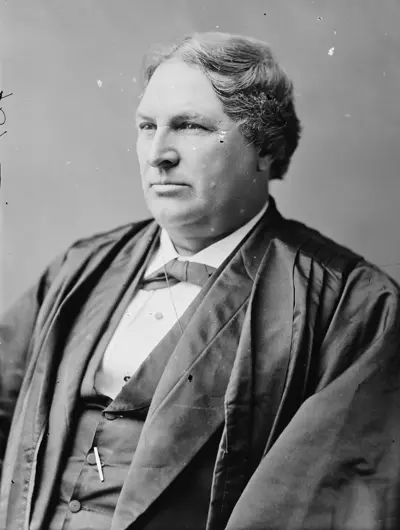
Samuel Freeman Miller was an associate justice of the United States Supreme Court who served from 1862 to 1890. He was a physician and lawyer.
