Joint Committee on Reconstruction Quotes
It must not be forgotten that the people of these States, without justification or excuse, rose in insurrection against the United States. They deliberately abolished their State governments so far as the same connected them politically with the Union.... They opened hostilities and levied war against the government. They continued this war for four years with the most determined and malignant spirit.... Whether legally and constitutionally or not, they did, in fact, withdraw from the Union and made themselves subjects of another government of their own creation. And they only yielded when they were compelled by utter exhaustion to lay down their arms ... expressing no regret, except that they had no longer the power to continue the desperate struggle The war thus waged was a civil war of the greatest magnitude. The people waging it were necessarily subject to all the rule which, by the law of nations, control a contest of that character, and to all the legitimate consequences following it. One of those consequences was that, within the limits prescribed by humanity, the conquered rebels were at the mercy of the conquerors. That a government thus outraged had a most perfect right to exact indemnity for the injuries done, and security against the recurrence of such outrages in the future, would seem too clear for dispute
Committee of the Congress. This was the prevailing Congressional and public view except for the South which had coalesced around an intellectual rationalization. See {618013}.
Joint Committee on Reconstruction, Report, June 20, 1866
Sourced by: Eigen's Political and Historical Quotations

This hypocrisy and insincerity was seen for what it was by the Radical Republicans, Abolitionists and the newly freed slaves themselves. See {617728} and {617339}. However, this approach soon was adopted as the “party line” by intellectual Southerners of the time, and has continued to this day. The rebellion that caused the deaths of more Americans than all the rest of our wars, was not as they stated it caused by any conflict over slavery, no economic causes, no differences in labor philosophies and trade, no contention over control of new territories, but was simply an attempt to vigorously support and defend the Constitution. However, one advantage to using this story as an explanation of the bloody rebellion, was that the defeated Southerners could see their acts as somewhat nobly motivated.


The South had attacked Fort Sumter

While Douglas and Lincoln were political opponents with little love lost between them, both were patriots. Douglas’s position were much more popular in the South, and the moment he realized that Lincoln would win the Presidency, he headed South where he was very persuasive in trying to hold the Union together, but he could not see all the potential rebels and was only effective with some. South Carolina not only seceded, but in order to prevent any changing of minds, some the worst of the South Carolinians, attacked Fort Sumter firing on the American Flag and attacking and capturing the Union troops who were totally outnumbered. The Civil War was then inevitable.

It would be almost 30 years until Jackson would have been proved correct and the Civil War had begun.

Commenting on remedies for possible Southern secession: Abraham Lincoln had already been elected, and Buchanan was sympathetic with the South.


Sherman had friends in the South and he saw rebellion and war coming. Most Southerners had a romanticized view of war and were so wrapped up in trying to preserve their economic and cultural way of life that they did not think through the implications of such a war. After and during the war, Sherman was particularly angry with the Southerners who had brought such terrible casualties and destruction upon the land and its people and he was the leader of the March through Georgiam the most effective and humiliating campaign against the South.

The Governor was a staunch Confederate supporter but his state legislature majority favored the Union. He was forced out of the governorship when the 1861 election gave the legislature a veto-proof pro Union majority.
The early Union military leadership was so poor and timid that it was not clearly demonstrated that a Confederacy was not viable until later in the war, and the Southerners possessed an extraordinary capacity for ignoring reality and self-delusion, that it was not demonstrated until Grant’s major victories and Sherman’s March through Georgia and the Southern East Coast that an independent South was not going to be.

There was some political pressure in the North, to offer terms to the South where they could cease the rebellion and return to the Union and return to the status quo ante—before the rebellion.
The Southern states were illegal rebels. A confederacy had always meant a voluntary association of otherwise independent entities. However technically the Southern states were not independent but in a state of illegal rebellion against the United States. Lincoln, a lawyer, could not being himself to refer to the South by their preferred name—the Confederacy. So this was how he and many in his administration referred to the South.


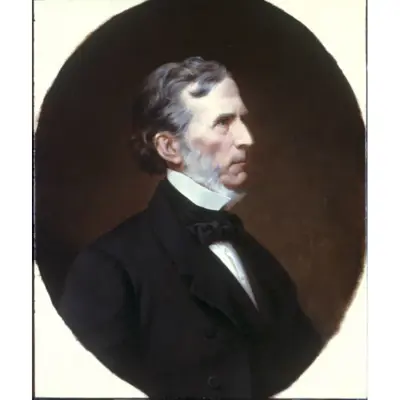
- Born:
- Nationality:
- Profession:
The Joint Committee on Reconstruction, also known as the Joint Committee of Fifteen, was a joint committee of the 39th United States Congress that played a major role in Reconstruction in the wake of the American Civil War. It was created to "inquire into the condition of the States which formed the so-called Confederate States of America, and report whether they, or any of them, are entitled to be represented in either house of Congress.”
