James Buchanan Quotes
War would not only present the most effectual means of destroying [the Union] but would banish all hope of its peaceable reconstruction.
Commenting on remedies for possible Southern secession: Abraham Lincoln had already been elected, and Buchanan was sympathetic with the South.
James Buchanan, 1791-1868, 15th President of the United States (Democrat, PA), State of the Union Message, December 1860
Sourced by: Eigen's Political and Historical Quotations

Urging use of force against the South:

As influential and revered as he was, Houston would not overcome the drive for secession by the wealthy, large, slave holders of Texas.


Committee of the Congress. This was the prevailing Congressional and public view except for the South which had coalesced around an intellectual rationalization. See {618013}.


Sherman had friends in the South and he saw rebellion and war coming. Most Southerners had a romanticized view of war and were so wrapped up in trying to preserve their economic and cultural way of life that they did not think through the implications of such a war. After and during the war, he was particularly angry with the Southerners who had brought such terrible casualties and destruction upon the land and its people.

He himself became a victim of the Civil War when Oliver Cromwell ordered him beheaded in 1658

It would be almost 30 years until Jackson would have been proved correct and the Civil War had begun.

Defending torture and other violations of civil rights by the Secret Service during the Civil War:


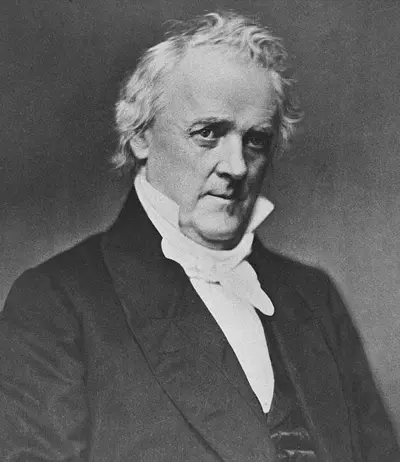
James Buchanan, Jr. was the 15th President of the United States (1857–61), serving immediately prior to the American Civil War. He represented Pennsylvania in the United States House of Representatives and later the Senate, then served as Minister to Russia under President Andrew Jackson. He was named Secretary of State under President James K. Polk, and as of 2016[update] is the last former Secretary of State to serve as President of the United States. After Buchanan turned down an offer to sit on the Supreme Court, President Franklin Pierce appointed him Ambassador to the United Kingdom, in which capacity he helped draft the Ostend Manifesto.; James McGill Buchanan, Jr. was an American economist known for his work on public choice theory (included in his most famous work The Calculus of Consent), for which he received the Nobel Memorial Prize in 1986. Buchanan's work initiated research on how politicians' and bureaucrats' self-interest, utility maximization and other non-wealth maximizing considerations affect their decision making. He was a member of the Board of Advisors of The Independent Institute, a member (and for a time the President) of the Mont Pelerin Society, a Distinguished Senior Fellow of the Cato Institute, and professor at George Mason University.
