Henry Clinton Quotes
Whereas the enemy [American Revolutionists] have adopted a practice of enrolling Negroes among their troops, I do hereby give Notice that all Negroes taken in Arms or upon any military Duty shall be purchased for the public service at a stated price; the money to be paid to the captors. But I do most strictly forbid any Person to sell or claim right over any Negroes the property of a Rebel who may take refuge with any part of this Army. And I do promise to every Negro who shall desert the Rebel Standard full Security to follow within the Lines any occupation which he may think proper
There were so many Blacks fighting for the Americans in the Revolution that the British Commander had to issue a special proclamation which would make slaves of any Negro captured but issued freedom to those who would desert. Despite the greater risk to Negro Revolutionaries than their white counterparts many volunteered and few deserted.
Henry Clinton, 1732-1795, Commander-in-Chief of the British Army in America During the Revolution, Proclamation, June 30, 1799
Sourced by: Eigen's Political and Historical Quotations

Negotiations regarding the exchange of prisoners and property. This was his view of his supposed obligation to return Negro slaves who had escaped and gone to the British during the war. The treaty of peace specified that all “property” including slaves, taken by, the British be returned to the Americans. But he and other officers did not always do so as they thought they had higher moral obligations. See {621936} for example.

There was little thought of emancipating slaves or their value to the South by the senior officers of the Union Army at the beginning of the war. The Secretary of War changed that. See {629183}for a typical Union General’s view at the beginning of the war.

The resolution was transmitted to the Provincial Congress on June 6, 1775 where it was tabled. Essentially this position was taken by the Continental Congress and General Washington—See {614018}—and then Washington reversed himself, {614220}


When the Union army began using Blacks as recruits, the South threatened to execute any Negro soldier they captured. Some Southerners opposed execution but favored enslavement of captured Northern Black soldiers. The Lincoln threat seems to have worked, although Lincoln opposed executing Southern officers in retaliation for the atrocities at southern prisoner of war camps

Benjamin was the Confederacy’s strongest proponent for use of Negro troops in exchange for a promise of freedom. Ironically, the racial prejudice of the Southern soldier may well have doomed the South’s last chance for independence. Lee, although he personally favored such a course of action, could not get a general sentiment from the army as a whole.

Just a month earlier Washington had issued a contradictory order. See {614221}. The Continental Congress, under pressure from the Southerners, compromised.
loyalty oath to the King of England His “Ethiopian Regiment” was the first Black military regiment in North America. Soon after, Rhode Island organized a Black military unit—see {613949}.

Washington and his staff had throughout the Revolution wanted to enlist Negroes but were thwarted by the Southern and conservative blocs of the Continental Congress when they tried it in the South. However, they finally succeeded in Rhode Island. Other states followed when it was clear that the Rhode Island experiment had been successful. See {614120} for the policy statement of the legislature and {614119} for the motto and a picture of the Negro regiment. This was however not the first Black military unit in North America. The Loyalist Governor of Virginia had formed a regiment comprised of slaves who he emancipated. See {636965}.
After the Civil War and Reconstruction, the American nation was still bitterly divided intelelctually, socially, emotionally and poliotically. In an effort to bring more unity to America, most of the power stucture and the influentials of the nation began to avoid those issues that would divide North and South and try and promote a narrative that both sides might be able to live with. And this is what Zeitz describes in this quotation. America went through a period of Revisionist History that even in the 21st century was held by many people. It wasn't until the middle of the 20th century that the real history and narrative of the Civil War and Reconstrution emerged from the few academics who had all along criticized the fabricated narritive that did unify the country at the cost of historical accuracy and truth. Many scholars point out that the price that America paid for this unity was the Jim Crow era and a century of legalized racism. Much of the nation was built on the labor of Negro slaves and the victims of the slavery era, also bore the brunt of American unity and reconcilliation.

He was a realist who foresaw that even though the South had been militarily defeated, there were those who would persist in their efforts to retain slavery or a de facto form where freedom is the form but subjugation was the substance. It would be Jim Crowe and terrorism in the form of the KKK and a successor to Lincoln who was very sympathetic to the aims and culture of the Southern Rebels.

Miller was the first Black American admitted to a Graduate Program—Johns Hopkins—in Mathematics
Washington quickly changed his mind when he realized that there were many Negroes fighting for his army and acquitting themselves very well. The pressure for troops and the English invitation to Negroes to help them and get their freedom, caused Washington to flip-flop on this point to the distress of most of his fellow Southerners. See {614220}.

Washington and Green won very few battles as the strategy was, like many revolutionary movements, simply to avoid losing and being wiped out—the strategy that finally won the war.

When the Confederate Government realized that the Union was planning to arm escaped slaves and induct them into the Union Army, they quickly passed a law that declared any escaped slave who joined the Union Army or wore its uniform was guilty of Treason and would be executed. Most Union Generals one way or another got word to the Confederate Officers that they had better treat all Negro Union Soldiers as prisoners of war. Even President Lincoln warned the South. Butler, however, had a large number of Negro troops in his area and had heard threats of some of the Southerners to execute Black prisoners of war. He had a way of making things very clear, and he was able to prevent murder of any of his Negro troops despite the Treason law.

Much of the South was so insular that people knew nothing about the notion of abolition and just assumed that no one would ever consider freeing the slaves. Many never knew that it was the South that first fired on the Union troops and flag. If the North won the war, the assumption was that Northerners would then own the plantations and the valuable slaves. In reality, while all slaves were emancipated in the South, very few plantations and farms were confiscated from their Southern owners by Northerners despite the fact that there was political pressure in the North to confiscate the land of all rebels who had committed treason and use the value to repay the Union bonds and care for the wounded Union veterans and the widows of dead Union Soldiers. Eggleston was an accomplished writer who had served in the Confederate army of the Civil War. 20 year after the war he wrote a series of articles for the prestigious Northern Atlantic Monthly trying to convey the war from the Southerner’s point of view.
This letter was signed by a local white Priest and two other leading planters. This quotation gives us a marvelous feeling for what occurred when parts of the South was occupied by the Union Army shortly after the Emancipation Proclamation was issued. Minor and his fellows just did not “get it.” The concept of freedom of the slaves was intellectually so foreign to them, that they wanted the Union Army to “compel” the freed slaves to work. They were horrified that slaves went wherever they wanted, and they were most outraged when former slaves who had enlisted in the Army, would “visit” their old plantation setting such a terrible example. The letter gives us a perspective on how difficult it was to change the mental set of Southern Whites and why Reconstruction was so difficult. The year of the letter is somewhat uncertain as the original letter appears to be dated 1862 but the writing is not clear and that date does not comport with the history of the era and we believe 1863 was the correct year. The photograph is of the first official colored troops mustered into the Union Army. They were called the Louisiana Native Guards and contained the ex slaves who went over to the Union side just before the time this slave owner complained. These ex slaves, in uniform, and with arms would sometimes visit the plantations where they and been enslaved, thrilling the remaining slaves and infuriating owners like Minor.

In the War of 1812 Cochrane was accused of fomenting a slave revolt in America which in part he succeeded in doing in parts of the South. Over 300 served in the British forces and many others emigrated.

Scott was then the Special Advisor on Negro Affairs to the Secretary of War in the Woodrrow Wilson administration. Wilaon hs commited U. S. Troops to fight oversease to "make the world safe for democracy", but many blacks and whites also saw gross hypocricy in asking Negores to fight for a Jim Crow, segregated America. See the related quotation 644805. Scott was also the major aide to Booker T, Washington, one of the leading Negro educators but a very pliable man on equal rights for the Blacks. The problem for the administration was much greater than that of WWII where the president was seen as very sympathetic to Blacks while Wilson was himself a racist. And in WWII the fight against the Nazis was a fight agaisnt racial supremacy. So this quotation and Scott's role was very important to the administration.

By 1863, Negro troops were being used to fill in gaps in the Union forces. Many union generals resisted having colored troops under their command. Thomas, however, welcomed them, and won several major battles where black soldiers were instrumental in victory.

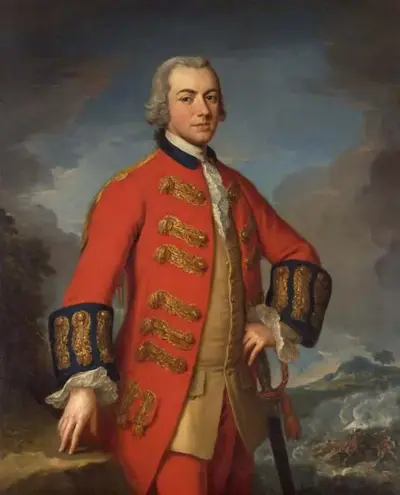
- Born: April 16, 1730
- Died: December 23, 1795
- Nationality:
- Profession:
General Sir Henry Clinton, KB was a British army officer and politician who sat in the House of Commons between 1772 and 1795. He is best known for his service as a general during the American War of Independence. First arriving in Boston in May 1775, from 1778 to 1782 he was the British Commander-in-Chief in North America. In addition to his military service, due to the influence of his cousin Henry Pelham-Clinton, 2nd Duke of Newcastle, he was a Member of Parliament for many years. Late in life he was named Governor of Gibraltar, but died before assuming the post.
