Judah P. Benjamin Quotes
There is a necessity of instant re-enforcement for your army…. Those slaves only who might volunteer to fight for their freedom, should be at once sent to the trenches….Opponents claimed that this would disband the army by reason of the violent aversion of the troops to have negroes in the field with them …. If we could get from the army an expression of its desire to be re-enforced by such negroes as for the boon of freedom will volunteer to go to the front, the measure will pass without further delay, and we may yet be able to give you such a force as will enable you to assume the offensive.
Benjamin was the Confederacy’s strongest proponent for use of Negro troops in exchange for a promise of freedom. Ironically, the racial prejudice of the Southern soldier may well have doomed the South’s last chance for independence. Lee, although he personally favored such a course of action, could not get a general sentiment from the army as a whole.
Judah P. Benjamin, 1811-1884, U. S. Senator (Whig & Democrat, LA), Confederate Attorney General, Secretary of War, & Secretary of State, Letter to General Robert E. Lee, February 11, 1865
Sourced by: Eigen's Political and Historical Quotations

The companion bill in the Confederate House, introduced by Barksdale of Mississippi, passed and had the support of Robert E. Lee (see {590135}), and but for Hunter’s opposition there might have been a very different outcome to the Civil War.

The bill was defeated in the Confederate Senate {590064} so was the last good opportunity for the Confederacy. Lee was totally correct about what the Union would do, and the Northern use of Negro troops from the South was the final nail in the Confederate coffin.

By 1863, Negro troops were being used to fill in gaps in the Union forces. Many union generals resisted having colored troops under their command. Thomas, however, welcomed them, and won several major battles where black soldiers were instrumental in victory.

When the Confederate Government realized that the Union was planning to arm escaped slaves and induct them into the Union Army, they quickly passed a law that declared any escaped slave who joined the Union Army or wore its uniform was guilty of Treason and would be executed. Most Union Generals one way or another got word to the Confederate Officers that they had better treat all Negro Union Soldiers as prisoners of war. Even President Lincoln warned the South. Butler, however, had a large number of Negro troops in his area and had heard threats of some of the Southerners to execute Black prisoners of war. He had a way of making things very clear, and he was able to prevent murder of any of his Negro troops despite the Treason law.

loyalty oath to the King of England His “Ethiopian Regiment” was the first Black military regiment in North America. Soon after, Rhode Island organized a Black military unit—see {613949}.

This Civil War recruiting poster was described by the Free Library of Philadelphia as “Civil War recruitment print targeting African Americans by evoking the freedoms granted by the Emancipation Proclamation. Depicts a montage of symbolic scenes centered around an African American Union soldier triumphantly holding up a sword and an American flag with the banner "Freedom to the Slave." He stands near broken shackles upon a tri-color flag adorned with a coiled snake. The flag is tugged upon by one of three joyous slaves freed by an African American soldier. Other scenes depict an African American man reading a newspaper on a rocking chair near a plow and child, African American children entering a "Public School" near a church, and a regiment of "U.S. Colored Troops" marching across a battlefield strewn with dead bodies.”

One of the most amazing things about Abraham Lincoln is the way he grew and matured over time. In 1854 he was not sure that the Negro could be the equal of the white. As he met more Black leaders, saw more, reflected more, and had more responsibility, he grew and developed his views on race. But it was statements like this that led to the great distrust that the very strong abolitionists like Wendell Phillips had in him.
The card was issued to all American troops in the theater. Similar versions were distributed to troops in Iraq, and other Arab countries.

Lincoln had promised amnesty to Southerners who would pledge loyalty to the Union. What many feared was that this would include slave owners re-enslaving their former "property," or that the government would allow them to do so in order to stop the rebellion.

Negotiations regarding the exchange of prisoners and property. This was his view of his supposed obligation to return Negro slaves who had escaped and gone to the British during the war. The treaty of peace specified that all “property” including slaves, taken by, the British be returned to the Americans. But he and other officers did not always do so as they thought they had higher moral obligations. See {621936} for example.


Washington and his staff had throughout the Revolution wanted to enlist Negroes but were thwarted by the Southern and conservative blocs of the Continental Congress when they tried it in the South. However, they finally succeeded in Rhode Island. Other states followed when it was clear that the Rhode Island experiment had been successful. See {614120} for the policy statement of the legislature and {614119} for the motto and a picture of the Negro regiment. This was however not the first Black military unit in North America. The Loyalist Governor of Virginia had formed a regiment comprised of slaves who he emancipated. See {636965}.
This letter was signed by a local white Priest and two other leading planters. This quotation gives us a marvelous feeling for what occurred when parts of the South was occupied by the Union Army shortly after the Emancipation Proclamation was issued. Minor and his fellows just did not “get it.” The concept of freedom of the slaves was intellectually so foreign to them, that they wanted the Union Army to “compel” the freed slaves to work. They were horrified that slaves went wherever they wanted, and they were most outraged when former slaves who had enlisted in the Army, would “visit” their old plantation setting such a terrible example. The letter gives us a perspective on how difficult it was to change the mental set of Southern Whites and why Reconstruction was so difficult. The year of the letter is somewhat uncertain as the original letter appears to be dated 1862 but the writing is not clear and that date does not comport with the history of the era and we believe 1863 was the correct year. The photograph is of the first official colored troops mustered into the Union Army. They were called the Louisiana Native Guards and contained the ex slaves who went over to the Union side just before the time this slave owner complained. These ex slaves, in uniform, and with arms would sometimes visit the plantations where they and been enslaved, thrilling the remaining slaves and infuriating owners like Minor.

The U. S. Navy had Black sailors even before the Civil War. Blacks had shipped out on Northern merchant vessels and whaling ships starting in colonial times. Many Blacks had nautical experience and were welcomed by the Northern Navy and treated very well. The Union Army in contrast was much more ambivalent about Blacks serving. Ironically the Navy was disbanded to save money and when it was reconstituted it was on a racially segregated basis completely foreign to American Naval history. It was the last of the American armed services to integrate and its officer corps has not desecrated as much as the other services.

The military weapon of freeing the slaves was advocated from the earliest days of the Civil War. However, most Northern political leaders were sure that the South would be economically broken by emancipation, and many were hoping to end the rebellion swiftly by some military victories, and the Confederate soldiers could return to an economically viable South. If the slaves were freed, Southern soldiers would have little to return to and would all have to become laborers and thus would fight then to the death. However, the more battlefield success the South had, the more the combination of the moral pressure of the abolitionists and the practical strategic pressure of those who wanted to cripple the South militarily by freeing the slaves, influence Lincoln’s decision.

The officers were all white, and Higginson was the Commander. It was his first experience with Negro troops, and he had heard much extrapolation from racist attitudes about Blacks not being able to make good soldiers. Ironically, the same suspicions of Blacks as military men carried over into the Second World War when this canard was disproved so publicly that it finally was erased with the exception of the most inveterate racists for whom no evidence would matter.

There was little thought of emancipating slaves or their value to the South by the senior officers of the Union Army at the beginning of the war. The Secretary of War changed that. See {629183}for a typical Union General’s view at the beginning of the war.

Much of the South was so insular that people knew nothing about the notion of abolition and just assumed that no one would ever consider freeing the slaves. Many never knew that it was the South that first fired on the Union troops and flag. If the North won the war, the assumption was that Northerners would then own the plantations and the valuable slaves. In reality, while all slaves were emancipated in the South, very few plantations and farms were confiscated from their Southern owners by Northerners despite the fact that there was political pressure in the North to confiscate the land of all rebels who had committed treason and use the value to repay the Union bonds and care for the wounded Union veterans and the widows of dead Union Soldiers. Eggleston was an accomplished writer who had served in the Confederate army of the Civil War. 20 year after the war he wrote a series of articles for the prestigious Northern Atlantic Monthly trying to convey the war from the Southerner’s point of view.

Butler was at the time the Union general in charge of Louisiana. He had on his hand a large group of slaves whose owners had abandoned the area. There was no emancipation yet. He wrote for instructions. The result was the first actual emancipation of slaves.

This was one of the several early unofficial Emancipations that was issued in the Civil War.

Although escaped slaves could not fight for the North, they could be very useful on road building and other military engineering projects needing labor. Every time a slave escaped, it diminished the military engineering labor of the Confederates by one but added to that of the Union. Pinkerton and others however engaged many escaped slaves who volunteered for an incredibly dangerous mission. They returned back to the Southern lines into the slave work gangs, and organized slave escapes of groups of Blacks. In addition, many of them, by observing and overhearing the Confederate soldiers gained information regarding supply and troop levels and movements, and this they brought back to the Union officers. Those that were caught were executed as spies. Escaped slaves were espionage and covert operations agents before they were allowed to be soldiers.
After the Civil War and Reconstruction, the American nation was still bitterly divided intelelctually, socially, emotionally and poliotically. In an effort to bring more unity to America, most of the power stucture and the influentials of the nation began to avoid those issues that would divide North and South and try and promote a narrative that both sides might be able to live with. And this is what Zeitz describes in this quotation. America went through a period of Revisionist History that even in the 21st century was held by many people. It wasn't until the middle of the 20th century that the real history and narrative of the Civil War and Reconstrution emerged from the few academics who had all along criticized the fabricated narritive that did unify the country at the cost of historical accuracy and truth. Many scholars point out that the price that America paid for this unity was the Jim Crow era and a century of legalized racism. Much of the nation was built on the labor of Negro slaves and the victims of the slavery era, also bore the brunt of American unity and reconcilliation.
As just one example of Southern States' reasons, see {583044}. Many of the Northern States had passed laws declaring everyone in the state was free and making it illegal to return or assist in the returning of escaped slaves. The Southerners got the Federal Fugitive Slave Act passed which required all Americans to assist in recapturing escaped slaves. It was the Northern States who claimed states' rights were being trampled. The South was vehemently opposed to States' Rights when it came to allowing individual states to decide who was free and who was not. The Southerners had only one fundamental reason for secession—the maintenance of the Negro slavery system on which much of their economy depended as did their sociology, culture, and way of life.

Lincoln, just before the Civil War, quoted Jefferson that if slavery were not ended in America the results would be disastrous. But Lincoln at the time probably did not imagine how right Jefferson was, and Jefferson himself probably 1 how terrible the Civil War would be.
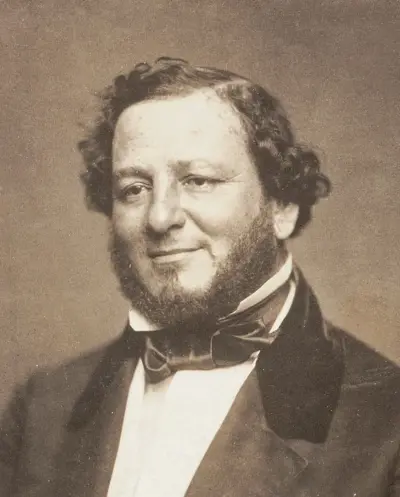
- Born: August 6, 1811
- Died: May 6, 1884
- Nationality:
- Profession:
Judah Philip Benjamin, QC was a lawyer and politician who was a United States Senator from Louisiana, a Cabinet officer of the Confederate States and, after his escape to the United Kingdom at the end of the American Civil War, an English barrister. Benjamin was the first Jew to hold a Cabinet position in North America and the first to be elected to the United States Senate who had not renounced his faith.
