George Washington Quotes
Neither negroes, boys unable to bear arms, nor old men unfit to endure the fatigues of the campaign, are to be enlisted
Washington quickly changed his mind when he realized that there were many Negroes fighting for his army and acquitting themselves very well. The pressure for troops and the English invitation to Negroes to help them and get their freedom, caused Washington to flip-flop on this point to the distress of most of his fellow Southerners. See {614220}.
George Washington, 1732-1799, 1st President of the United States (VA), General Order, November 12, 1775
Sourced by: Eigen's Political and Historical Quotations

Just a month earlier Washington had issued a contradictory order. See {614221}. The Continental Congress, under pressure from the Southerners, compromised.

loyalty oath to the King of England His “Ethiopian Regiment” was the first Black military regiment in North America. Soon after, Rhode Island organized a Black military unit—see {613949}.

Negotiations regarding the exchange of prisoners and property. This was his view of his supposed obligation to return Negro slaves who had escaped and gone to the British during the war. The treaty of peace specified that all “property” including slaves, taken by, the British be returned to the Americans. But he and other officers did not always do so as they thought they had higher moral obligations. See {621936} for example.

By 1863, Negro troops were being used to fill in gaps in the Union forces. Many union generals resisted having colored troops under their command. Thomas, however, welcomed them, and won several major battles where black soldiers were instrumental in victory.

There were so many Blacks fighting for the Americans in the Revolution that the British Commander had to issue a special proclamation which would make slaves of any Negro captured but issued freedom to those who would desert. Despite the greater risk to Negro Revolutionaries than their white counterparts many volunteered and few deserted.
At this point, Stearns had already organized and trained 3,000 Black Troops from the South. He was a strong advocate of recruiting and enlisting as many slaves as they could. Ironically, the desire to serve in the Army with a weapon, was symbolically a powerful symbol of equality and manliness that it was effective with Northern free Blacks and Southern escaped slaves. Another interesting thing was that Stearns insisted that the ex-slaves not only made better soldiers than the Confederates but that they were better than most Union White troops. That view was not promulgated very publically.


Benjamin was the first African American general.


The officers were all white, and Higginson was the Commander. It was his first experience with Negro troops, and he had heard much extrapolation from racist attitudes about Blacks not being able to make good soldiers. Ironically, the same suspicions of Blacks as military men carried over into the Second World War when this canard was disproved so publicly that it finally was erased with the exception of the most inveterate racists for whom no evidence would matter.

When the Confederate Government realized that the Union was planning to arm escaped slaves and induct them into the Union Army, they quickly passed a law that declared any escaped slave who joined the Union Army or wore its uniform was guilty of Treason and would be executed. Most Union Generals one way or another got word to the Confederate Officers that they had better treat all Negro Union Soldiers as prisoners of war. Even President Lincoln warned the South. Butler, however, had a large number of Negro troops in his area and had heard threats of some of the Southerners to execute Black prisoners of war. He had a way of making things very clear, and he was able to prevent murder of any of his Negro troops despite the Treason law.

The New England and Middle Atlantic States had recruited and allowed Negroes to serve in their divisions with excellent results. These two Southern states were suffering badly as a result of the British Military dominance and atrocities. Almost all whites who were patriots were already under arms. Hence the recommendation. Despite their precarious position, the Southern States would not follow the recommendation. Many were convinced that the Blacks would never make good soldiers, and the those Southerners who disagreed were terrified that once armed, the Blacks would never submit to slavery and would support slave insurrections of the Black slaves who were not in the military.


Shortly thereafter, Ma Hongkui, and his soldiers ran for their lives and barely escaped to Taiwan as the Communists took over all of the Chinese mainland.

This statement was made when he was a general of a segregated army fighting for a segregated nation that had not yet passed the Civil Rights Act or the Voting Rights Act. Even he misjudged the capability of the armed forces to desegregate.

“There” referred to the new American Colonies. He was advocating mobilizing the poor and destitute of England and sending them to America to provide manpower for a needed workforce and to be soldiers in the event of wars. The poor have historically been used indiscriminately for military manpower needs until Post WWII America where the military technology began to require minimum standards of intelligence and literacy. With the all volunteer military and higher standards, the majority of the military in America has been from the lower socioeconomic classes.

The George W. Bush Administration had gone to war against Iraq for reasons that turned out not to be true, and then after a military victory with few casualties, botched the occupation of the country and a vicious insurgency developed bogging down the nation in its longest war in history. The major burden fell on the armed forces and their families. The hearings were in part examining the Bush Administration policies.

What was absurd about this statement is that tens of thousands of men were drafted during the Vietnam war unless they had connections or were not physically fit. The implication that minority youth who did volunteer were not “patriotic” like he was became an insult to many Americans. The Congressman was a “Chicken Hawk”—a politician very aggressive about sending our military into combat, yet who never served in the military themselves. Later, DeLay was convicted and sentenced to jail for money laundering and illegally spending and raising campaign funds. He was also reprimanded by the House Ethics Committee for unethical methods of fund raising for other earlier actions.

There is a , romantic American myth about the Militiamen in Colonial and Revolutionary America—the citizen soldiers who would leave their farms and rise to the military necessity of the day. However, not only were the militia very hard to muster to duty, but most actually didn’t own or have experience with firearms, and the prevailing opinion of knowledgeable military leaders from George Washington on down was that the militia were not very good soldiers. See {613015}, {613016}, {613022}, {613027}, {621987}, {621988}, {613030}, {613033}, & {613056}.
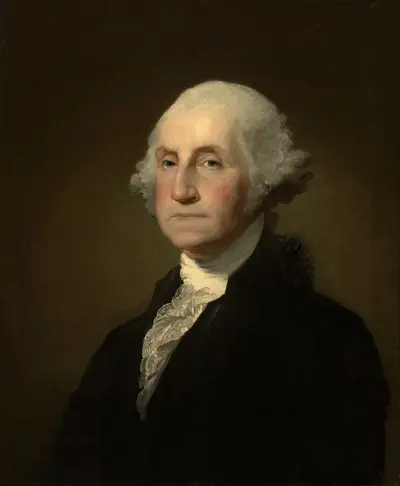
- Born: February 22, 1732
- Died: December 14, 1799
- Nationality: American
- Profession: President
George Washington was the first President of the United States (1789-97), the Commander-in-Chief of the Continental Army during the American Revolutionary War, and one of the Founding Fathers of the United States. He presided over the convention that drafted the current United States Constitution and during his lifetime was called the "father of his country".
