Alfred Pleasonton Quotes
The terms were that the war was not to be ended until the South is crushed, slavery was abolished and Lincoln was reelected
On his deathbed he claimed to Kelly that he had been offered command of the Army of the Potomac but was not willing to "pay the price" which he claimed was to accept the terms. Pleasonton, always more of a bureaucrat than an ideologue or strong leader, like many Union officers, only wanted to defang the South so that they could not threaten the rest of the states but was not convinced that "crushing" the rebels was worth the cost or that slavery or the reelection of Lincoln was worth it. There is no independent verification of his receiving the offer, but what is more likely was as the Cavalry Commander of the Army of the Potomac he was "sounded out" on the subject.
Alfred Pleasonton, 1824-1897, Union Major General, United States Internal Revenue Commissioner, Deathbed Conversation with Historical Artist & Sculptor James Edward Kelly
Sourced by: Eigen's Political and Historical Quotations


Lincoln had promised amnesty to Southerners who would pledge loyalty to the Union. What many feared was that this would include slave owners re-enslaving their former "property," or that the government would allow them to do so in order to stop the rebellion.


He may well have been right if the South had capitulated. But that is exactly what happened when they did not and were beaten. So the worst that the South could have ended up with by not following Vance’s view would be what they ended up without the many deaths and wounded and the massive destruction of property that took place in the latter part of the war.


The amendments failed as did the compromise.

The issue is whether Kansas would enter the Union as a slave state of a free state. If a free state, the free states would be able to block further slavery. If Kansas were to become a slave state, the slave states would have a sufficient majority to make all future expansion hospitable to slavery. The slavery forces started sending men and families into Kansas so that they could vote; the abolitionists did the same. Both sides armed and a war began with each faction trying to kill or drive the other faction out of Kansas before the vote. See {612516} for the anti-slavery perspective.

Wade was one of the Radical Republicans who advocated a much more vigorous prosecution of the Civil War effort in the North. It is important for two reasons: First, it illustrates the position of the “Hawks” who constantly pressured Lincoln to counter the Democrat lack of enthusiasm for the fighting. Many believed that the South would come to its senses and end the rebellion. Second and more important, this is one of the quotations that apologists for the South during the Jim Crow segregation issue use to show that there was a strong desire to impoverish the South. This is partly true. Wade and the other radicals did argue to impoverish the South only so long as they were continuing the war and rebellion. They did not argue that the South should be impoverished after the war was over. However, the reality was that the Southern economy had become so dependent on slave labor, that after Emancipation, it was very difficult to rebuild the Southern Economy. With Slavery Southern Cotton sold to England was cheaper than Egyptian Cotton. If labor had to be paid, the Egyptian cotton became cheaper. The South had squandered almost all of their capital resources on financing the war and had no capital to finance modern manufacturing enterprises. And they so resented Northerners that it was very difficult for Northern businessmen who did have capital to start and finance enterprises in the South. There also was little money for good public schools after the war, and the inferior education of the South made the situation very hard to change.

Much of the South was so insular that people knew nothing about the notion of abolition and just assumed that no one would ever consider freeing the slaves. Many never knew that it was the South that first fired on the Union troops and flag. If the North won the war, the assumption was that Northerners would then own the plantations and the valuable slaves. In reality, while all slaves were emancipated in the South, very few plantations and farms were confiscated from their Southern owners by Northerners despite the fact that there was political pressure in the North to confiscate the land of all rebels who had committed treason and use the value to repay the Union bonds and care for the wounded Union veterans and the widows of dead Union Soldiers. Eggleston was an accomplished writer who had served in the Confederate army of the Civil War. 20 year after the war he wrote a series of articles for the prestigious Northern Atlantic Monthly trying to convey the war from the Southerner’s point of view.

Churchill saw the American Civil War as inevitable as it placed two huge forces in opposition. The moral force to eliminate slavery was up against the economic force of the entire Southern economy. The Southern slaves were worth more than all the factories, railroads, stores, real estate, farms and goods of the entire South. If slavery ended, the upper class Southerners would all be economically ruined. If slavery did not end, the United States would contain the most evil and immoral institution then known to the world.

Marx followed the American Civil War very closely. The freeing of the slaves caused an immediate social, moral and economic revolution, the results of which we live with today.

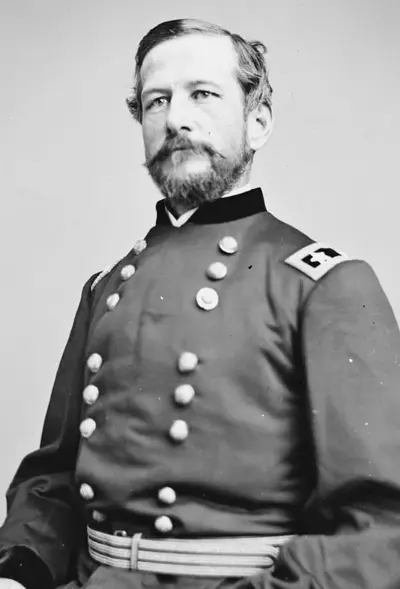
Alfred Pleasonton was a United States Army officer and major general of volunteers in the Union cavalry during the American Civil War. He commanded the Cavalry Corps of the Army of the Potomac during the Gettysburg Campaign, including the largest predominantly cavalry battle of the war, Brandy Station. In 1864, he was transferred to the Trans-Mississippi Theater, where he defeated Confederate General Sterling Price in two key battles, including the Battle of Mine Creek, the second largest cavalry battle of the war, effectively ending the war in Missouri. He was the son of Stephen Pleasonton and younger brother of Augustus Pleasonton.
