Benjamin Wade Quotes
The war must be carried on until the absolute, unqualified and unconditional subjugation of every rebel in the land to the Constitution and the Laws…until there is no source from which they can derive revenue or means for the maintenance of the war except by depriving the [Southern] people of their property day after day, year after year, so long as the war shall continue, thus reducing them to poverty and want.
Wade was one of the Radical Republicans who advocated a much more vigorous prosecution of the Civil War effort in the North. It is important for two reasons: First, it illustrates the position of the “Hawks” who constantly pressured Lincoln to counter the Democrat lack of enthusiasm for the fighting. Many believed that the South would come to its senses and end the rebellion. Second and more important, this is one of the quotations that apologists for the South during the Jim Crow segregation issue use to show that there was a strong desire to impoverish the South. This is partly true. Wade and the other radicals did argue to impoverish the South only so long as they were continuing the war and rebellion. They did not argue that the South should be impoverished after the war was over. However, the reality was that the Southern economy had become so dependent on slave labor, that after Emancipation, it was very difficult to rebuild the Southern Economy. With Slavery Southern Cotton sold to England was cheaper than Egyptian Cotton. If labor had to be paid, the Egyptian cotton became cheaper. The South had squandered almost all of their capital resources on financing the war and had no capital to finance modern manufacturing enterprises. And they so resented Northerners that it was very difficult for Northern businessmen who did have capital to start and finance enterprises in the South. There also was little money for good public schools after the war, and the inferior education of the South made the situation very hard to change.
Benjamin Franklin Wade, 1800-1878, U. S. Senator (Whig & Republican, OH), Senate Debate, 1861
Sourced by: Eigen's Political and Historical Quotations


On his deathbed he claimed to Kelly that he had been offered command of the Army of the Potomac but was not willing to "pay the price" which he claimed was to accept the terms. Pleasonton, always more of a bureaucrat than an ideologue or strong leader, like many Union officers, only wanted to defang the South so that they could not threaten the rest of the states but was not convinced that "crushing" the rebels was worth the cost or that slavery or the reelection of Lincoln was worth it. There is no independent verification of his receiving the offer, but what is more likely was as the Cavalry Commander of the Army of the Potomac he was "sounded out" on the subject.

Committee of the Congress. This was the prevailing Congressional and public view except for the South which had coalesced around an intellectual rationalization. See {618013}.

Butler was at the time the Union general in charge of Louisiana. He had on his hand a large group of slaves whose owners had abandoned the area. There was no emancipation yet. He wrote for instructions. The result was the first actual emancipation of slaves.


Indeed, he was wrong in the sense that the Southern whites did NOT even obey the letter of the law. The Klu Klux Klan and the rest of Southern Jim Crow terrorism broke the laws of the states and local communities as well as Federal law but they did so with impunity. Andrews recognized the problem but never suspected that it would be as bad as it got with public torture and lynching commonplace and approved by most white Southerners.

This is an interesting retrospective on slavery after the tragedy of the Civil War was recognized.

This concept of Total War turns out to be the only way to bring many conflicts to an end. Sherman was hated by generations of Southerners because he appeared to be vengeful to humble the Southern pride and spirit. But actually, Sherman was not personally vengeful at all and respected the South and understood its point of view more than most in the North. However, he was one of the first of the Western World’s military leaders to realize that with modern warfare and the then modern weapons, the only way to win a war was to persuade the enemy to stop fighting and if they refused, as the South kept doing, the only rational and humane course was to end the war as swiftly and totally as possible.
He was a realist who foresaw that even though the South had been militarily defeated, there were those who would persist in their efforts to retain slavery or a de facto form where freedom is the form but subjugation was the substance. It would be Jim Crowe and terrorism in the form of the KKK and a successor to Lincoln who was very sympathetic to the aims and culture of the Southern Rebels.
Armstrong was a Union military chaplain with the troops that had captured Petersburg, Virginia. Of particular interest in this quotation is his report on the attitude of the poor whites after the war had destroyed the economy of the area and reduced the former wealthy aristocrats to poverty.


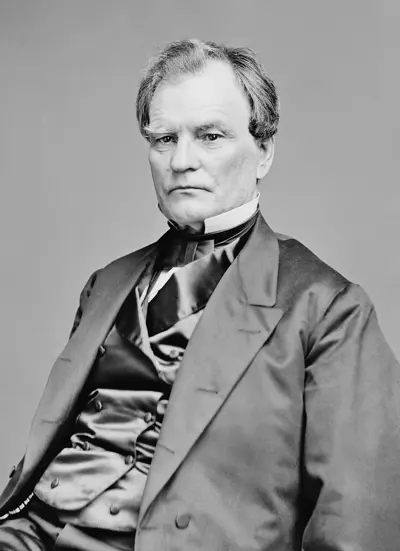
Benjamin Franklin "Bluff" Wade was an American lawyer and politician who served as a United States Senator for Ohio from 1851 to 1869. He is known for his leading role among the Radical Republicans including support for civil rights, women's suffrage, and trade unions. Had the 1868 impeachment of U.S. President Andrew Johnson led to a conviction in the Senate, as president pro tempore of the U.S. Senate, Wade would have become president for the remaining nine months of Johnson's term.
