Corrine Brown Quotes
The Emancipation Proclamation, signed by President Abraham Lincoln, was put into effect on January 1, 1863, but news of the Proclamation and enforcement did not reach Texas until after the end of the Civil War almost two years later.
United States, Congress, House. Representative Brown speaking on Recognizing the Historical Significance of Juneteenth Independence Day. Congressional Record, Government Printing Office, 19 Jun. 2006, p. H4198.

On his deathbed he claimed to Kelly that he had been offered command of the Army of the Potomac but was not willing to "pay the price" which he claimed was to accept the terms. Pleasonton, always more of a bureaucrat than an ideologue or strong leader, like many Union officers, only wanted to defang the South so that they could not threaten the rest of the states but was not convinced that "crushing" the rebels was worth the cost or that slavery or the reelection of Lincoln was worth it. There is no independent verification of his receiving the offer, but what is more likely was as the Cavalry Commander of the Army of the Potomac he was "sounded out" on the subject.

Lincoln had promised amnesty to Southerners who would pledge loyalty to the Union. What many feared was that this would include slave owners re-enslaving their former "property," or that the government would allow them to do so in order to stop the rebellion.


At the time, the prevailing federal policy was to return fugitive slaves to their owners. Lincoln was intent on keeping Kentucky and Maryland, both slave states, in the union, even at the cost of returning fugitive slaves. Shortly after, he came up with the policy of always returning fugitive slaves except in the rebellious states of the confederacy where the slaves were legally defined as ‘contraband’—war material, and thus could be seized by Union forces. Many fugitive slaves were thus employed by the Union for construction projects. Later, the Emancipation Proclamation set the slaves of the Confederacy free.


The Emancipation Proclamation was actually issued on January 1, 1863. However, the news of their freedom did not reach West Texas Blacks until the middle of June and spread by word of mouth from June 13 to June 19. June "Teenth" has been celebrated since on the 19th of June.

After the Presidential years of James Buchanan who protected the South from slavery reform and abolition as the North was gaining political power and the abolitionists were having a greater and greater effect on public opinion in the North. While Southerners did not believe Lincoln would emancipate the slaves, they realized that the majority of the growing nation was opposed to slavery, and more and more Northern states were passimg laws making any slave who sets foot in the State a free person. Slaves coud not only have more reason to run away, but slave owners would not be able to get their “property” back. Lincoln would not help the South as Buchanan did, and the Southerners realized that over time, slavery would no longer be feasible or profitable. Cobb, very experienced at Washington politics, realized the changes that would come and thought that they would be “certain and speedy.” The irony was that if the South had not seceded and simply dragged its feet legislatively, it would have taken two or three decades for slavery to end. However, by seceding and initially fighting so hard and well while poor Union generals were in command, Lincoln was forced to try more drastic measures and issued the Emancipation Proclamation after only a few years. The Civil War and seccession was not only a tactical and strategic error for the South, but rapidly brought about just what the Southerners were fighting to prevent.

Churchill saw the American Civil War as inevitable as it placed two huge forces in opposition. The moral force to eliminate slavery was up against the economic force of the entire Southern economy. The Southern slaves were worth more than all the factories, railroads, stores, real estate, farms and goods of the entire South. If slavery ended, the upper class Southerners would all be economically ruined. If slavery did not end, the United States would contain the most evil and immoral institution then known to the world.

Marx followed the American Civil War very closely. The freeing of the slaves caused an immediate social, moral and economic revolution, the results of which we live with today.

At this point, there had hardly been any fighting and no outrages or war crimes were yet committed by either side. These would come later—more on the Confederate side as they did not want to take the limited resources they had from their troops to fulfil abstract obligations to prisoners of war or to civilians. A few deliberately chose to use terror tactics. The Union troops also at various points in the war got out of hand and looted personal property of civilians. But at this point, this proclamation was just lies and propaganda.
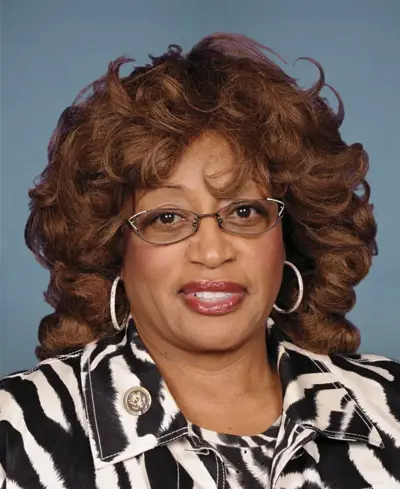
Corrine Brown is an American former politician and convicted felon, who served as a member of the U.S. House of Representatives from Florida from 1993 to 2017. She is a member of the Democratic Party. After a court-ordered redistricting significantly changed her district, and a federal indictment for corruption, Brown was defeated in the 2016 Democratic primary by Al Lawson, who went on to win Brown's former seat.
