Howell Cobb Quotes
Every hour that Georgia stays in the union after Lincoln comes into power would be an hour of degradation, to be followed by certain and speedy ruin.
After the Presidential years of James Buchanan who protected the South from slavery reform and abolition as the North was gaining political power and the abolitionists were having a greater and greater effect on public opinion in the North. While Southerners did not believe Lincoln would emancipate the slaves, they realized that the majority of the growing nation was opposed to slavery, and more and more Northern states were passimg laws making any slave who sets foot in the State a free person. Slaves coud not only have more reason to run away, but slave owners would not be able to get their “property” back. Lincoln would not help the South as Buchanan did, and the Southerners realized that over time, slavery would no longer be feasible or profitable. Cobb, very experienced at Washington politics, realized the changes that would come and thought that they would be “certain and speedy.” The irony was that if the South had not seceded and simply dragged its feet legislatively, it would have taken two or three decades for slavery to end. However, by seceding and initially fighting so hard and well while poor Union generals were in command, Lincoln was forced to try more drastic measures and issued the Emancipation Proclamation after only a few years. The Civil War and seccession was not only a tactical and strategic error for the South, but rapidly brought about just what the Southerners were fighting to prevent.
Howell Cobb, 1815-1868, U. S. Congressman (Democrat, GA), Speaker of the House, Secretary of the Treasury, Confederate General, December 6, 1860
Sourced by: Eigen's Political and Historical Quotations

This quotation is fascinating and illustrates the depth and complexity of the problem facing Abraham Lincoln. Howell actually used the word “evil” to describe the abolitionists and their political efforts end slavery. He and other slave holders did not see slavery and the murder, brutality, and torture that went with it as evil. After the Presidential years of James Buchanan who protected the South from slavery reform and abolition as the North was gaining political power and the abolitionists were having a greater and greater effect on public opinion in the North. While Southerners did not believe Lincoln would emancipate the slaves, they realized that the majority of the growing nation was opposed to slavery, and more and more Northern states were passing laws making any slave who sets foot in the State a free person. Slaves could not only have more reason to run away, but slave owners would not be able to get their “property” back. Lincoln would not help the South as Buchanan did, and the Southerners realized that over time, slavery would no longer be feasible or profitable. Cobb, very experienced at Washington politics, realized the changes that would come and thought that they would be “certain and speedy.”—see {620555}. Lincoln had been elected a month earlier and without Buchanan as President to protect the institution of slavery, the anti-slavery majority of the country would prevail unless the South seceded. Cobb was one of the strong advocates. 6 days later, the Georgia legislature called for a convention to debate secession. The irony was that if the South had not seceded and simply dragged its feet legislatively, it would have taken two or three decades for slavery to end. However, by seceding and initially fighting so hard and well while weak Union generals were in command, Lincoln was forced to try more drastic measures and issued the Emancipation Proclamation after only a few years. The Civil War and secession was not only a tactical and strategic error for the South, but rapidly brought about just what the Southerners were fighting to prevent.


While Douglas and Lincoln were political opponents with little love lost between them, both were patriots. Douglas’s position were much more popular in the South, and the moment he realized that Lincoln would win the Presidency, he headed South where he was very persuasive in trying to hold the Union together, but he could not see all the potential rebels and was only effective with some. South Carolina not only seceded, but in order to prevent any changing of minds, some the worst of the South Carolinians, attacked Fort Sumter firing on the American Flag and attacking and capturing the Union troops who were totally outnumbered. The Civil War was then inevitable.


Marx followed the American Civil War very closely. The freeing of the slaves caused an immediate social, moral and economic revolution, the results of which we live with today.


As just one example of Southern States' reasons, see {583044}. Many of the Northern States had passed laws declaring everyone in the state was free and making it illegal to return or assist in the returning of escaped slaves. The Southerners got the Federal Fugitive Slave Act passed which required all Americans to assist in recapturing escaped slaves. It was the Northern States who claimed states' rights were being trampled. The South was vehemently opposed to States' Rights when it came to allowing individual states to decide who was free and who was not. The Southerners had only one fundamental reason for secession—the maintenance of the Negro slavery system on which much of their economy depended as did their sociology, culture, and way of life.


There were some Southern Apologists who during the Jim Crow era and even into modern times, argued that slavery and the desire to maintain that was a minor cause of the Civil War but succession came about over differences in philosophy of government. This document by Mississippi made it perfectly clear why they favored succession: Slavery and their desire to maintain that institution.


The South had attacked Fort Sumter


While this assessment was true up until the 1980s. By the 21st century there were almost no serious historians who thought that the motivation of the Confederate States for the Civil War was anything but slavery and the economic impact that abolition might bring. However, one of your advantages having this collection of historical quotations is that you can see for yourself why the Southern states say they were seceding. This following are four of the official secession resolution documents. Read these and you will see that all the claims that there were other major reasons for secession are just attempts to make the Confederacy a little less brutal and greedy. See {621371}, {619793}, {621372}, {621375}

Some Southerners, in order to obtain support in England for the Confederate cause claimed in their propaganda that slavery was not the issue but their issue with the Union was just one of local and regional autonomy. The British and most Europeans at that time were strongly against slavery so this “spin” might have gotten some support. Stowe and others put the lie to this, and the Confederacy never did get any significant material support from any country in Europe. The secession resolutions of the Southern States all state that Slavery was the cause (and often the ONLY cause stated) of secession. Also Southern General Mosby, called the spin for what it was. See {584991}.

Much of the South was so insular that people knew nothing about the notion of abolition and just assumed that no one would ever consider freeing the slaves. Many never knew that it was the South that first fired on the Union troops and flag. If the North won the war, the assumption was that Northerners would then own the plantations and the valuable slaves. In reality, while all slaves were emancipated in the South, very few plantations and farms were confiscated from their Southern owners by Northerners despite the fact that there was political pressure in the North to confiscate the land of all rebels who had committed treason and use the value to repay the Union bonds and care for the wounded Union veterans and the widows of dead Union Soldiers. Eggleston was an accomplished writer who had served in the Confederate army of the Civil War. 20 year after the war he wrote a series of articles for the prestigious Northern Atlantic Monthly trying to convey the war from the Southerner’s point of view.

The Southern states were illegal rebels. A confederacy had always meant a voluntary association of otherwise independent entities. However technically the Southern states were not independent but in a state of illegal rebellion against the United States. Lincoln, a lawyer, could not being himself to refer to the South by their preferred name—the Confederacy. So this was how he and many in his administration referred to the South.
Oates was a Confederate Colonel during the Civil War. His statement almost started a brawl as the Memorial Dedication was a joint North-South participation event. Northern politicians, officers and men were outraged and rose to their feet with several mounting the rostrum to refute Oates intemperate remarks. However, like Southern politicians of the 1960s, they produced a lot of redneck support with such extreme statements. The main reason this quotation is important is that most politicians of North and South wanted to get the animosity of the Civil War over with and to do so sponsored these memorial events where both sides could celebrate and remember the bravery of men fighting and dying for their cause. The photographs of former enemies shaking hands which the newspapers ran frequently, would give the impression that by the 1880s the hatred and animosity of the Civil War was behind the nation. However, that was not at all true. Most veterans of both sides maintained their hatreds throughout their entire lives. Even their children carried the hatred into the next generation. Politicians were expected to not open the scabs of the old wounds in public, but many like Oates found political utility in not doing so. The moral outrage of many in the North remained until WWII when regional unity genuinely transcended the Civil War. See {639364} for a Northern example with no political motive but with uncontrollable moral outrage.
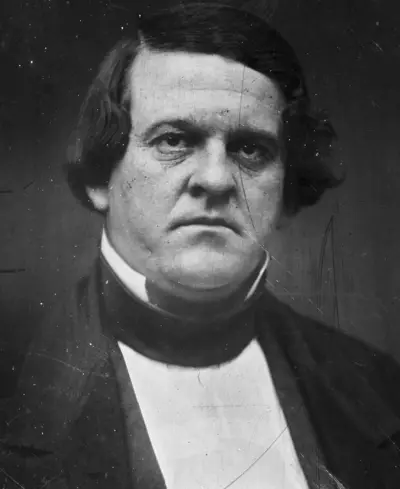
- Born: September 7, 1815
- Died: October 9, 1868
- Nationality:
- Profession:
Howell Cobb was an American political figure. A southern Democrat, Cobb was a five-term member of the United States House of Representatives and Speaker of the House from 1849 to 1851. He also served as the 40th Governor of Georgia (1851–1853) and as a Secretary of the Treasury under President James Buchanan (1857–1860).
