Lady Bird Johnson Quotes
I wonder if anyone but me will remember that June Teenth was always celebrated by all the Negroes in Texas …. It was the day that the Emancipation Proclamation went into effect a hundred or so years ago.
The Emancipation Proclamation was actually issued on January 1, 1863. However, the news of their freedom did not reach West Texas Blacks until the middle of June and spread by word of mouth from June 13 to June 19. June "Teenth" has been celebrated since on the 19th of June.
Claudia Johnson, 1912-2007, [Lady Bird], First Lady (Lyndon Baines Johnson), Diary Entry, June 19, 1964
Sourced by: Eigen's Political and Historical Quotations


Lincoln had promised amnesty to Southerners who would pledge loyalty to the Union. What many feared was that this would include slave owners re-enslaving their former "property," or that the government would allow them to do so in order to stop the rebellion.


Marx followed the American Civil War very closely. The freeing of the slaves caused an immediate social, moral and economic revolution, the results of which we live with today.


While this assessment was true up until the 1980s. By the 21st century there were almost no serious historians who thought that the motivation of the Confederate States for the Civil War was anything but slavery and the economic impact that abolition might bring. However, one of your advantages having this collection of historical quotations is that you can see for yourself why the Southern states say they were seceding. This following are four of the official secession resolution documents. Read these and you will see that all the claims that there were other major reasons for secession are just attempts to make the Confederacy a little less brutal and greedy. See {621371}, {619793}, {621372}, {621375}

At the time, the prevailing federal policy was to return fugitive slaves to their owners. Lincoln was intent on keeping Kentucky and Maryland, both slave states, in the union, even at the cost of returning fugitive slaves. Shortly after, he came up with the policy of always returning fugitive slaves except in the rebellious states of the confederacy where the slaves were legally defined as ‘contraband’—war material, and thus could be seized by Union forces. Many fugitive slaves were thus employed by the Union for construction projects. Later, the Emancipation Proclamation set the slaves of the Confederacy free.

In April, 1784, the Continental Congress passed a series of laws that Jefferson had drafted for the NorthWest territory—Ohio then being the west and the states that would develop there. However, the quotation is the clause that the Southern States blocked and hence did not become law, as the Soothers states cared little about the status of the area regarding slavery, but feared that the new states wold become a sanctuary for runaway slaves. It was another case where Jefferson attempted to end slavery. It also was yet another example of the unwieldiness of the Continental Congress to manage the new nation which led up to the Constitutional Convention of 1787. Ironically, as a price for union, the Southern States demanded and obtained a disproportionate representation in the New House of Representatives by having 60 percent of their slaves counted inzallocating congressional seats. The senate also worked in their favor as there were enough Southern states to block any attack on slavery in the Senate. There was no democratic way to eliminate slavery and the Civil War resulted. However, Jefferson’s proposed law was passed by the last Continental Congress in June, 1787. The difference was that there was also added a proviso that required the return of all runaway slaves from the new territory and states which was lacking in the earlier attempt.


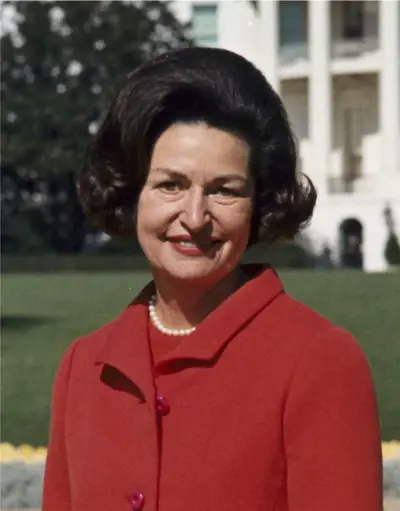
Claudia Alta "Lady Bird" Johnson was an American socialite and First Lady of the United States as the wife of the 36th President of the United States, Lyndon B. Johnson from 1963 to 1969. She had previously served as the Second Lady of the United States from 1961 to 1963.
