Ambrose Burnside Quotes
Being about to land on the soil of North Carolina, the general commanding desires his soldiers to remember that they are here to support the Constitution and the laws, to put down rebellion, and to protect the persons and property of the loyal and peaceable citizens of the State.
United States, War Department. The War of the Rebellion: A Compilation of the Official Records of the Union and Confederate Armies. Series I, Vol. 9, Government Printing Office, 1883, p. 359.

First Irish Bishop in the United States. American Catholic bishops were divided during the Civil War over the slavery question. For a bishop’s view opposing slavery, see Purcell {612351}.

Wade was one of the Radical Republicans who advocated a much more vigorous prosecution of the Civil War effort in the North. It is important for two reasons: First, it illustrates the position of the “Hawks” who constantly pressured Lincoln to counter the Democrat lack of enthusiasm for the fighting. Many believed that the South would come to its senses and end the rebellion. Second and more important, this is one of the quotations that apologists for the South during the Jim Crow segregation issue use to show that there was a strong desire to impoverish the South. This is partly true. Wade and the other radicals did argue to impoverish the South only so long as they were continuing the war and rebellion. They did not argue that the South should be impoverished after the war was over. However, the reality was that the Southern economy had become so dependent on slave labor, that after Emancipation, it was very difficult to rebuild the Southern Economy. With Slavery Southern Cotton sold to England was cheaper than Egyptian Cotton. If labor had to be paid, the Egyptian cotton became cheaper. The South had squandered almost all of their capital resources on financing the war and had no capital to finance modern manufacturing enterprises. And they so resented Northerners that it was very difficult for Northern businessmen who did have capital to start and finance enterprises in the South. There also was little money for good public schools after the war, and the inferior education of the South made the situation very hard to change.


This oath was required of Southern Rebels who wanted obtain amnesty from treason which they had committed by engaging in the Civil War. See {623307} for the Presidential Proclamation.

He stated that he had a vision and made these two prophesies that indeed came true. The first was the South Carolina secession starting the Civil War. The second, when the North used former slaves as soldiers who fought their old masters.

Butler was at the time the Union general in charge of Louisiana. He had on his hand a large group of slaves whose owners had abandoned the area. There was no emancipation yet. He wrote for instructions. The result was the first actual emancipation of slaves.

He had no authority to do this. He just took it upon himself. This was one of the incidents which caused later Congresses to pass very strict laws limiting the authority of all Federal Military and other intelligence and police forces so that they have little or no authority within the United States. President Lincoln did not allow the order to stand, although he repudiated it very delicately and as privately as possible. Many in his own party strongly favored this proclamation as it cracked down on the Southern Rebels and emancipated slaves—both objectives of many Republicans. In addition, Fremont was very popular with the people and had strong political connections. (He would later run for President.) See {635739}.

Note that Lincoln did not justify the emancipation proclamation on moral or humanitarian grounds, but on the grounds of military necessity.


The South had attacked Fort Sumter

Grant was a new Brigadier General and occupied Paducah

While Douglas and Lincoln were political opponents with little love lost between them, both were patriots. And Douglas was committed to seeing that Lincoln was inaugurated and the Union preserved, if Lincoln won the election. When Lincoln did so, Douglas traveled throughout the South trying to persuade Southerners to stay in the Union. See {584870}.


The issue was the voting franchise for Negroes in the aftermath of the Civil War.


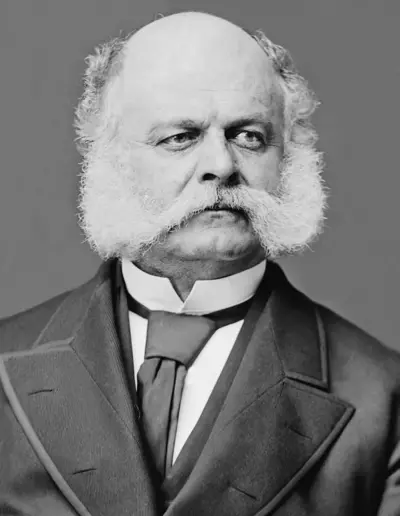
Ambrose Everett Burnside was an American soldier, railroad executive, inventor, industrialist, and politician from Rhode Island. He served as the Governor of Rhode Island from 1866 to 1869, and as a United States Senator for Rhode Island from 1875 until his death.
