Ulysses S. Grant Quotes
I have come among you, not as an enemy, but as your fellow citizen. Not to maltreat or annoy you, but to respect and enforce the rights of all loyal citizens. An enemy in rebellion against our common government has taken possession of and planted its guns on the soil of Kentucky and fired upon you… I am here to defend you against this enemy, to assist the authority and sovereignty of your government. I have nothing to do with opinions, and shall deal only with armed rebellion and its aiders and abettors. You can pursue your normal avocations without fear. The strong arm of the Government is here to protect its friends, and punish its enemies. Whenever it is manifest that you are able to defend yourselves and maintain the authority of the Government and protect the rights of loyal citizens, I shall withdraw the forces under my command.
Grant was a new Brigadier General and occupied Paducah
Ulysses S. Grant, 1822-1885, 18th President of the United States (Republican, OH), U.S. Government Proclamation, Paducah, Kentucky, September 1861
Sourced by: Eigen's Political and Historical Quotations


The White Africaners were attacking the Blacks to force them off their land so the Afrkaners could take over. The country was under British rule and the unarmed Blacks were being slaughtered by the Afrikaners who were British Subjects. Eventually the Boer War set the English against the Afrikaners. See {583902} for a related quotation.
He was a brutal, sadistic war criminal who was assassinated by one of his many enemies in 2000 before he could be brought to trial.

See Noah Webster and Timothy Pickering for similar positions. The War of 1812 was very unpopular with the New England states. They had the most developed trade with England and were economically injured by the curtailment of that trade. The citizens of Essex wanted to give the State Legislature the most possible moral and political power to negotiate an end to the war.


1st Earl of Chatham. The speech was given in the midst of the American Revolution.


He had just assumed his post 6 days earlier. At this point he did not have enough knowledge to favor or oppose the regime change, but he did realize that the decision was a serious one and there would be no turning back. Diem was a creature of the Central Intelligence Agency. An anti-Communist Christian in a Buddhist county, the CIA engineered his rise to power, created his political party, provided him with cash to bribe other Vietnamese politicians, and paid for all the propaganda so he would “win” the Presidential elections. However, he abused the Buddhists, was thoroughly corrupt and ran a corrupt administration, but worst of all from the American point of view, he was unable to motivate the South Vietnamese population to fight the Communists. He reached the point where he was more of a liability, and the Central Intelligence Agency engineered a coup d’etat to remove him from power and replace him with a President more to our liking. (See {634540}.)


Queen Victoria

Ataturk had been a military hero, but was very much opposed to war and military adventurism not unlike the Dwight Eisenhower and Colin Powell type leaders. However, the one thing that he thought worth the sacrifice of his own and other Turkish lives was Turkish independence and sovereignty. Historically, the Ottoman Empire which Ataturk finally ended, had dominated half of Europe and all of the Mid East at the cost of sovereignty of other nations and Ataturk saw no more important virtue with dying for than national sovereignty. See {125322} and {584501}.


England had gone through a bloody Civil War with the Parliament on one side and the King on the other. The King lost and was beheaded later that year. See {597353}.


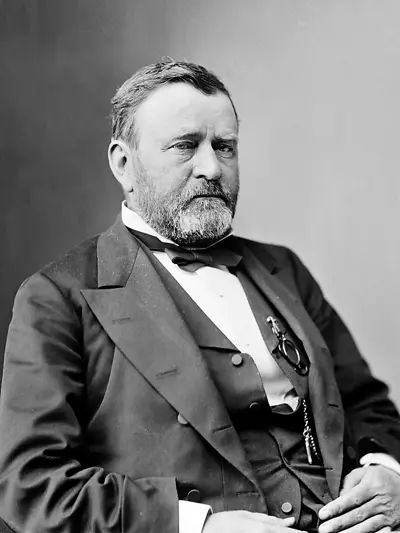
Ulysses S. Grant was an American military leader who served as the 18th president of the United States from 1869 to 1877. As president, Grant was an effective civil rights executive who created the Justice Department and worked with the Radical Republicans during Reconstruction to protect African Americans. As Commanding General, he led the Union Army to victory in the American Civil War in 1865 and thereafter briefly served as Secretary of War.
