Charles I Quotes
I never did begin the war with the two Houses of Parliament... They began war upon me... if anybody will look at the dates of what happened... they will see clearly that they began these unhappy troubles, not I... therefore I tell you I am the martyr of the people.
England had gone through a bloody Civil War with the Parliament on one side and the King on the other. The King lost and was beheaded later that year. See {597353}.
Charles I, 1600-1649, King of Great Britain & Ireland, Speech, 1648
Sourced by: Eigen's Political and Historical Quotations


This was Executive Privilege of the time. The result of this type of conflict between the executive and the legislative body was a Civil War in which Parliament won. This concept of executive privilege operates to this day in America where the President typically refuses to have his special assistants and staff be questioned by Congressional investigating committees. IT also extends to documents where the President has refused to allow Congress access to papers. In the Watergate scandal, it was the Supreme Court Decision that President Nixon could not claim Executive Privilege with respect to the Watergate tapes. Their exposure forced his resignation.


The Regicide of Charles I was still a very sensitive subject with Englishmen loyal to the King in the Colonial era. So this was an incredibly radical and incendiary statement for an American minister to make. However, he did acknowledge that a people had a right to have a king {634001} unlike Thomas Paine who did not—see {634004}.

Some of the Patriots of Early America realized that the oppressions of British rule were coming from Parliament and initially took the position that only the King could make laws for the colonies and not Parliament. Therefore, they were as Englishmen challenging illegal English laws. Most American hostility was directed at Parliament and not the King. However, once there was any physical resistance, King George came down with such a heavy hand that American hatred transferred to him. For related quotes on the King/Parliament issue, see {639145}, {639144}, {639142}, {639141}, {639140}, & {639137}


It would be almost 30 years until Jackson would have been proved correct and the Civil War had begun.

The ambassador's hyperbole caused or was the excuse for President Lyndon Johnson to send the marines into the Dominican Republic. There were only two American civilian casualties—both were reporters accidently shot by U.S. Marines.


She responded to the Lord Chief Justice and to Lord Cecil and asked them to so inform the Commons and the House of Lords. Cecil needed three drafts to convey the response but tone it down a little, thus performing the duties of a modern press secretary.

Quoted in somewhat different form by Richard Nixon

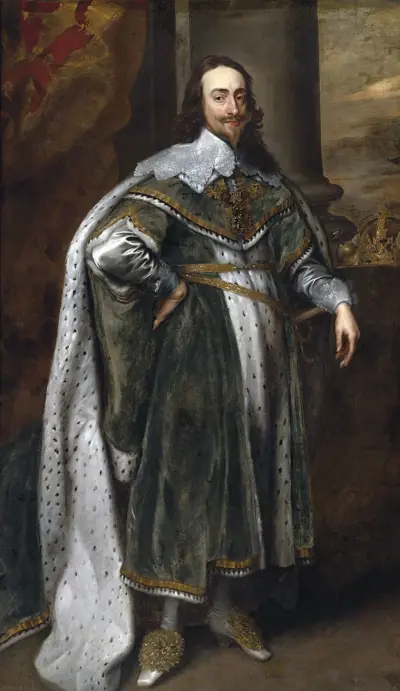
- Born: November 19, 1600
- Died: January 30, 1649
- Nationality:
- Profession:
Charles I was King of England, Scotland, and Ireland from 27 March 1625 until his execution in 1649. He was born into the House of Stuart as the second son of King James VI of Scotland, but after his father inherited the English throne in 1603 (as James I), he moved to England, where he spent much of the rest of his life. He became heir apparent to the three kingdoms of England, Scotland, and Ireland in 1612 on the death of his elder brother Henry Frederick, Prince of Wales. An unsuccessful and unpopular attempt to marry him to the Spanish Habsburg princess Maria Anna culminated in an eight-month visit to Spain in 1623 that demonstrated the futility of the marriage negotiations. Two years later, he married the Bourbon princess Henrietta Maria of France.
