Thomas Paine Quotes
Your dependence upon the crown is no advantage, but rather an injury to the people of Britain, as it increases the power and influence of the King.
Many American colonists had relatives and friends in England, and Paine argued that American independence would help and not het the English people.
Paine, Thomas. The American Crisis, No. 7. John Dunlap, 1778, p. 2.


Lotario de' Conti. The Pope did not want anything to diminish the absolute power of Kings as Popes might be next to lose their absolute authority. Despite the Pope’s nullification, Magna Carta had huge influence in England and the world. Note that the Pope actually called the agreement “unjust”, which gives us an excellent idea of the concept of justice amongst the power elites of the 13th century.


Sir Walter was imprisoned in the Tower of London for 13 years, during which time he turned to historical pursuits.

Note that the Queen always used the 3rd person rather than the 1st when referring to herself. This was true of most of the leading public figures in England at the time. Although she detested Gladstone, she gained control of her feelings and did her duty and “sent for” him to form the Government. She was personally delighted when, as she predicted, his government then had political difficulties.

In 1848 a number of revolutions flared throughout Europe with a call for democracy rather than monarchy. The Prussian king was one of those who really believed that he was selected by God to rule, was very frightened and tried to enlist the Queen and England to present a united front against the revolutionaries. England, which had already had a strong functioning parliament and extensive voting suffrage, protected most of the rights of its citizens and was a Constitutional Monarchy where there were limits to the power of the monarch. Further, Victoria was extremely popular and in many ways was far ahead of the electorate in terms of modern democratic reforms. So she was not in the panic of many of the other crowned heads of Europe were in. Somewhat following the example of England, King William IV allowed a parliament and minimized the strong military role that characterized Prussia. Most of the 1848 revolutions failed to sieze governments but, as with Prussia, forced reforms in what was a long movement to European democracy that would take another 150 years. Note also the logic about religion. Since the revolutionists did not believe in the divine right of kings, they opposed God’s will on earth. Therefore, they opposed God and must be atheists. Almost all counter revolutionary accusations included the claim—often not true—that the revolutionaries were atheists.

Some of the Patriots of Early America realized that the oppressions of British rule were coming from Parliament and initially took the position that only the King could make laws for the colonies and not Parliament. Therefore, they were as Englishmen challenging illegal English laws. Most American hostility was directed at Parliament and not the King. However, once there was any physical resistance, King George came down with such a heavy hand that American hatred transferred to him. For related quotes on the King/Parliament issue, see {639145}, {639144}, {639142}, {639141}, {639140}, & {639137}


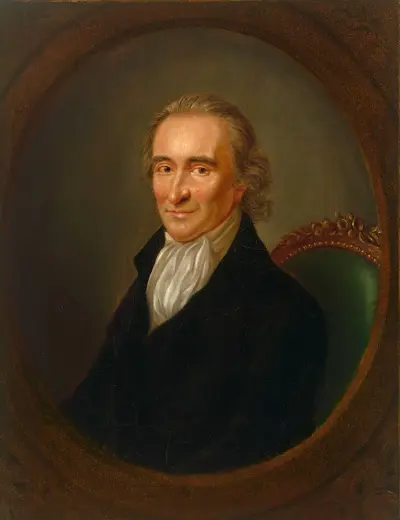
Thomas Paine was an English-born American political activist, philosopher, political theorist, and revolutionary. He authored Common Sense (1776) and The American Crisis (1776–1783), the two most influential pamphlets at the start of the American Revolution, and helped inspire the patriots in 1776 to declare independence from Great Britain. His ideas reflected Enlightenment-era ideals of transnational human rights. Historian Saul K. Padover described him as "a corsetmaker by trade, a journalist by profession, and a propagandist by inclination".
