A. P. Herbert Quotes
The whole Constitution has been erected upon the assumption that the King not only is capable of doing wrong but is more likely to do wrong than other men if he is given the chance.
Alan Patrick Herbert, 1890-1971, British Writer & Member of Parliament, "What Is the Crown?", Uncommon Law, 1935
Sourced by: Eigen's Political and Historical Quotations

Many American colonists had relatives and friends in England, and Paine argued that American independence would help and not het the English people.


The issues of check and balances in the American constitution were radical by world standards of the day. However, it was by no means an new concept and as this quotation illustrates was discussed and debated in England, but although England was far ahead of almost all other countries with respect to eliminating absolute power, they never took it as far as the Americans did. That took a revolution.


In 1628 Parliament, in response to abuses by King Charles I, was about to pass The Petition of Rights–-a type of Bill of Rights. The King gave assurances that the practices—such as forcing nobles to lend him money—would not continue and didn't want to be embarrassed by passage of a law which he claimed would indicate that the Parliament did not trust him and weaken the dignity of the monarchy. The Petition of Rights passed with Cole’s leadership.


Prior to Cooke’s indictment of English King Charles I, there was a concept of Royal Impunity—that a sovereign could not legally be called to account for his actions as ruler of the state. The concept of “sovereign immunity” was a concept where the sovereign and his agents could be given immunity for specific actions, but they never would have impunity again where there were no limits to the crimes they might commit against their own people. Charles I refused to even recognize Cooke’s indictment and so have heads of state called to account for their major crimes since then all the way down to Saddam Hussein in 2006 who made the same argument. Cooke was himself hanged, drawn and quartered almost 20 years after the Charles I trial for his part in the “Regicide” so the concept of Royal Impunity did not die quickly.


Lotario de' Conti. The Pope did not want anything to diminish the absolute power of Kings as Popes might be next to lose their absolute authority. Despite the Pope’s nullification, Magna Carta had huge influence in England and the world. Note that the Pope actually called the agreement “unjust”, which gives us an excellent idea of the concept of justice amongst the power elites of the 13th century.

Typical of the times, the king was accountable to no one for anything. 200 years later, most of the world have accepted the principle that no one is above the law and that every leader is accountable to the people.


Sir Walter was imprisoned in the Tower of London for 13 years, during which time he turned to historical pursuits.


See {592811} for Adams response.


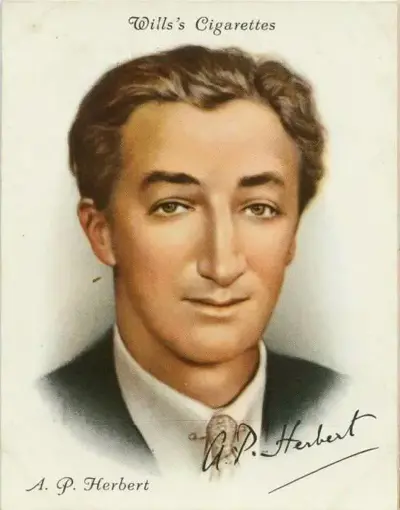
Sir Alan Patrick Herbert CH, usually known as A. P. Herbert or simply A. P. H., was an English humorist, novelist, playwright and law reform activist, and an Independent Member of Parliament for Oxford University from 1935 until 1950, when university constituencies were abolished. Born in Ashtead, Surrey, Herbert attended Winchester College and New College, Oxford, graduating with a starred first in Jurisprudence in 1914. He joined the Royal Naval Volunteer Reserve as an ordinary seaman in World War I, later serving as an officer with the Royal Naval Division. He fought in Gallipoli and on the Western Front, becoming battalion adjutant in 1917, before injury excluded him from the front line. After the war, he published The Secret Battle and joined the staff of Punch in 1924. He also wrote librettos for musicals. Elected as Independent MP for Oxford University in the 1935 general election, Herbert campaigned for private member's rights, piloted the Matrimonial Causes Act 1937 through Parliament, opposed the Entertainments Duty, and campaigned against the Oxford Group. He joined the River Emergency Service in 1938 and served in World War II as a petty officer in the Royal Naval Auxiliary Patrol. He captained his river boat, the Water Gipsy, on the River Thames. In 1943, he joined a parliamentary commission to investigate the future of the Dominion of Newfoundland.
