Edward Coke Quotes
We stand at present on the confines between the liberty of the subject and the prerogatives of the king.
Edward Coke, 1552-1634, English Solicitor General, Attorney General and Speaker of the House of Commons, Speech in the House debating the Petition of Rights, 1628
Sourced by: Eigen's Political and Historical Quotations

Many American colonists had relatives and friends in England, and Paine argued that American independence would help and not het the English people.

Some of the Patriots of Early America realized that the oppressions of British rule were coming from Parliament and initially took the position that only the King could make laws for the colonies and not Parliament. Therefore, they were as Englishmen challenging illegal English laws. Most American hostility was directed at Parliament and not the King. However, once there was any physical resistance, King George came down with such a heavy hand that American hatred transferred to him. For related quotes on the King/Parliament issue, see {639145}, {639144}, {639142}, {639141}, {639140}, & {639137}

Some of the Patriots of Early America realized that the oppressions of British rule were coming from Parliament and initially took the position that only the King could make laws for the colonies and not Parliament. Therefore, they were as Englishmen challenging illegal English laws. Most American hostility was directed at Parliament and not the King. However, once there was any physical resistance, King George came down with such a heavy hand that American hatred transferred to him. For related quotes on the King/Parliament issue, see {639145}, {639143}, {639142}, {639141}, {639140}, & {639137}


The message was actually a threat in effect telling Parliament that if it did not pass the correct appropriations, the king might supplant them. He dissolved Parliament later that year. Note that the partisanship of the times was principally between the king and the parliament.


At that time the king not only called Parliament into session but terminated the session and set the agenda. In this case, Charles I didn't want royal activities regarding taxation to be debated much less legislated upon. As the speaker rose to leave the chair, he was forcibly held in place by two members as the house voted by acclamation to condemn the taxes and even the merchants who paid them. This was perhaps the first legislative tax revolt in history.
The statement so offended the Lords—the highest court of England—that he was imprisoned by the Lords and not released until he had recanted the position. The argument goes on today in many countries incuding the United States.


The king's son, Prince Albert had dropped some papers and was instructed by the king to pick them up himself rather than allow the servants to do it.

The issues of check and balances in the American constitution were radical by world standards of the day. However, it was by no means an new concept and as this quotation illustrates was discussed and debated in England, but although England was far ahead of almost all other countries with respect to eliminating absolute power, they never took it as far as the Americans did. That took a revolution.


At the time there was no concept of serious separation of powers. For all practical purposes, the King ruled and he shared some of his powers with the Parliament. The next centuries in England would see the great battle for governmental power between the monarch and the Parliament. Today, the British monarch has no power but still retains a great deal of influence in England but largely because Queen Elisabeth is so well loved and respected.

Beaumarchais served the French King Louis XVI as a spy and advisor on foreign affairs. He was instrumental in influencing the French King and his government to tilt in favor of the American Revolutionaries. Beaumarchais’s reaction to the English was typical of European royalists who saw the political infighting and turmoil of a parliamentary government as frantic and destabilizing. Ironically, most Frenchman preferred it and that led to the French Revolution.
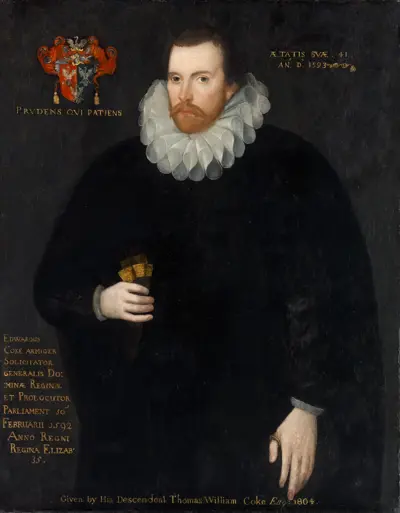
Sir Edward Coke SL was an English barrister, judge, and politician who is considered to be the greatest jurist of the Elizabethan and Jacobean eras.
