HENRY VIII
At the time there was no concept of serious separation of powers. For all practical purposes, the King ruled and he shared some of his powers with the Parliament. The next centuries in England would see the great battle for governmental power between the monarch and the Parliament. Today, the British monarch has no power but still retains a great deal of influence in England but largely because Queen Elisabeth is so well loved and respected.
He particularly had difficulty with the Pope and whose authority was supposed to be dominant in Europe. King Henry left the Catholic Church and made Protestantism the official English Church. It has been such ever since—all the result of a power struggle between two men.
The King assumed the role of head of the Church of England.
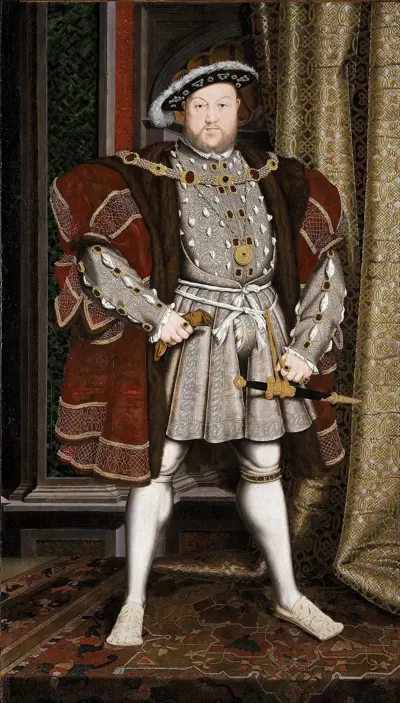
Henry VIII was King of England from 1509 until his death in 1547. Henry is best known for his six marriages, and, in particular, his efforts to have his first marriage (to Catherine of Aragon) annulled. His disagreement with Pope Clement VII about such an annulment led Henry to initiate the English Reformation, separating the Church of England from papal authority. He appointed himself Supreme Head of the Church of England and dissolved convents and monasteries, for which he was excommunicated. Henry is also known as "the father of the Royal Navy," as he invested heavily in the navy, increasing its size from a few to more than 50 ships, and established the Navy Board.
