Henry VIII Quotes
I have chief charge of you under God, both of your souls and bodies.
The King assumed the role of head of the Church of England.
Henry VIII, 1491-1547, King of England, 1533
Sourced by: Eigen's Political and Historical Quotations

There was a continuing power struggle between the more powerful kings of Europe and the Roman Catholic Pope. This struggle however was not one of church and state. Neither the kings nor the clergy viewed the two as separate domains. Instead they saw the two in much the same way as the ancient Jews and many contemporary Muslims view relationship—as an inseparable amalgam. However there was much debate over who could best protect and manage the amalgamated entity. In this case Alcuin was arguing that Charlemagne could ensure the well-being of the church better than the Pope. The power struggle went on for centuries between more or less able, powerful, and corrupt kings and popes.

Justinian, like many civil political leaders before and after him, took great pains to minimize the civil authority of the church. Separation of church and state is not a modern notion, though it was harder to accomplish in antiquity. Rulers would want to coopt the religion to help legitimize their rule, but tried to keep the church as weak as they could unless another religion was challenging for supremecy.


While he did not believe that clerics should engage in politics, he did believe that Islamic values and law should be embodied in the nation’s constitution and laws.


Magistrates included not only judges but mayors, governors and other Executive officials appointed by the King. The President of the United States is often referred to as the “Chief Magistrate”. At the time, Baptists taught that authorities were acting for God therefore must be obeyed.

William the Conqueror. This is one of the earliest government action separating some church functions from state functions.


It is this proclamation and others like it that caused many of the American Founding Fathers to include the doctrine of separation of church and state. In this case, and many others, the government actually proscribed and controlled the prayers and the liturgy. See {617532} where the government proscribes the proportion of revenues that must be spent on the poor.


Note that in addition to getting rid of the authority of the King, New York—over a decade before the Bill of Rights and the First Amendment, provided for a ban on an established church or favoring one Christian sect over another. Even then New York was a multi religious and multi ethnic society with its strong Dutch tradition along with the English tradition. New York did not go as far as the First Amendment would do later in terms of freedom of religion. NY only mentioned Christian sects. However they did implement separation of church and state and an establishment clause. See {621429} for another clause that ensures separation of church and state.

This was a very interesting quotation in that there was no scripture of any religion that even mentions the United States nor which nations would lead the world and which should follow.
The political control technique of establishing a religion where by God himself ordains the ruler was not unique to the Christians and Muslims. The technique was also used in the Inca Empire of Peru. The first Inca who came up with this creative theocratic concept did so in about 1200.


England had, under Henry VIII, left the Roman Catholic Church where the King replaced the Pope as head of the English Church. Henry’s successors then had to organize and manage the national Christian church. James was discussing the hierarchy of the Church of England and there was a suggestion that Bishops be eliminated and have every priest directly responsible to the crown. Bishops would be powerful figures who might form a power center. (They did later). However, King James I observed that the King is God’s choice and rules by divine right. So there had to be bishops to crown kings. The bishoprics were retained.

Williams was a minority voice throughout most of the world on this point. Even in modern times there are many civil and religious authorities do do not agree. The belief of God’s impotence and the need for the “sword of steel” seem so contradictory yet it persists even to modern times.
Sometimes referred to as Gaspar de Toledo. This quotation Illustrates one of the ways that Churches maintained power over the secular government even though they were supposedly separate. By maintaining control over the secular leaders consciences and sense of morality, the Church could control the secular government. In this particular historical case, there was not even a supposed separation. The Confessor had an ex officio role in the high council. See {629457}.
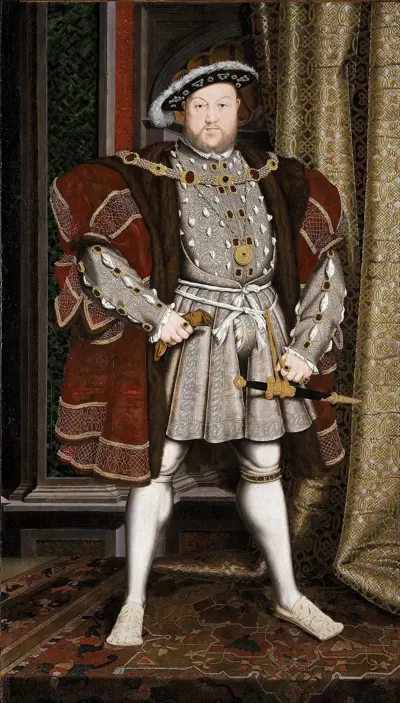
Henry VIII was King of England from 1509 until his death in 1547. Henry is best known for his six marriages, and, in particular, his efforts to have his first marriage (to Catherine of Aragon) annulled. His disagreement with Pope Clement VII about such an annulment led Henry to initiate the English Reformation, separating the Church of England from papal authority. He appointed himself Supreme Head of the Church of England and dissolved convents and monasteries, for which he was excommunicated. Henry is also known as "the father of the Royal Navy," as he invested heavily in the navy, increasing its size from a few to more than 50 ships, and established the Navy Board.
