William Laud Quotes
As you see the clergy to come nearer the alter than others, so remember, that in all places convenient, to give them greater honour; that the Mediator of God and man may establish you on a kingly throne.
Laud was then the Bishop of London.
William Laud, 1573-1645, English Archbishop of Canterbury, Statement to King Charles I as he coronated the king, 1625
Sourced by: Eigen's Political and Historical Quotations

In effect this was one of the earliest civil Blue Laws.

The early human idea that human rulers must somehow divine and/or designated and supported by the deity was present over many cultures and geographies.

Philip II, by this statement, and his subsequent behavior, made a major step forward in France for the separation of church and state. Previously, French kings played a major part in the selection of the bishops and other high clerics of the realm. Phillip ceased that type of interference. He did however, close down a religious commune for misbehavior, but that was at the request of both the church and civil authorities. See {617074} . The religious authorities at the time were delighted with this form of separation of church and state, but they were adamant that their church should be able to influence the monarchy and laws of the realm. In contrast today, the Chinese government does not allow any religion to interfere with the operation of the government, but insists that the Dali Lama and the Bishops of the Catholic church can only be appointed with their approval. Separation of church and state is a two way phenomenon.


Sometimes referred to as Gaspar de Toledo. This quotation Illustrates one of the ways that Churches maintained power over the secular government even though they were supposedly separate. By maintaining control over the secular leaders consciences and sense of morality, the Church could control the secular government. In this particular historical case, there was not even a supposed separation. The Confessor had an ex officio role in the high council. See {629457}.

The King assumed the role of head of the Church of England.

1st Viscount Bolingbroke. This is the argument that was and still is given by most theocracies and nations opposed to pluralism. It was also a quotation which with the American founders were familiar and were targeting this view when they demanded the 1st Amendment.

Gandhi was asked if the King had offered and encouragement for Indian Independence from England.


Clerics of the age were often combinations of fund raisers and tax collectors.


The Pope separates the church from the civil law to a degree that is a rarity amongst religions. Even Catholic Pope John Paul II who prohibited priests from holding political office always saw Papal and clerical influence on civil law making and interpretation as a fundamentally important role.

In 1980 Pope John Paul II issued a general order prohibiting priests from holding civil political positions. Many wondered whether Drinan, a marvelous and popular Congressman, would obey and leave Congress. He announced he was not going to seek election and his colleague immediately after his announcement asked him to share his thinking. This was his response.

Jefferson wrote his friend that the New England clergy had opposed him because he would block their efforts to merge church and state. Inscribed in the rotunda of the Jefferson Memorial in Washington DC. The third sentence is often quoted without the first two.


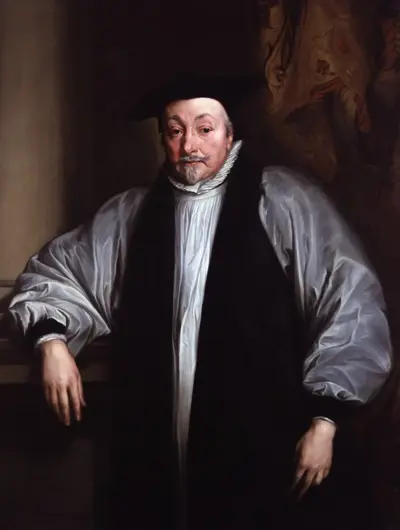
William Laud was a clergyman in the Church of England, appointed Archbishop of Canterbury by Charles I in 1633. A key advocate of Charles's religious reforms, he was arrested by Parliament in 1640, and executed towards the end of the First English Civil War in January 1645.
