Pope Shenouda III of Alexandria Quotes
Our duty as Clergymen is to guide people through the commandments of God. We have no power, nor any authority, to give or declare laws against the laws of God
The Pope separates the church from the civil law to a degree that is a rarity amongst religions. Even Catholic Pope John Paul II who prohibited priests from holding political office always saw Papal and clerical influence on civil law making and interpretation as a fundamentally important role.
Shenouda III, [Nazeer Gayed], 117th Coptic Pope of Alexandria and Patriarch of the See of St. Mark, Homosexuality And Ordination Of Women
Sourced by: Eigen's Political and Historical Quotations

Hizb ut-Tahrir is a “worldwide Islamic political party.” It is banned as a terrorist, violence provoking institution in most of the Muslim countries and many nations in Europe.


Justinian, like many civil political leaders before and after him, took great pains to minimize the civil authority of the church. Separation of church and state is not a modern notion, though it was harder to accomplish in antiquity. Rulers would want to coopt the religion to help legitimize their rule, but tried to keep the church as weak as they could unless another religion was challenging for supremecy.


The letter was written at the behest of the Archbishop of Canterbury. The quotation appears to ratify the Pope’s unlimited power, but in actuality carves out an exception whereby the Pope’s authority might be challenged in the future. Specifically, it claims the Pope has not the authority to alter that which “by the word of God, has eternal validity.” Politically, this position put the pope in a box. By arguing against the proposition, the Pope would have to maintain that he should have the right to alter the word of God that had eternal validity which no pope wanted to state. By not challenging the doctrine, there was an opening by which the pope’s omnipotence could be challenged in the future.


people for whom transfusions are proscribed Watchtower Bible and Tract Society of New York

While he did not believe that clerics should engage in politics, he did believe that Islamic values and law should be embodied in the nation’s constitution and laws.


This quotation, 500 years later, would be used by American anti-Catholics to justify their antipathy to the Catholic Church. This was about a most undemocratic statement about the common man and his capabilities which was completely counter to the American view. The fact that it was 500 years past or that many American Catholics did not believe it or that even if they did, it was restricted to matters of theological faith, was not considered by the Know-Nothings and others.

Philip II, by this statement, and his subsequent behavior, made a major step forward in France for the separation of church and state. Previously, French kings played a major part in the selection of the bishops and other high clerics of the realm. Phillip ceased that type of interference. He did however, close down a religious commune for misbehavior, but that was at the request of both the church and civil authorities. See {617074} . The religious authorities at the time were delighted with this form of separation of church and state, but they were adamant that their church should be able to influence the monarchy and laws of the realm. In contrast today, the Chinese government does not allow any religion to interfere with the operation of the government, but insists that the Dali Lama and the Bishops of the Catholic church can only be appointed with their approval. Separation of church and state is a two way phenomenon.

This is often referred to as the “prophetic mission.” This line appears on most Muslim coins and some monuments.


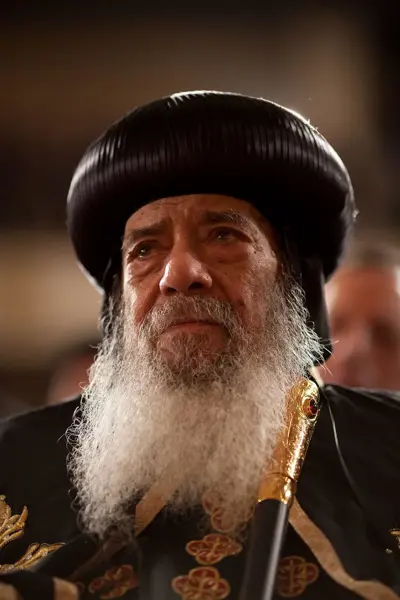
Pope Shenouda III was the 117th Pope of Alexandria and Patriarch of the See of St. Mark. His episcopate lasted 40 years, 4 months, and 4 days from 14 November 1971 until his death.
