John of Salisbury Quotes
Undoubtedly, to the Pope, all things are allowable ; that is, all things that belong by divine right to ecclesiastical authority. He is free to make new laws and to do away the old ones. Only it is not in his power to change anything which, by the word of God, has eternal validity.
The letter was written at the behest of the Archbishop of Canterbury. The quotation appears to ratify the Pope’s unlimited power, but in actuality carves out an exception whereby the Pope’s authority might be challenged in the future. Specifically, it claims the Pope has not the authority to alter that which “by the word of God, has eternal validity.” Politically, this position put the pope in a box. By arguing against the proposition, the Pope would have to maintain that he should have the right to alter the word of God that had eternal validity which no pope wanted to state. By not challenging the doctrine, there was an opening by which the pope’s omnipotence could be challenged in the future.
John of Salisbury, c. 1115-1180, English Ecclesiastic & Scholar, Letter to Pope Alexander III, Quoted in Augustus Neander, History of Christianity and the Church, 1851
Sourced by: Eigen's Political and Historical Quotations


This notice of Excommunication was promulgated to the Catholic clergy in Ireland in May of 1538. It required all Roman Catholic leaders to size the property of Protestants or Catholics who sympathized with them. Those who did were then regarded as traitors by the Protestant King. The anti-Protestant feeling culminated with the massacre of about 100 Protestants who were drowned in Bann a few years later.


This concept is not terribly different from the concept of the theocracy of the Islamic government of Iran in the 21st century. There is a civil government but it serves and is “under the direction of the spiritual power.”


The Holy Roman Emperor and the Pope were at odds. The Pope had issued an edict staking out the powers of the Pope. King Henry called a conclave of clerics and deposed Pope Leo VII. The Pope Excommunicated Henry and deposed him as king and emperor. Civil war ensued, and finally they reached a compromise and accommodation with each other." Saint Hildebrand


John Ilyitch Sergieff. The power of the leadership of organizations, religious and secular, has long been in contention. There are those who advocate the strong, very powerful executive such as Russia under the Czars and the Roman Catholic Church and those who prefer a weaker leader with very limited power such as the United States and the Russian Orthodox Church.

This was before the state had officially sanctioned and accepted the church. Most of the institutions were pagan and the kings had subjects of both religions with Christianity not yet dominant. Yet among Christians, the Church had government temporal power, even before the church was allied with the state.

King Henry VIII had left the Roman Catholic church and taken England and Ireland out also. He replaced the Pope as the head of the English and Irish churches. There was much opposition in Ireland and the priests were the most assertive opponents to the change and were still loyal to the Pope. Queen Elizabeth continued to have problems with the Priests. James I, Elizabeth’s successor, became fed up by the Roman Catholic Priests and therefor issued this Proclamation.

Wycliffe, although a Roman Catholic, was an early reformist. He not only opposed the Pope vis a vis King Edward of England, but he went against church doctrine and printed the first English Bible. He was burned at the stake.


His positions presaged some of those of Protestants in the Reformation. In the great struggle of the time between the Pope and the Emperor, Marsilius was the leading advocate for the emperor’s superiority of authority. The Pope wrote a condemnation of these ideas.


The Pope separates the church from the civil law to a degree that is a rarity amongst religions. Even Catholic Pope John Paul II who prohibited priests from holding political office always saw Papal and clerical influence on civil law making and interpretation as a fundamentally important role.

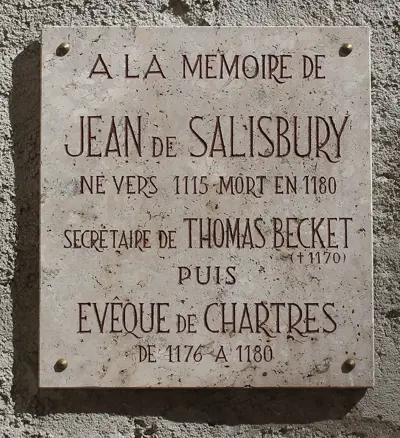
John of Salisbury, who described himself as Johannes Parvus ("John the Little"), was an English author, philosopher, educationalist, diplomat and bishop of Chartres.
