Innocent III Quotes
just as the moon derives its light from the sun and is indeed lower than it in quantity and quality, in position and in power, so too the royal power derives the splendor of its dignity from the pontifical authority...
Innocent III, ~1160-1216, Roman Catholic Pope, Letter to the Prefect Acerbius and the nobles of Tuscany, 1198
Sourced by: Eigen's Political and Historical Quotations

The letter was written at the behest of the Archbishop of Canterbury. The quotation appears to ratify the Pope’s unlimited power, but in actuality carves out an exception whereby the Pope’s authority might be challenged in the future. Specifically, it claims the Pope has not the authority to alter that which “by the word of God, has eternal validity.” Politically, this position put the pope in a box. By arguing against the proposition, the Pope would have to maintain that he should have the right to alter the word of God that had eternal validity which no pope wanted to state. By not challenging the doctrine, there was an opening by which the pope’s omnipotence could be challenged in the future.


The Christian Roman Empire was split in two—a Western (Latin) Empire led by the Roman Catholic Church in Rome, and the Eastern (Greek) Roman Empire led by the Orthodox Church headquartered in Constantinople (Byzantium). The two churches were not only in a theological conflict but violence broke out and the armies of the two religious empires attacked each other now and then. In 1439, leaders of the two versions of Christianity met in Florence, and they agreed to reunuion in which the Eastern Orthodox would again acknowledge the authority of the Pope. This was not a popular agreement with the majority of the Eastern Orthodox people and some of the clerical leadership. Constantine, realizing that he did not have pubic support at home for the end to the schism and the acceptance of the authority of the Pope, kept stalling on officially announcing and implementing the unity treaty. The Pope’s patience was wearing thin. Constantine did not adhere to ther treaty and the two churches have been apart ever since.


The Holy Roman Emperor and the Pope were at odds. The Pope had issued an edict staking out the powers of the Pope. King Henry called a conclave of clerics and deposed Pope Leo VII. The Pope Excommunicated Henry and deposed him as king and emperor. Civil war ensued, and finally they reached a compromise and accommodation with each other." Saint Hildebrand

This concept is not terribly different from the concept of the theocracy of the Islamic government of Iran in the 21st century. There is a civil government but it serves and is “under the direction of the spiritual power.”


This notice of Excommunication was promulgated to the Catholic clergy in Ireland in May of 1538. It required all Roman Catholic leaders to size the property of Protestants or Catholics who sympathized with them. Those who did were then regarded as traitors by the Protestant King. The anti-Protestant feeling culminated with the massacre of about 100 Protestants who were drowned in Bann a few years later.

The Vatican & the Chinese Communist Government had been at odds for years with much of the Chinese church going underground. Fr. Jin had been jailed for a decade. Then the government allowed him and the Catholic Church and operate openly, but there were still Vatican conflicts over numerous issues including the right of the Government to approve senior appointments of church officials—a privilege the church claimed exclusively. The Vatican ordered Jin not to cooperate and especially not to reopen the national theological seminary which the government had ordered closed. There had been no training for Chinese priests and Jin wanted to reopen the national theological seminary but the Vatican refused cooperation waiting for the government to capitulate to the Vatican’s various demands. Fr. Jin defied the Vatican & reopened the seminary. Without officially admitting their failed tactics, the Vatican let the discipline issue against Jin drop & the national theological seminary thrived.


This edict in effect divided up the New World between Spain and the other Catholic countries. The Pope wanted to avoid conflict among the Catholic powers of Europe. Shortly afterward, the Pope brokered a specific deal, The Treaty of Tordesillas, dividing exploration rights between Spain and Portugal. The Pope divided up the New World, land he had never visited, people he had never met, among Catholic European powers.
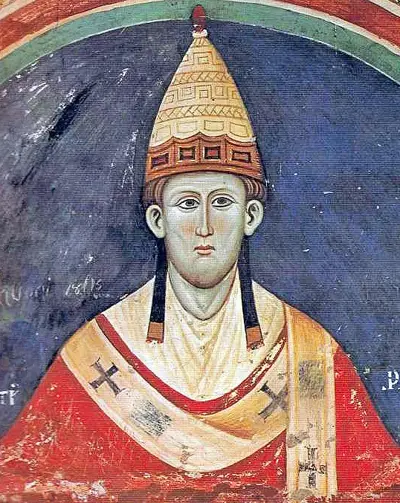
Pope Innocent III was the 176th Pope of the Catholic Church from 8 January 1198 to his death.
