Nicholas I Quotes
If you, with your nobles and the people of Constantinople accept the decree of union, you will find Us and Our venerable brothers, the cardinals of the Holy Roman Church, ever eager to support your honor and your empire. But if you and your people refuse to accept the decree, you will force Us to take such measures as are necessary for your salvation and Our honor.
The Christian Roman Empire was split in two—a Western (Latin) Empire led by the Roman Catholic Church in Rome, and the Eastern (Greek) Roman Empire led by the Orthodox Church headquartered in Constantinople (Byzantium). The two churches were not only in a theological conflict but violence broke out and the armies of the two religious empires attacked each other now and then. In 1439, leaders of the two versions of Christianity met in Florence, and they agreed to reunuion in which the Eastern Orthodox would again acknowledge the authority of the Pope. This was not a popular agreement with the majority of the Eastern Orthodox people and some of the clerical leadership. Constantine, realizing that he did not have pubic support at home for the end to the schism and the acceptance of the authority of the Pope, kept stalling on officially announcing and implementing the unity treaty. The Pope’s patience was wearing thin. Constantine did not adhere to ther treaty and the two churches have been apart ever since.
Nicholas I800-867, Roman Catholic Pope, Statement to Byzantium Emperor Constantine XI, ~1452
Sourced by: Eigen's Political and Historical Quotations

In this speech, and in {634756}, he argued against unification to a public that was mostly opposed. The leadership was interested because they were facing the Muslim Ottoman Turks who were getting more powerful each day. The Eastern Emperor, Constantine XI, more of a soldier and politician than a cleric, wanted the military strength of the Franks and other Western European Christian armies to help protect the Eastern Empire and Byzantium and were willing to reunite under the Pope to get it. Gennadios and his faction were not. They prevailed and the next year, the Muslims conquered Byzantium which had little help from the armies of the Western Roman Empire.
The Christian Roman Empire was split in two—a Western (Latin) Empire led by the Roman Catholic Church in Rome, and the Eastern (Greek) Roman Empire led by the Orthodox Church headquartered in Constantinople (Byzantium). The two churches were not only in a theological conflict but violence broke out and the armies of the two religious empires attacked each other now and then. In 1439, leader of the two versions of Christianity met in Florence, and they agreed to reunuion in which the Eastern Orthodox would again acknowledge the authority of the Pope. This was not a popular agreement with the majority of the Eastern Orthodox people and some of the clerical leadership including Gennadios who had dissented in 1439 and voted against unification. In this speech, and in {634755}, he argued against unification to a public that was mostly opposed. The leadership was interested because they were facing the Muslim Ottoman Turks who were getting more powerful each day. The Eastern Emperor, Constantine XI, more of a soldier and politician than a cleric, wanted the military strength of the Franks and other Western European Christian armies to help protect the Eastern Empire and Byzantium and were willing to reunite under the Pope to get it. Gennadios and his faction were not. They prevailed and the next year, the Muslims conquered Byzantium which had little help from the armies of the Western Roman Empire.

King Henry VIII had left the Roman Catholic church and taken England and Ireland out also. He replaced the Pope as the head of the English and Irish churches. There was much opposition in Ireland and the priests were the most assertive opponents to the change and were still loyal to the Pope. Queen Elizabeth continued to have problems with the Priests. James I, Elizabeth’s successor, became fed up by the Roman Catholic Priests and therefor issued this Proclamation.

The Vatican & the Chinese Communist Government had been at odds for years with much of the Chinese church going underground. Fr. Jin had been jailed for a decade. Then the government allowed him and the Catholic Church and operate openly, but there were still Vatican conflicts over numerous issues including the right of the Government to approve senior appointments of church officials—a privilege the church claimed exclusively. The Vatican ordered Jin not to cooperate and especially not to reopen the national theological seminary which the government had ordered closed. There had been no training for Chinese priests and Jin wanted to reopen the national theological seminary but the Vatican refused cooperation waiting for the government to capitulate to the Vatican’s various demands. Fr. Jin defied the Vatican & reopened the seminary. Without officially admitting their failed tactics, the Vatican let the discipline issue against Jin drop & the national theological seminary thrived.

The Roman Catholic Church then maintained that salvation was dependent upon obedience to the Pope in all things civil and religious. See {595166} for the way that the Church at the time allowed some authority to civil authorities.

Lotario de' Conti
The Christian world was in a great struggle with Islam. The Sultans were trying to take over Constantinople—the seat of the Eastern Orthodox Church. The Western Catholic Church in Rome also yearned for unification but under the Pope and his Cardinals. Notaraus feared them more than the Ottomans. Howeer, it was the latter who conquered Constantinople (Byzantium) in 1453 and executed the “first family” when Notaras would not deliver his children to Sultan Mehmet as hostages for assuring “good behavior” by the Greek community.
This began the Church's most notorious attack on any dissent or disagreement and it was the start of the Inquisition.
As a result of Henry VIII establishing himself as the head of the Church in England and Ireland in place of the Pope, Henry’s heirs also became head of the Church. And that was the role that Queen Elisabeth had inherited in addition to the Crown. Many of those loyal to the Pope found most offensive the fact that a woman was making decisions for men and women on matters of faith. A Papal representative travelled with FitzGerald and probably helped him compose this document of which this is but 2 sentences. He may have drafted it completely. The Pope was a factor in many of the Irish rebellions against the English, and this caused great suspicion of all English Catholics whose loyalty to the Queen was in conflict with their loyalty to the Pope who was plotting for a Catholic takeover of England and Ireland.


This quotation which appears on the surface to be simply a petulant Pope overreacting to some criticism about the church doctrine and custom of holy communion, was the trigger for one of the most momentous events in Western history—the schism between the Roman Catholic Church and the Eastern Orthodox Church." Bruno of Egisheim-Dagsburg (German)


The letter was written at the behest of the Archbishop of Canterbury. The quotation appears to ratify the Pope’s unlimited power, but in actuality carves out an exception whereby the Pope’s authority might be challenged in the future. Specifically, it claims the Pope has not the authority to alter that which “by the word of God, has eternal validity.” Politically, this position put the pope in a box. By arguing against the proposition, the Pope would have to maintain that he should have the right to alter the word of God that had eternal validity which no pope wanted to state. By not challenging the doctrine, there was an opening by which the pope’s omnipotence could be challenged in the future.


While Aquinas brought much wisdom and good to the Church, this statement and others laid a foundation for murdering non-believers and organizing the Inquisition.

Of all the Western Colonial Powers, Spain was the worst. They took the most from their possessions and contributed the least. Worst, they killed off almost all the indigenous people.


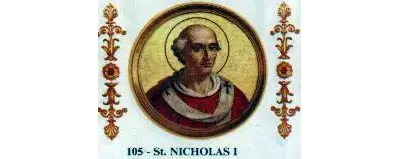
Nicholas I, called Nicholas the Great, was the bishop of Rome from 24 April 858 until his death. He is remembered as a consolidator of papal authority, exerting decisive influence on the historical development of the papacy and its position among the Christian nations of Western Europe. Nicholas I asserted that the pope should have suzerainty over all Christians, even royalty, in matters of faith and morals.
