Leo IX Quotes
You are said to have publicly condemned the Apostolic and Latin church, without either a hearing or a conviction. And the chef reason for this condemnation, which displays an unexampled presumption and unbelievable effrontery, is that the Latin church dares to celebrate the commemoration of the Lord's passion with unleavened bread. What an unguarded accusation is this of yours, what an evil piece of arrogance! You place your mouth in heaven while your tongue, going through the world, strives such human arguments and conjectures to undermine and subvert the ancient faith.
This quotation which appears on the surface to be simply a petulant Pope overreacting to some criticism about the church doctrine and custom of holy communion, was the trigger for one of the most momentous events in Western history—the schism between the Roman Catholic Church and the Eastern Orthodox Church." Bruno of Egisheim-Dagsburg (German)
Leo IX, 1002—1054, , Pope of the Roman Catholic Church, Message to the Byzantine Ecumenical Patriarch of Constantinople, Michael I Cerularius, ~1000 —1059, September 1053
Sourced by: Eigen's Political and Historical Quotations

The Christian Roman Empire was split in two—a Western (Latin) Empire led by the Roman Catholic Church in Rome, and the Eastern (Greek) Roman Empire led by the Orthodox Church headquartered in Constantinople (Byzantium). The two churches were not only in a theological conflict but violence broke out and the armies of the two religious empires attacked each other now and then. In 1439, leaders of the two versions of Christianity met in Florence, and they agreed to reunuion in which the Eastern Orthodox would again acknowledge the authority of the Pope. This was not a popular agreement with the majority of the Eastern Orthodox people and some of the clerical leadership. Constantine, realizing that he did not have pubic support at home for the end to the schism and the acceptance of the authority of the Pope, kept stalling on officially announcing and implementing the unity treaty. The Pope’s patience was wearing thin. Constantine did not adhere to ther treaty and the two churches have been apart ever since.

Whoever teaches differently from what I have taught, … condemns God and must remain a child of hell.
Humility and doubt were not characteristics of Martin Luther.

Olivi was a brilliant scholar who ran afoul of the religious authorities on several occasions. He was accused of being a heretic for his writings, but was exonerated after intensive trials and debates. In this quotation, he attributed the religious error of Jews and others, not to the anti-Christ, human venality, or even fault of character, but from a difference in human perspective. He was a pioneering original thinker, who while not well appreciated in his lifetime, had a significant cult following including several cardinals of The Church that arose after his death. However, other conservative forces then decided that he was a heretic after all. They burned his writings and destroyed his tomb. Today, there is a street in France named for him.


This sura is used by moderate Muslims showing that The Prophet was somewhat tolerant of those who even mock the word of Allah. Nonetheless, most fundamentalist Muslims believe that anyone who mocks the word of Allah or His Prophet should be killed. Muhammad said not to sit with them—his modern followers too often call it heresy and want to kill them.


Pope Innocent Iii was an interesting combination of primitive traditional Church inhumanity and intolerance for dissent and modern Christian views at the same time. Consider {45387} and {45384} for his proactive tolerance and protection of Jews and {45383} for his intolerance of Muslims and {45382} for his persecution of heretics.


He was officially hanged for his offence of making this statement on January 8, 1697. His execution, which raised considerable concern, was the last execution for blasphemy in Britain.
Luther’s attitude toward the Catholic mass was the main reason the Protestant churches abolished the mass.


King Henry VIII had left the Roman Catholic church and taken England and Ireland out also. He replaced the Pope as the head of the English and Irish churches. There was much opposition in Ireland and the priests were the most assertive opponents to the change and were still loyal to the Pope. Queen Elizabeth continued to have problems with the Priests. James I, Elizabeth’s successor, became fed up by the Roman Catholic Priests and therefor issued this Proclamation.
The Christian Roman Empire was split in two—a Western (Latin) Empire led by the Roman Catholic Church in Rome, and the Eastern (Greek) Roman Empire led by the Orthodox Church headquartered in Constantinople (Byzantium). The two churches were not only in a theological conflict but violence broke out and the armies of the two religious empires attacked each other now and then. In 1439, leader of the two versions of Christianity met in Florence, and they agreed to reunuion in which the Eastern Orthodox would again acknowledge the authority of the Pope. This was not a popular agreement with the majority of the Eastern Orthodox people and some of the clerical leadership including Gennadios who had dissented in 1439 and voted against unification. In this speech, and in {634755}, he argued against unification to a public that was mostly opposed. The leadership was interested because they were facing the Muslim Ottoman Turks who were getting more powerful each day. The Eastern Emperor, Constantine XI, more of a soldier and politician than a cleric, wanted the military strength of the Franks and other Western European Christian armies to help protect the Eastern Empire and Byzantium and were willing to reunite under the Pope to get it. Gennadios and his faction were not. They prevailed and the next year, the Muslims conquered Byzantium which had little help from the armies of the Western Roman Empire.
In this speech, and in {634756}, he argued against unification to a public that was mostly opposed. The leadership was interested because they were facing the Muslim Ottoman Turks who were getting more powerful each day. The Eastern Emperor, Constantine XI, more of a soldier and politician than a cleric, wanted the military strength of the Franks and other Western European Christian armies to help protect the Eastern Empire and Byzantium and were willing to reunite under the Pope to get it. Gennadios and his faction were not. They prevailed and the next year, the Muslims conquered Byzantium which had little help from the armies of the Western Roman Empire.

Samuel Langhorne Clemens, 1835-1910

While Aquinas brought much wisdom and good to the Church, this statement and others laid a foundation for murdering non-believers and organizing the Inquisition.


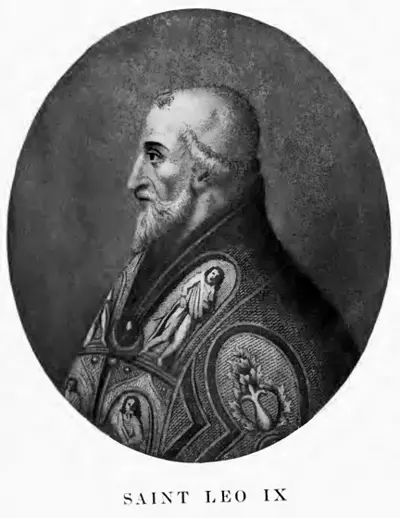
Pope Leo IX, born Bruno of Egisheim-Dagsburg, was the bishop of Rome and ruler of the Papal States from 12 February 1049 to his death in 1054. Leo IX is widely considered the most historically significant German pope of the Middle Ages; he was instrumental in the precipitation of the Great Schism of 1054, considered the turning point in which the Catholic and Eastern Orthodox Churches formally separated. He is venerated as a saint in the Catholic Church.
