Martin Luther Quotes
The Mass is the greatest blasphemy of God, and the highest idolatry upon earth, an abomination the like of which has never been in Christendom since the time of the Apostles.
Luther’s attitude toward the Catholic mass was the main reason the Protestant churches abolished the mass.
Martin Luther, 1483-1546, German Theologian & Founder of Protestantism, Table Talk
Sourced by: Eigen's Political and Historical Quotations

Whoever teaches differently from what I have taught, … condemns God and must remain a child of hell.
Humility and doubt were not characteristics of Martin Luther.

Pope Innocent Iii was an interesting combination of primitive traditional Church inhumanity and intolerance for dissent and modern Christian views at the same time. Consider {45387} and {45384} for his proactive tolerance and protection of Jews and {45383} for his intolerance of Muslims and {45382} for his persecution of heretics.

This statement in particular was extremely problematical. Sarbi is not just any old Mullah, but the Mufti of Jerusalem, on of the highest ranking Muslims in the World. This statement puts countries like Egypt and Jordan in a very difficult situation as the officials making treaties with the U. S. will be in effect excommunicated.

While Aquinas brought much wisdom and good to the Church, this statement and others laid a foundation for murdering non-believers and organizing the Inquisition.
Saint Benedicta was born and brought up as a Jew and converted to Catholicism. She and a few other leading German Catholics spoke out forcefully against Nazi crimes and immoralities. She was one of the few German Catholics who wanted the Pope to act more forcefully in Germany.

He had whipped the crowd up into a feverish pitch until someone rushed the bound and tied blacksmith and stabbed him to death. He had only criticized Mathias for being too harsh and stern a leader.

Constantine the Great. This is one of Constantine’s major defenses of his decision to adopt Christianity. Scholars today still argue as to what part practical politics played in Constantine’s conversion and what part was his personal religious conversion.

This edict gave great support to the Inquisitors of all Catholic countries. See {617572}
Saint Benedicta was born and brought up as a Jew and converted to Catholicism. She and a few other leading German Catholics spoke out forcefully against Nazi crimes and immoralities. She was one of the few German Catholics who wanted the Pope to act more forcefully in Germany. The most controversial aspect of the Pontificate of Pius XI was his relative silence and failure to use the powers of the church and excommunication to condemn and control the Nazi rise to power and their, aggression, discrimination, and atrocities including mass murders. The Pope did occasionally speak out condemning the worst of the German Nazi outrages to morality, but he did not do so very vigorously or order the German Cardinals and other bishops to do so. Supporters of Pius XI point out that the entire Catholic Church in Germany was in peril. The Nazis might have shut down their churches, jailed or murdered priests and seize church property. Many of the German Catholics, including the clergy, were Nazi party members or supporters, and he feared a political schism of German Catholics as well. And Italy, surrounding the Vatican was then under the control of the Italian Fascists who were allies of the Nazis, The Vatican itself and its staff were themselves vulnerable and could have been easily occupied. Apologists for Pius XI observe that the entire Church and its leadership could have been wiped out had they ignored the practicality that the Fascists were in control and would tolerate the Church just so far. Saint Teresa and other Catholics who were outspoken, along with the few Protestant Lutheran Clerics who opposed the Nazis, were indeed arrested and Saint Teresa was finally murdered at the Auschwitz concentration camp. Even that did not galvanize Pope Pius XI to assertive anti Nazi action. The records of the Vatican for that period have not been opened for public study so it is not known for sure that the Pope even saw Saint Teresa’s letter or it was intercepted by the strong pro Nazi faction in the Vatican. That year, Pius signed a Concordat (agreement) with the Nazi Government which many in the Vatican naively believed would control and limit the worst of the Nazi actions. But by 1937, Pius condemned the “violations” of the Concordat and Nazi anti-Semitism as well (encyclical written in German, Mit brennender Sorge (With Burning Anxiety). His critics observe that he went no further, even with the Catholic Nazi clerics and other Catholics. The Carmelite order tried to protect Saint Teresa who was then just a non and leading Catholic intellectual (she had a PhD in philosophy) by sending her to a Carmelite facility in Holland. But the Germans overran the Netherlands, arrested her and sent her to Auschwitz where she was martyred. She was beatified by Pope John Paul II in 1987.


Oliver Cromwell’s Puritan Parliament was opposed to the celebration of Christmas on religious grounds. See {629849} for more on the Puritans and Christmas. Generally, it was the Catholics who celebrated Christmas and typically they had a Christmas Mass. The anti-Catholic bias was so great that the Pope was often accused of being the Anti-Christ - a terrible insult.

Samuel Langhorne Clemens, 1835-1910


See {639434}, {639436}, and {639437} for the triggers to this report.


This quotation which appears on the surface to be simply a petulant Pope overreacting to some criticism about the church doctrine and custom of holy communion, was the trigger for one of the most momentous events in Western history—the schism between the Roman Catholic Church and the Eastern Orthodox Church." Bruno of Egisheim-Dagsburg (German)

Michael Servetus, 1511-1553, a Spanish theologian, was tried and burned at the stake in Switzerland. John Calvin drew up the charges and pronounced the sentence. However his ill health prevented him from personally officially reading the charges. De la Fontaine did it in his stead. Most people are familiar with the charges of questioning the doctrine of the Trinity. However, before those there were a series of more civilly oriented charges of which sever are given herein. Note the emphasis on his book. It was found do offensive that it was burned along with Servetus. See related quote.
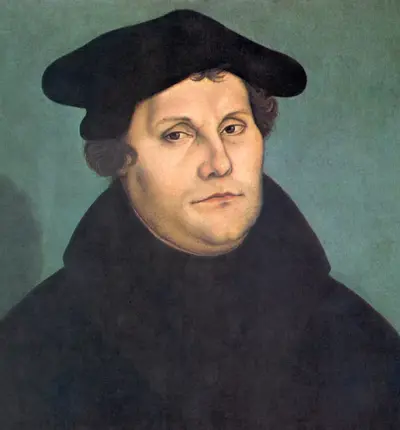
Martin Luther, O.S.A. was a German professor of theology, priest, author, composer, Augustinian monk, and a seminal figure in the Reformation. Luther was ordained to the priesthood in 1507. He came to reject several teachings and practices of the Roman Catholic Church; in particular, he disputed the view on indulgences. Luther proposed an academic discussion of the practice and efficacy of indulgences in his Ninety-five Theses of 1517. His refusal to renounce all of his writings at the demand of Pope Leo X in 1520 and the Holy Roman Emperor Charles V at the Diet of Worms in 1521 resulted in his excommunication by the pope and condemnation as an outlaw by the Holy Roman Emperor.
