Frederick the Great Quotes
All heretics who continue obstinate, should be burnt. All heretics who repented, should be imprisoned for life.
This edict gave great support to the Inquisitors of all Catholic countries. See {617572}
Frederic II, 1194-1250, Holy Roman Emperor & King of Jerusalem, Leader of the 6th Crusade, 1244, Quoted in John Foxe, Book of Martyrs
Sourced by: Eigen's Political and Historical Quotations

See {617571} for his edicts which aided the Inquisitors.

The King, a religious exremist fanatic, was a great supporter of the Inquisition whose excesses were horrible during his reign.

While Aquinas brought much wisdom and good to the Church, this statement and others laid a foundation for murdering non-believers and organizing the Inquisition.


It is this verse that for some Muslims justifies terrorism against non-Muslims. See {584354} for a specific example. There are similar provisions in the Old Testament which a few extremely conservative Jews and Christians have used to advocate for blasphemy being a capital crime. Note that if an unbeliever repents and becomes a Muslim, he should be spared.
Since Muslims try and convert others, one who changes religion and becomes a Muslim is exempt. The death penalty is reserved for Muslims who leave the religion.

At the time Islam was quite conflicted about the role of innovation, science and reform. Innovators were to many theologians as dangerous to society as heretics and had to be refuted. Al-Ashari’s school of thought has prevailed in much of the Muslim world to this day.

This was the beginning of the inquisition.
The church was in constant roil with the Bishops, the Pope and the Holy Roman Emperor each striving for superiority over the other two, almost like branches of government fighting for power. This was the bishops attempt to “impeach” the Holy Roman Emperor who was never charged or given an opportunity to face or refute the charges. He was not even present at the Council. See {611260} for his reply.

The King, a religious fanatic, was a great supporter of the Inquisition whose excesses were even more horrible during his reign than others.

Michael Servetus, 1511-1553, a Spanish theologian, was tried and burned at the stake in Switzerland. John Calvin drew up the charges and pronounced the sentence. However his ill health prevented him from personally officially reading the charges. De la Fontaine did it in his stead. Most people are familiar with the charges of questioning the doctrine of the Trinity. However, before those there were a series of more civilly oriented charges of which sever are given herein. Note the emphasis on his book. It was found do offensive that it was burned along with Servetus. See related quote.
This statement in particular was extremely problematical. Sarbi is not just any old Mullah, but the Mufti of Jerusalem, on of the highest ranking Muslims in the World. This statement puts countries like Egypt and Jordan in a very difficult situation as the officials making treaties with the U. S. will be in effect excommunicated.

Bashir advocates adapting Sharia—Islamic Law—for all people in Indonesia—regardless of their religion or their preference for separation of church and state. This is diametrically opposite to an Islamic Syrian poet of 1000 years ago—see {624477}. Many Muslims have become more intolerant than some of their earlier scholars. Bashir also differs from most Indonesian Muslims who have historically not shared his bigotry and intolerance.
The Prophet Muhammad when he was the spiritual and civil leader never called for the death of anyone who insulted him. This is strictly a mania of extremist followers of Islam. However, it should be kept in mind that the Roman Catholic Church in its history murdered people for insulting the Pope or Jesus. It all stems from the Old Testament call for the execution of heretics and blasphemers.

Ingersoll was considered to be the greatest orator and political thinker of his day, but his overt atheistic views curtailed his elected political career.

He had whipped the crowd up into a feverish pitch until someone rushed the bound and tied blacksmith and stabbed him to death. He had only criticized Mathias for being too harsh and stern a leader.
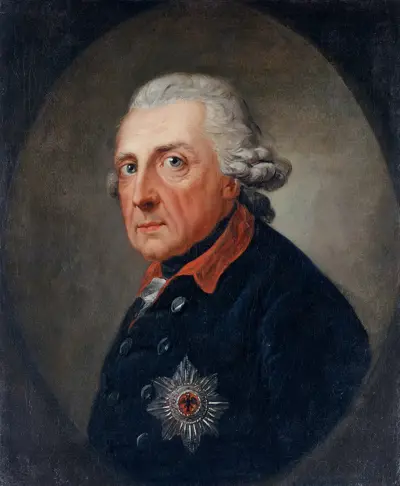
- Born: January 24, 1712
- Died: August 17, 1786
- Nationality: English
- Profession: Poet
Frederick II was a Prussian king and military leader who ruled the Kingdom of Prussia from 1740 until 1786, reigning longer than any other Hohenzollern king. His most significant accomplishments during his reign included his reorganization of Prussian armies, his military successes in the Silesian wars and the Partitions of Poland, and his patronage of the arts and the Enlightenment. Frederick was the last Hohenzollern monarch titled King in Prussia and declared himself King of Prussia after annexing strategic parts of the Polish–Lithuanian Commonwealth in 1772. Prussia greatly increased its territories and became a leading military power in Europe under his rule. He became known as Frederick the Great (German: Friedrich der Große) and was nicknamed "The Old Fritz" (German: "Der Alte Fritz") by the Prussian people and eventually the rest of Germany.
