Innocent III Quotes
The corruption of the people has its chief source in the clergy. From this arise the evils of Christendom: faith perishes, religion is defaced, liberty is restricted, justice is trodden under foot, the heretics multiply, the schismatics are emboldened, the faithless grow strong, the Saracens are victorious.
Lotario de' Conti
Innocent III, ~1161-1216, Roman Catholic Pope, Quoted in Henry Charles Lea, A History of the Inquisition of the Middle Ages, 1888
Sourced by: Eigen's Political and Historical Quotations


The Christian Roman Empire was split in two—a Western (Latin) Empire led by the Roman Catholic Church in Rome, and the Eastern (Greek) Roman Empire led by the Orthodox Church headquartered in Constantinople (Byzantium). The two churches were not only in a theological conflict but violence broke out and the armies of the two religious empires attacked each other now and then. In 1439, leaders of the two versions of Christianity met in Florence, and they agreed to reunuion in which the Eastern Orthodox would again acknowledge the authority of the Pope. This was not a popular agreement with the majority of the Eastern Orthodox people and some of the clerical leadership. Constantine, realizing that he did not have pubic support at home for the end to the schism and the acceptance of the authority of the Pope, kept stalling on officially announcing and implementing the unity treaty. The Pope’s patience was wearing thin. Constantine did not adhere to ther treaty and the two churches have been apart ever since.


While Aquinas brought much wisdom and good to the Church, this statement and others laid a foundation for murdering non-believers and organizing the Inquisition.


In this speech, and in {634756}, he argued against unification to a public that was mostly opposed. The leadership was interested because they were facing the Muslim Ottoman Turks who were getting more powerful each day. The Eastern Emperor, Constantine XI, more of a soldier and politician than a cleric, wanted the military strength of the Franks and other Western European Christian armies to help protect the Eastern Empire and Byzantium and were willing to reunite under the Pope to get it. Gennadios and his faction were not. They prevailed and the next year, the Muslims conquered Byzantium which had little help from the armies of the Western Roman Empire.
Pope Innocent Iii was an interesting combination of primitive traditional Church inhumanity and intolerance for dissent and modern Christian views at the same time. Consider {45387} and {45384} for his proactive tolerance and protection of Jews and {45383} for his intolerance of Muslims and {45382} for his persecution of heretics.

5th Earl of Montrose. The public reaction to a new prayer book issued by the King and created by the King’s religious appointees. Although Protestant in nature, it was created without the early Scottish Protestant tradition of consultation with many levels of clergy and society. It was seen as authoritarian and much like the Catholic mass which was proscribed by Rome. The National Covenant was a document of protest. It was first drafted by Alexander Henderson and Johnston of Wariston, and signed by others, but Montrose was the first signer and the acknowledged leader of the Covenanters.


Many of the Church wanted Wycliff excommunicated, but the King and Parliament seemed to like his writing and sermons. So he was protected in his lifetime. He died at the age of 60 of a stroke. After his death the Church burned all his books that had been banned, and exhumed his body. That was burned at the stake and his ashes scattered in a river. Martin Luther did not try to reform the Church in a vacuum. There had been various critics of the Church before Luther and Wycliff was one. The last statement in this quotation was the one that really hit the then mostly corrupt clergy where it hurt.


The King, a religious exremist fanatic, was a great supporter of the Inquisition whose excesses were horrible during his reign.

The struggle in the Catholic Church reached an amazing state. Just after a new pope, Martin V, had been elected the Council of Bishops at Constance came up with this notion which placed their views above those of the Pope under the theory that this particular council derived its power and authority directly from Christ while the pope was only God’s “vicar on earth.” The struggle was somewhat akin to the inevitable struggle for power between an executive branch and a legislative branch. The Council’s ascendancy didn’t last very long and was repudiated by successive popes.

John Ilyitch Sergieff. Issues of civil and religious freedom have caused schisms and hostility between different religions.

The Roman Catholic Clergy as well as the Vatican was quite corrupt in Luther’s time which was one of the reasons for his reform effort. Throughout history some clerics have abused their positions and roles and acted as impediments to the faith in their own religions.
Luther’s attitude toward the Catholic mass was the main reason the Protestant churches abolished the mass.

Bashir advocates adapting Sharia—Islamic Law—for all people in Indonesia—regardless of their religion or their preference for separation of church and state. This is diametrically opposite to an Islamic Syrian poet of 1000 years ago—see {624477}. Many Muslims have become more intolerant than some of their earlier scholars. Bashir also differs from most Indonesian Muslims who have historically not shared his bigotry and intolerance.

This notice of Excommunication was promulgated to the Catholic clergy in Ireland in May of 1538. It required all Roman Catholic leaders to size the property of Protestants or Catholics who sympathized with them. Those who did were then regarded as traitors by the Protestant King. The anti-Protestant feeling culminated with the massacre of about 100 Protestants who were drowned in Bann a few years later.


He was persecuted by the Roman Catholic Church for figuring out that the earth revolved around the sun which was contrary to church teaching at the time.
The Church exercised the law enforcement and censorship authority in all Catholic countries. Note the offense of saying anything which is “offensive to pious ears”. The particular example that “offended” the pious was that a heretic should not be executed. These were the cultural values of the day.
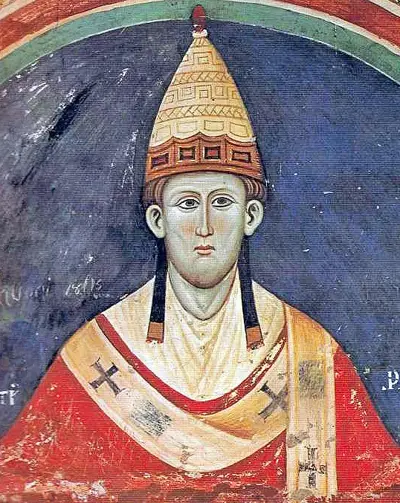
Pope Innocent III was the 176th Pope of the Catholic Church from 8 January 1198 to his death.
