Paul III Quotes
I do further declare him or her, father or mother, brother or sister, son or daughter, husband or wife, uncle or aunt, nephew or niece, kinsman or kinswoman, master or mistress, and all others, nearest or dearest relations, friend or acquaintance whatsoever, accursed, that either do or shall hold, for the time to come, any ecclesiastical or civil power above the authority of the Mother Church; or that do or shall obey, for the time to come, any of her, the Mother of Churches' opposers or enemies
This notice of Excommunication was promulgated to the Catholic clergy in Ireland in May of 1538. It required all Roman Catholic leaders to size the property of Protestants or Catholics who sympathized with them. Those who did were then regarded as traitors by the Protestant King. The anti-Protestant feeling culminated with the massacre of about 100 Protestants who were drowned in Bann a few years later.
Paul III, 1468-1549, [Alessandro Farnese], Roman Catholic Pope, Papal Bull of Excommunication, 1538
Sourced by: Eigen's Political and Historical Quotations


The letter was written at the behest of the Archbishop of Canterbury. The quotation appears to ratify the Pope’s unlimited power, but in actuality carves out an exception whereby the Pope’s authority might be challenged in the future. Specifically, it claims the Pope has not the authority to alter that which “by the word of God, has eternal validity.” Politically, this position put the pope in a box. By arguing against the proposition, the Pope would have to maintain that he should have the right to alter the word of God that had eternal validity which no pope wanted to state. By not challenging the doctrine, there was an opening by which the pope’s omnipotence could be challenged in the future.

King Henry VIII had left the Roman Catholic church and taken England and Ireland out also. He replaced the Pope as the head of the English and Irish churches. There was much opposition in Ireland and the priests were the most assertive opponents to the change and were still loyal to the Pope. Queen Elizabeth continued to have problems with the Priests. James I, Elizabeth’s successor, became fed up by the Roman Catholic Priests and therefor issued this Proclamation.


The Holy Roman Emperor and the Pope were at odds. The Pope had issued an edict staking out the powers of the Pope. King Henry called a conclave of clerics and deposed Pope Leo VII. The Pope Excommunicated Henry and deposed him as king and emperor. Civil war ensued, and finally they reached a compromise and accommodation with each other." Saint Hildebrand


In effect, the English Parliament replaced the Pope as head of the Catholic church in Ireland with King Henry the VIII. He had already become the head of the Church in England when the Pope refused to grant him the right of divorce so that he could marry Anne Boleyn, The Irish clergy and many Irishman were aghast. They were instructed to erase the Pope from their literature {639436}. They were even more distressed when the English Royal Commission recommended the closing of all Irish monasteries. See {639434}.


This concept is not terribly different from the concept of the theocracy of the Islamic government of Iran in the 21st century. There is a civil government but it serves and is “under the direction of the spiritual power.”


The Roman Catholic Church in America had a very difficult problem with slavery. Catholics were themselves a minoirty, hated and distrusted by many Protestants. In most of the country, the distrusr was based on their large immigrant population, but in the South Catholic theology was hated and the Vatican and Pope were particular targets. The Catholic Clergy generally did not want to take sides in the most contentious issue in America since its inception. The Southern Catholic Clergy did not have that option as in the South, anyone who was not a supporter of slavery was an "enemy of the community and subject to all kinds of violence." Some Southern priests were willing to take the personal risk but did not want to put their followers at risk. In a strange consequence, Catholics--especially Irish Catholics--fought on both sides of the Civil War and often against each other. While it was not an exemplary moral behavior for the Church, there were difficult pressures on Catholic leaders. Further, most of the lowest and most difficult, undesirable jobs were filled by Catholics and most Catholic laymen so and end to slavery as the start of pitting the Catholics against the Blacks. So there was not a groundswell for abolition in most Catholic parishes even in the North.


The Vatican & the Chinese Communist Government had been at odds for years with much of the Chinese church going underground. Fr. Jin had been jailed for a decade. Then the government allowed him and the Catholic Church and operate openly, but there were still Vatican conflicts over numerous issues including the right of the Government to approve senior appointments of church officials—a privilege the church claimed exclusively. The Vatican ordered Jin not to cooperate and especially not to reopen the national theological seminary which the government had ordered closed. There had been no training for Chinese priests and Jin wanted to reopen the national theological seminary but the Vatican refused cooperation waiting for the government to capitulate to the Vatican’s various demands. Fr. Jin defied the Vatican & reopened the seminary. Without officially admitting their failed tactics, the Vatican let the discipline issue against Jin drop & the national theological seminary thrived.
The Roman Catholic Church then maintained that salvation was dependent upon obedience to the Pope in all things civil and religious. See {595166} for the way that the Church at the time allowed some authority to civil authorities.

His response was to being asked whether he could do something with Russian Catholics to help Laval win favor with the Pope, to counter the increasing threat of Nazism. This quotation is often used as an example of Stalin’s disrespect for the Papacy. However, in this case, the Pope was extremely weak politically and some argue spiritually for he did not oppose Hitler and the Nazis very much. Defenders of the Papacy argue that Hitler had overwhelming force and little respect for the Pope, and ironically this was what Stain was referring to. Ironically, another Pope, John Paul, had a major part in bring down the Soviet Union and he had no divisions.

This was before the state had officially sanctioned and accepted the church. Most of the institutions were pagan and the kings had subjects of both religions with Christianity not yet dominant. Yet among Christians, the Church had government temporal power, even before the church was allied with the state.


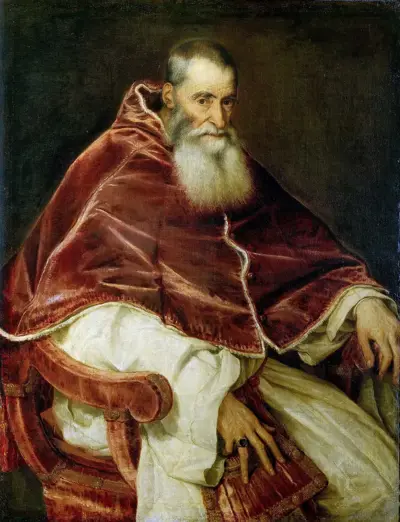
Pope Paul III, born Alessandro Farnese, was head of the Catholic Church and ruler of the Papal States from 13 October 1534 to his death in 1549.
