Martin Luther Quotes
The Romanists have, with great adroitness, drawn three walls round themselves, with which they have hitherto protected themselves, so that no one could reform them, whereby all Christendom has fallen terribly. Firstly, if pressed by the temporal power, they have affirmed and maintained that the temporal power has no jurisdiction over them, but, on the contrary, that the spiritual power is above the temporal. Secondly, if it were proposed to admonish them with the Scriptures, they objected that no one may interpret the Scriptures but the Pope. Thirdly, if they are threatened with a council, they pretend that no one may call a council but the Pope.
Martin Luther, 1483-1546, German Theologian & Founder of Protestantism, Address To The Nobility of the German Nation, 1520
Sourced by: Eigen's Political and Historical Quotations

This notice of Excommunication was promulgated to the Catholic clergy in Ireland in May of 1538. It required all Roman Catholic leaders to size the property of Protestants or Catholics who sympathized with them. Those who did were then regarded as traitors by the Protestant King. The anti-Protestant feeling culminated with the massacre of about 100 Protestants who were drowned in Bann a few years later.


5th Earl of Montrose. The public reaction to a new prayer book issued by the King and created by the King’s religious appointees. Although Protestant in nature, it was created without the early Scottish Protestant tradition of consultation with many levels of clergy and society. It was seen as authoritarian and much like the Catholic mass which was proscribed by Rome. The National Covenant was a document of protest. It was first drafted by Alexander Henderson and Johnston of Wariston, and signed by others, but Montrose was the first signer and the acknowledged leader of the Covenanters.


His response was to being asked whether he could do something with Russian Catholics to help Laval win favor with the Pope, to counter the increasing threat of Nazism. This quotation is often used as an example of Stalin’s disrespect for the Papacy. However, in this case, the Pope was extremely weak politically and some argue spiritually for he did not oppose Hitler and the Nazis very much. Defenders of the Papacy argue that Hitler had overwhelming force and little respect for the Pope, and ironically this was what Stain was referring to. Ironically, another Pope, John Paul, had a major part in bring down the Soviet Union and he had no divisions.

The King had earlier replaced the Pope as the head of the English church. The references to money referred to a then common corruption of the Church whereby people could buy indulgences—religious papal pardons of past or future sins. This was a major revenue source for the Vatican and a major issue for Martin Luther and the Protestant Reformers some of who saw the pope as the Devil incarnate See {623153}. For Martin Luther’s view pf the practice and {626720}, {595195}, and {639436} for other contemporary views.

This quotation illustrates how much of an egomaniac Hitler was. Here, he had achieved almost nothing in his life very significant yet, and he compared his points to those of the founder of Protestantism when Martin Luther nailed his points to the doors of the Roman Catholic Church in Wittenberg. For a short time, they actually became more important to Germans that the points of Luther, but that didn’t last very long, and Germany has reformed itself and Luther’s points are well remembered, and Hitler’s are only studied by scholars interested in the history of the period and the Nazi era—the most tragic in German history.


The struggle in the Catholic Church reached an amazing state. Just after a new pope, Martin V, had been elected the Council of Bishops at Constance came up with this notion which placed their views above those of the Pope under the theory that this particular council derived its power and authority directly from Christ while the pope was only God’s “vicar on earth.” The struggle was somewhat akin to the inevitable struggle for power between an executive branch and a legislative branch. The Council’s ascendancy didn’t last very long and was repudiated by successive popes.

Lotario de' Conti

This is a classic example of institutional reluctance to examine history in the light and morality of the present. Nations have difficulties coming to grips with their pasts just as Churches and other institutions do.


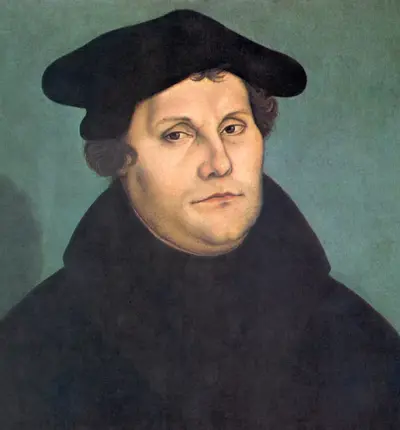
Martin Luther, O.S.A. was a German professor of theology, priest, author, composer, Augustinian monk, and a seminal figure in the Reformation. Luther was ordained to the priesthood in 1507. He came to reject several teachings and practices of the Roman Catholic Church; in particular, he disputed the view on indulgences. Luther proposed an academic discussion of the practice and efficacy of indulgences in his Ninety-five Theses of 1517. His refusal to renounce all of his writings at the demand of Pope Leo X in 1520 and the Holy Roman Emperor Charles V at the Diet of Worms in 1521 resulted in his excommunication by the pope and condemnation as an outlaw by the Holy Roman Emperor.
