Council of Constance Quotes
This … legitimately assembled in the Holy Ghost, forming a general council and representing the Catholic Church militant, has its power immediately from Christ, and every one, whatever his state or position, even if it be the Papal dignity itself, is bound to obey it in all those things which pertain to the faith and the healing of the said schism, and to the general reformation of the Church of God … It further declares that any one, whatever his condition, station or rank, even if it be the Papal, who shall contumaciously refuse to obey the mandates, decrees, ordinances or instructions which have been, or shall be issued by this holy council, or by any other general council, legitimately summoned, which concern, or in any way relate to the above mentioned objects, shall, unless he repudiate his conduct, be subject to condign penance and be suitably punished, having recourse, if necessary, to the other resources of the law...
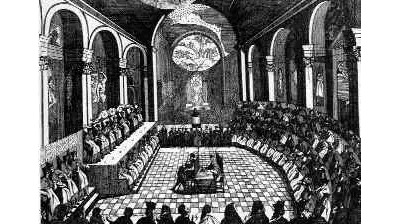
The struggle in the Catholic Church reached an amazing state. Just after a new pope, Martin V, had been elected the Council of Bishops at Constance came up with this notion which placed their views above those of the Pope under the theory that this particular council derived its power and authority directly from Christ while the pope was only God’s “vicar on earth.” The struggle was somewhat akin to the inevitable struggle for power between an executive branch and a legislative branch. The Council’s ascendancy didn’t last very long and was repudiated by successive popes.
Council of Constance, Sacrosancta, 1415
Sourced by: Eigen's Political and Historical Quotations

At the time there was no pope. Before an election for one was held, all the electors made the collective oath and promise to maintain the idea of a council of clerics if he were elected Pope. After the Pope was elected, the bishops solidified their power even claiming ascendancy and authority, when assembled, over the Pope. See the Council of Constance {610980} 6 years later.


He was the only English Pope. This was the authority that enabled English King Henry II to invade Ireland. Many historians consider it the beginning of the problems between the Ireland and England which persists to this day. See {610520}. Some scholars think that this bull was a forgery stating that the writing style was different from other bulls of Adrian IV. Opponents believe that a change in secretaries could easily have accounted for the difference.

The Roman Catholic Church then maintained that salvation was dependent upon obedience to the Pope in all things civil and religious. See {595166} for the way that the Church at the time allowed some authority to civil authorities.


The Holy Roman Emperor and the Pope were at odds. The Pope had issued an edict staking out the powers of the Pope. King Henry called a conclave of clerics and deposed Pope Leo VII. The Pope Excommunicated Henry and deposed him as king and emperor. Civil war ensued, and finally they reached a compromise and accommodation with each other." Saint Hildebrand
Despite his recognition of this point, he too became an advocate of murdering religious opponents.

There was a schism in the Catholic Church. Based on the “flawed” election described by the protesting Cardinals herein, the Revolting Cardinals had their own election, selecting Robert of Geneva--Clement VII, and moved their papacy to Avignon, France where they built a fortress that the mob could not storm. For years there were two Popes and two sets of Cardinals fighting it out.

Lotario de' Conti
Ceremonialists refer to Roman Catholics.

Pen name: Jack Nipps

The use of “despotic” did not imply cruelty or even poor management of the society. The term was used to indicate that Brigham Young, the then Mormon Leader, had the powers and authority of a dictator. At the time most Americans in the East knew little about the Mormons. Ludlow was one of the early observers of Mormon society in Utah who wrote about the Mormons in popular—albeit intellectual—magazines. Ludlow regarded Mormonism as it was then practiced as incompatible with, and dangerous for, America, not because of the plural marriage, but the conflicts with the concepts of democracy and self-government. The authority that Brigham Young and the church then exercised over civil life was what distressed him and many other Americans.


- Born:
- Nationality:
- Profession:
The Council of Constance was a 15th-century ecumenical council recognized by the Catholic Church, held from 1414 to 1418 in the Bishopric of Constance in present-day Germany. The council ended the Western Schism by deposing or accepting the resignation of the remaining papal claimants and by electing Pope Martin V.
