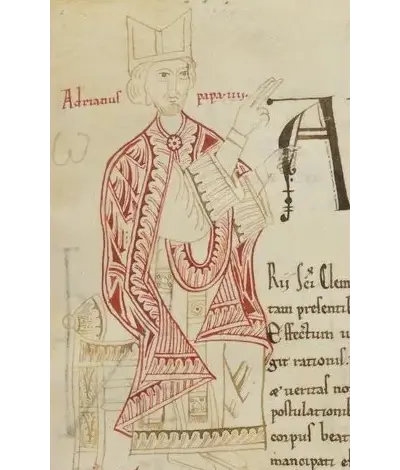
Adrian IV Quotes
Thou hast signified to us, indeed, most beloved son in Christ, that thou dost desire to enter into the island of Ireland, in order to subject the people to the laws and to extirpate the vices that have there taken root, and that thou art willing to pay an annual pension to St. Peter of one penny from every house, and to preserve the rights of the churches in that land inviolate and entire. We, therefore, seconding with the favor it deserves thy pious and laudable desire, and granting a benignant assent to thy petition, are well pleased that, for the enlargement of the bounds of the church. for the restraint of vice, for the correction of morals and the introduction of virtues, for the advancement of the Christian religion, thou shouldst enter that island, and carry out there the things that look to the honor of God and to its own salvation. And may the people of that land receive thee with honor, and venerate thee as their master; provided always that the rights of the churches remain inviolate and entire, and saving to St. Peter and the holy Roman Church the annual pension of one penny from each house. If, therefore, thou dost see fit to complete what thou hast conceived in thy mind, strive to imbue that people with good morals, and bring it to pass, as well through thyself as through those whom thou dost know from their faith, doctrine, and course of life to be fit for such a work, that the church may there be adorned, the Christian religion planted and made to grow, and the things which pertain to the honour of God and to salvation be so ordered that thou may'st merit to obtain an abundant and lasting reward from God, and on earth a name glorious throughout the ages.
He was the only English Pope. This was the authority that enabled English King Henry II to invade Ireland. Many historians consider it the beginning of the problems between the Ireland and England which persists to this day. See {610520}. Some scholars think that this bull was a forgery stating that the writing style was different from other bulls of Adrian IV. Opponents believe that a change in secretaries could easily have accounted for the difference.
Adrian IV, ~1100-1159, [Nicholas Breakspear], Roman Catholic Pope, Papal Bull, 1155
Sourced by: Eigen's Political and Historical Quotations
He was the only English Pope. The act of invasion had been sanctified earlier in Adrian’s Papal Bull. See {610518}. Henry’s invasion was successful but the occupation and reform was a disaster which has ramifications to this day.
There are some who question the authenticity of this Bull. However, its existence was supported by John of Salisbury who claimed to be the emissary who arranged the Bull. See {611696}. However, those who are shocked that the Pope could have been so crass as to “give” a country to Henry II for money have claimed that the writing of John was also a forgery,
Note the fact that the Vatican received a “fee” for in effect giving Ireland to Heny II. There are some people who doubt the authenticity of this particular bull. They argue that the English domination of Ireland was never sanctioned by the Church. Supporters of the authenticity however have the majority of the arguments. There are several Papal documents that refer to a Papal Bull sent to England’s king on the subject of Ireland. The “deal” with the cut for the church and the guarantee of church property was typical of deals made at the time. And there are copies of the bull that have been preserved (the original has never been found.)
The struggle in the Catholic Church reached an amazing state. Just after a new pope, Martin V, had been elected the Council of Bishops at Constance came up with this notion which placed their views above those of the Pope under the theory that this particular council derived its power and authority directly from Christ while the pope was only God’s “vicar on earth.” The struggle was somewhat akin to the inevitable struggle for power between an executive branch and a legislative branch. The Council’s ascendancy didn’t last very long and was repudiated by successive popes.
King Henry VIII had left the Roman Catholic church and taken England and Ireland out also. He replaced the Pope as the head of the English and Irish churches. There was much opposition in Ireland and the priests were the most assertive opponents to the change and were still loyal to the Pope. Queen Elizabeth continued to have problems with the Priests. James I, Elizabeth’s successor, became fed up by the Roman Catholic Priests and therefor issued this Proclamation.
Thomas of London. Tennyson’s quotations was not literal but the synthesis of the conflict. Beckett was the friend of King Henry and his Chancellor. Henry against Becket’s advice appointed him Archbishop of Canterbury, the head of the church in England. Soon Henry came into conflict with the Church and Thomas sided with the Church and against his old friend and king. The king had him assassinated despite their friendship.
The King had earlier replaced the Pope as the head of the English church. The references to money referred to a then common corruption of the Church whereby people could buy indulgences—religious papal pardons of past or future sins. This was a major revenue source for the Vatican and a major issue for Martin Luther and the Protestant Reformers some of who saw the pope as the Devil incarnate See {623153}. For Martin Luther’s view pf the practice and {626720}, {595195}, and {639436} for other contemporary views.
opposition to the church of the time
See {610517} for the Papal Bull which “gave” Ireland to England. There has been some dispute over whether this was a forgery to support the authenticity of the Papal Bull which itself was questioned.
It is this proclamation and others like it that caused many of the American Founding Fathers to include the doctrine of separation of church and state. In this case, and many others, the government actually proscribed and controlled the prayers and the liturgy. See {617532} where the government proscribes the proportion of revenues that must be spent on the poor.
Many of the Church wanted Wycliff excommunicated, but the King and Parliament seemed to like his writing and sermons. So he was protected in his lifetime. He died at the age of 60 of a stroke. After his death the Church burned all his books that had been banned, and exhumed his body. That was burned at the stake and his ashes scattered in a river. Martin Luther did not try to reform the Church in a vacuum. There had been various critics of the Church before Luther and Wycliff was one. The last statement in this quotation was the one that really hit the then mostly corrupt clergy where it hurt.
This is a very important quotation because it reflects the attitude of many of the leading American expansionists and imperialists of the period—ie that American imperialism would uplift peoples around the world. This was an extension of the religious motive of many of the British imperialists who referred to the “3 Cs”: Commerce, Civilization & Christianity. Seelye himself was a missionary of the Protestant Dutch Reformed Church.
This quotation is classic in that it illustrates a fundamental difference between a political and religious view of rights. Politically a citizen is entitled to rights with no requirement or condition of responsibility. Politically, we may desire and applaud or even reward responsible behavior, but we may not condition the rights on someone’s version of responsible use of the rights. Indeed, the real test is if people have rights who are generally thought to be irresponsible. See {633640} .
This was Jefferson’s definition of Christianity. However, for orthodox Christians, this was insufficient as Jefferson did not believe in the Trinity or in the divinity of Jesus. Nor did he believe in the Biblical narrative of most historical events. He was a Christian in the sense that he thought the ethics and philosophy of Jesus was as good as he had seen. See {629222}. In this sense, a number of the Founding Fathers were “Deists” including Jefferson’s conservative rival, John Adams.
Early Christianity had a wide diversity of sect and opinion.
- Born: September 1, 1159
- Died: September 1, 1159
- Nationality:
- Profession:
Pope Adrian IV, was head of the Catholic Church and ruler of the Papal States from 4 December 1154 to his death in 1159. He is the only Englishman to have been pope.