Gregory of Nazianzus Quotes
If they who hold such views have authority to meet, your Wisdom approved in Christ must see that, inasmuch as we do not approve their views, any permission of assembly granted to them is nothing less than a declaration that their view is thought more true than ours. For if they are permitted to teach their view as godly men, and with all confidence to preach their doctrine, it is manifest that the doctrine of the Church has been condemned, as though the truth were on their side. For nature does not admit of two contrary doctrines on the same subject being both true. How then could your noble and lofty mind submit to suspend your usual courage in regard to the correction of so great an evil?
opposition to the church of the time
Gregory of Nazianzus, 325-389, Orator, Theologian, and Saint, Opposition to freedom of assembly, Letter to Nectarius, Bishop Of Constantinople on the Apollinarian Controversy
Sourced by: Eigen's Political and Historical Quotations

In addition to being a Roman Catholic priest, Father Coughlin was an outspoken radio commentator who was well known for his controversial political opinions, see {598783}, {598784}.


He was the only English Pope. This was the authority that enabled English King Henry II to invade Ireland. Many historians consider it the beginning of the problems between the Ireland and England which persists to this day. See {610520}. Some scholars think that this bull was a forgery stating that the writing style was different from other bulls of Adrian IV. Opponents believe that a change in secretaries could easily have accounted for the difference.


In modern times this would appear to be a most reasonable approach to quality and doctrinal control within a church. But keep in mind that these were to be promulgated by Catholic Kings and become the civil law of the land as well as the religious. So the Catholic Bishops were granted control of who could preach in any church in the Bishopric. The power of the state was there to back up the Bishops with criminal laws and law enforcement. This together with the Inquisition would counter the forces of Reformation—Protestants.

The Roman Catholic Clergy as well as the Vatican was quite corrupt in Luther’s time which was one of the reasons for his reform effort. Throughout history some clerics have abused their positions and roles and acted as impediments to the faith in their own religions.


Despite his recognition of this point, he too became an advocate of murdering religious opponents.


Carroll was writing to Troy during the time of the question of Catholic emancipation in England. Here he is clearly alluding to the British form of government. Carroll never missed the opportunity to champion religious freedom as manifested in the U.S. Constitution. For an earlier example of his praise for religious freedom, see {596933}.

The struggle in the Catholic Church reached an amazing state. Just after a new pope, Martin V, had been elected the Council of Bishops at Constance came up with this notion which placed their views above those of the Pope under the theory that this particular council derived its power and authority directly from Christ while the pope was only God’s “vicar on earth.” The struggle was somewhat akin to the inevitable struggle for power between an executive branch and a legislative branch. The Council’s ascendancy didn’t last very long and was repudiated by successive popes.


While he did not believe that clerics should engage in politics, he did believe that Islamic values and law should be embodied in the nation’s constitution and laws.

It is this proclamation and others like it that caused many of the American Founding Fathers to include the doctrine of separation of church and state. In this case, and many others, the government actually proscribed and controlled the prayers and the liturgy. See {617532} where the government proscribes the proportion of revenues that must be spent on the poor.

This notice of Excommunication was promulgated to the Catholic clergy in Ireland in May of 1538. It required all Roman Catholic leaders to size the property of Protestants or Catholics who sympathized with them. Those who did were then regarded as traitors by the Protestant King. The anti-Protestant feeling culminated with the massacre of about 100 Protestants who were drowned in Bann a few years later.

Note the opposition to freedom of speech for contrary theological views. This has been typical of most religions whenever they could exercise or influence state power.
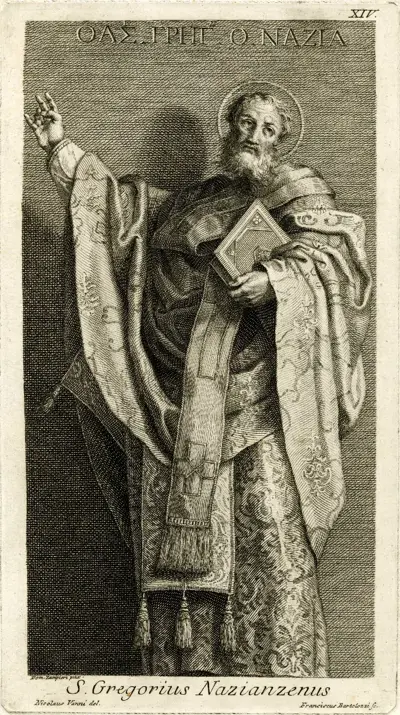
Gregory of Nazianzus, also known as Gregory the Theologian or Gregory Nazianzen, was a 4th-century Archbishop of Constantinople and theologian. He is widely considered the most accomplished rhetorical stylist of the patristic age.[6] As a classically trained orator and philosopher, he infused Hellenism into the early church, establishing the paradigm of Byzantine theologians and church officials.
