George Mundelein Quotes
Father Coughlin has the right to express his views on current events, but he is not authorized to speak for the Catholic Church, nor does he represent the doctrine or sentiment of the Church.
In addition to being a Roman Catholic priest, Father Coughlin was an outspoken radio commentator who was well known for his controversial political opinions, see {598783}, {598784}.
George Mundelein, 1872-1939, Roman Catholic Cardinal (Chicago), Quoted in Fisher, Catholics in America, 2000
Sourced by: Eigen's Political and Historical Quotations

The Priest was the right wing demagogic radio host of his day. Virulently anti-Semitic and anti-Black, he was threatened with excommunication by the Catholic Church, which finally ordered him to cease us weekly radio show and stop the political hate.
Attacking FDR by pandering to anti-Semites and falsely claiming that a Jewish financier, Bernard Baruch ran the government: The Priest was the right wing demagogic radio host of his day. Virulently anti-Semitic and anti-Black, he was threatened with excommunication by the Catholic Church, which finally ordered him to cease us weekly radio show and stop the political hate.

opposition to the church of the time


While the Visigoths had some very advanced legal principles, this law, quoted in its entirety is typical of the nations that were part of the Catholic world. The church and its doctrines were immune from any possible criticism, explicit or implicit. This is the most formalized and sophisticated compendium of laws of the so-called “barbaric peoples” of Europe. The compilation was in many ways a documentation of the traditional laws of the Visigoths that had evolved over hundreds of years.


The Church exercised the law enforcement and censorship authority in all Catholic countries. Note the offense of saying anything which is “offensive to pious ears”. The particular example that “offended” the pious was that a heretic should not be executed. These were the cultural values of the day.


There are some who question the authenticity of this Bull. However, its existence was supported by John of Salisbury who claimed to be the emissary who arranged the Bull. See {611696}. However, those who are shocked that the Pope could have been so crass as to “give” a country to Henry II for money have claimed that the writing of John was also a forgery,
Carroll was writing to Troy during the time of the question of Catholic emancipation in England. Here he is clearly alluding to the British form of government. Carroll never missed the opportunity to champion religious freedom as manifested in the U.S. Constitution. For an earlier example of his praise for religious freedom, see {596933}.

Prior to Vatican II, freedom of conscience was not explicit in Catholic Doctrine. The controlling view had been that of Pope Pius IX a hundred years earlier. See {612299}.


when the encyclical Casti Connubii was promulgated This was written before he was elected Pope. At the time there was some movement within the Catholic Church towards the possible liberalization of the traditional prohibition against birth control of any kind. At the time Montini was in the minority on the Commission, and after he assumed the Papacy, he became a majority of one.

Smith was the first Roman Catholic to run for President. He was very popular but there was a substantial amount of anti-Catholicism in America at the time. He lost, probably by the margin of the anti-Catholic vote.
Coughlin was a great admirer of Adolf Hitler and Benito Mussolini and the Fascists. He was one of the American “heroes” in Nazi Germany, receiving assistance from the Nazi government. Between his anti-Semitism and support for Hitler, Fascism and radical socialism, the Vatican ordered him off the air and shut down his political demagoguery.


Islamic modernists like Serageldin are many among the educated Muslims but their views are often drowned out by the violence and extremist statements of the fundamentalists.

Much of the Catholic Church was greatly influenced by Aquinas long past his death. This quotation laid the foundation for the view, that anything the Church does, even if seemingly wrong or absurd, has some positive value. Here, Aquinas refused to totally condemn the Church practice of giving indulgences (official absolution for serious sins) to the rich in exchange for money. His view assumes that there must be some good in all acts of the church, even if we can not now determine it. This view makes reform very difficult even after the evil is recognized. Some theologians argue that although this perpetuates some bad practices, it provides stability and prevents leaders of the church from constantly trying to adapt the church to meet current popular or civil criticism.
The Protestant Clergy issued similar statements. This was one of the few areas of agreement.

The Roman Catholic Church then maintained that salvation was dependent upon obedience to the Pope in all things civil and religious. See {595166} for the way that the Church at the time allowed some authority to civil authorities.


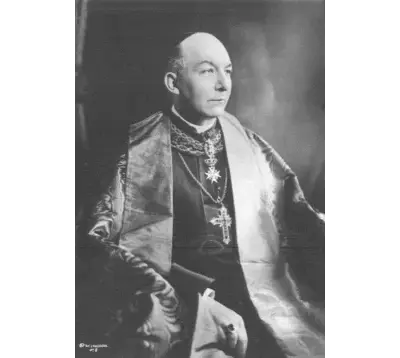
George William Mundelein was an American Cardinal of the Roman Catholic Church. He served as Archbishop of Chicago from 1915 until his death, and was elevated to the cardinalate in 1924.
