Council of Trent Quotes
If anyone says that the holy Catholic Church was not moved by just causes and reasons that laymen and clerics when not consecrating should communicate under the form of bread only, or has erred in this, let him be anathema [excommunicated.]
Council of Trent, Roman Catholic Church Conclave, Canon 2 of the 21st Session
Sourced by: Eigen's Political and Historical Quotations


King Henry VIII had left the Roman Catholic church and taken England and Ireland out also. He replaced the Pope as the head of the English and Irish churches. There was much opposition in Ireland and the priests were the most assertive opponents to the change and were still loyal to the Pope. Queen Elizabeth continued to have problems with the Priests. James I, Elizabeth’s successor, became fed up by the Roman Catholic Priests and therefor issued this Proclamation.


This notice of Excommunication was promulgated to the Catholic clergy in Ireland in May of 1538. It required all Roman Catholic leaders to size the property of Protestants or Catholics who sympathized with them. Those who did were then regarded as traitors by the Protestant King. The anti-Protestant feeling culminated with the massacre of about 100 Protestants who were drowned in Bann a few years later.

In addition to being a Roman Catholic priest, Father Coughlin was an outspoken radio commentator who was well known for his controversial political opinions, see {598783}, {598784}.


when he ingests the wafer at holy communion He was referring to the Roman Catholic communion where the bread wafer is believed to be the body of Christ. This really offended many Protestants who saw it as blasphemous and to many justified their intolerance. And yet, as Locke herein observed, there was really no injury that a Roman Catholic taking communion inflicted on a Protestant who had nothing to do with the Catholic service. Of course, the same logic did not then apply to the Roman Catholic intolerance of Jewish and Muslim religious customs in which they were not involved.


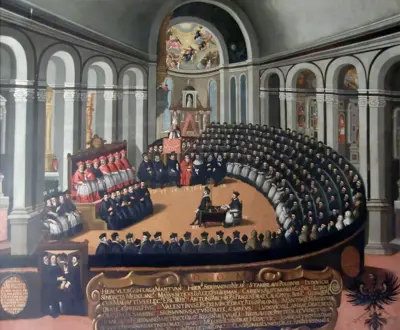
The Council of Trent (Latin: Concilium Tridentinum), held between 1545 and 1563 in Trent (or Trento, in northern Italy), was the 19th ecumenical council of the Catholic Church. Prompted by the Protestant Reformation, it has been described as the embodiment of the Counter-Reformation.
