COUNCIL OF TRENT
While most of the Council of Trent was very conservative in that they were dealing with the threat of Reformation and the Protestants, this particular Cannon is profoundly liberal. Women, who had virtually no rights had often been “sent” to a convent by a father or guardian, the local priest or bishop, and in some cases even a husband. This established for the first time that women could not be forced to take vows—a major step in the evolution of the freedom of women in Western society.
This was a fairly radical constraint on what had been a traditional priestly prerogative throughout the ages. However, the penalty for such a sin and infraction was rather modest—a warning for the first offence, followed by reducing the cleric’s income. There were more serious punishments proscribed for repeated offenses, but typical of most reform efforts a newly prohibited activity carries a very light penalty. For example $20 fines for providing alcohol to a minor was the initial penalty in some states. A then current comparison can be made since elsewhere in this council dueling between Christians was also prohibited. But the penalty for even the first offence was excommunication.
In modern times this would appear to be a most reasonable approach to quality and doctrinal control within a church. But keep in mind that these were to be promulgated by Catholic Kings and become the civil law of the land as well as the religious. So the Catholic Bishops were granted control of who could preach in any church in the Bishopric. The power of the state was there to back up the Bishops with criminal laws and law enforcement. This together with the Inquisition would counter the forces of Reformation—Protestants.
The council was not only fearful of Protestant preaching, but hereby granted a local monopoly within the Catholic Church to the local Bishop.
The clerics of the day were exasperated trying to control the new technology of printing. Almost anyone could produce books and many did. Some of these dealt with religion and some were anonymous. The Council required that members of religious orders have their books reviewed prior to publication by their religious superiors, but the thing that frustrated them most was the anonymous tract. They could not attack the character of the personage of the author and in there was slander or heresy, they had no one to attack or punish.
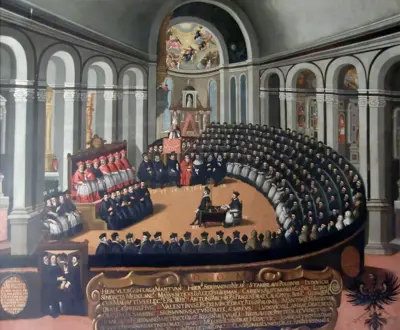
The Council of Trent (Latin: Concilium Tridentinum), held between 1545 and 1563 in Trent (or Trento, in northern Italy), was the 19th ecumenical council of the Catholic Church. Prompted by the Protestant Reformation, it has been described as the embodiment of the Counter-Reformation.
