Council of Trent Quotes
Regulars, of whatsoever order they may be, may not preach even in the churches of their own orders, unless they have been examined and approved of as regards their life, manners, and knowledge, by their own superiors, and with his license; with which license they shall be bound to present themselves personally before the bishops, and beg a blessing from them, before they begin to preach. But, (to preach) in churches which are not those of their own orders, besides the license of their own superiors they shall be obliged to have also the license of the bishop, without which they may not on any account preach in the said churches
In modern times this would appear to be a most reasonable approach to quality and doctrinal control within a church. But keep in mind that these were to be promulgated by Catholic Kings and become the civil law of the land as well as the religious. So the Catholic Bishops were granted control of who could preach in any church in the Bishopric. The power of the state was there to back up the Bishops with criminal laws and law enforcement. This together with the Inquisition would counter the forces of Reformation—Protestants.
Council of Trent, Roman Catholic Church Conclave, Fifth Session, June 17, 1546
Sourced by: Eigen's Political and Historical Quotations

This notice of Excommunication was promulgated to the Catholic clergy in Ireland in May of 1538. It required all Roman Catholic leaders to size the property of Protestants or Catholics who sympathized with them. Those who did were then regarded as traitors by the Protestant King. The anti-Protestant feeling culminated with the massacre of about 100 Protestants who were drowned in Bann a few years later.

opposition to the church of the time


He was the only English Pope. This was the authority that enabled English King Henry II to invade Ireland. Many historians consider it the beginning of the problems between the Ireland and England which persists to this day. See {610520}. Some scholars think that this bull was a forgery stating that the writing style was different from other bulls of Adrian IV. Opponents believe that a change in secretaries could easily have accounted for the difference.

In addition to being a Roman Catholic priest, Father Coughlin was an outspoken radio commentator who was well known for his controversial political opinions, see {598783}, {598784}.

Many of the Church wanted Wycliff excommunicated, but the King and Parliament seemed to like his writing and sermons. So he was protected in his lifetime. He died at the age of 60 of a stroke. After his death the Church burned all his books that had been banned, and exhumed his body. That was burned at the stake and his ashes scattered in a river. Martin Luther did not try to reform the Church in a vacuum. There had been various critics of the Church before Luther and Wycliff was one. The last statement in this quotation was the one that really hit the then mostly corrupt clergy where it hurt.

The council was not only fearful of Protestant preaching, but hereby granted a local monopoly within the Catholic Church to the local Bishop.
While most of the Council of Trent was very conservative in that they were dealing with the threat of Reformation and the Protestants, this particular Cannon is profoundly liberal. Women, who had virtually no rights had often been “sent” to a convent by a father or guardian, the local priest or bishop, and in some cases even a husband. This established for the first time that women could not be forced to take vows—a major step in the evolution of the freedom of women in Western society.


He was one of the few Christians who were then aware of and commented upon the new Reform Judaism—a new Americanized form of Judaism that was then developing. America and its separation of church and state had become a fertile environment for the creation and development of new religions (Mormons, Christian Scientists) and new offshoots of existing religions (Pentecostals, Reform Jews). The Reform Judaism, which many orthodox Jews do not even consider it a legitimate form of Judaism, became, in less than a century the most popular form of Judaism for American Jews.


He was persecuted by the Roman Catholic Church for figuring out that the earth revolved around the sun which was contrary to church teaching at the time.


The clerics of the day were exasperated trying to control the new technology of printing. Almost anyone could produce books and many did. Some of these dealt with religion and some were anonymous. The Council required that members of religious orders have their books reviewed prior to publication by their religious superiors, but the thing that frustrated them most was the anonymous tract. They could not attack the character of the personage of the author and in there was slander or heresy, they had no one to attack or punish.

It is this proclamation and others like it that caused many of the American Founding Fathers to include the doctrine of separation of church and state. In this case, and many others, the government actually proscribed and controlled the prayers and the liturgy. See {617532} where the government proscribes the proportion of revenues that must be spent on the poor.


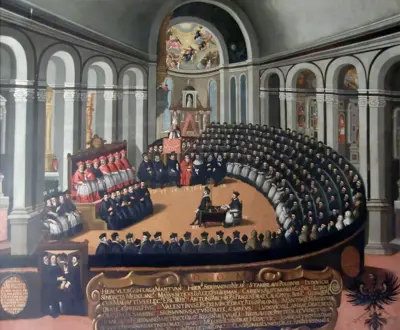
The Council of Trent (Latin: Concilium Tridentinum), held between 1545 and 1563 in Trent (or Trento, in northern Italy), was the 19th ecumenical council of the Catholic Church. Prompted by the Protestant Reformation, it has been described as the embodiment of the Counter-Reformation.
