Council of Trent Quotes
The holy Synod places under anathema all and singular those persons, of what quality or condition soever they may be, whether clerics or laymen, Seculars or Regulars, or with whatsoever dignity invested, who shall, in any way whatever, force any virgin, or widow, or any other woman whatsoever,--except in the cases provided for by law,--to enter a convent against her will, or to take the habit of any religious order, or to make her profession; as also all those who lend their counsel, aid, or countenance thereunto ; and those also who, knowing that she does not enter into the convent voluntarily, or voluntarily take the habit, or make her profession, shall, in any way, interfere in that act, by their presence, or consent, or authority.
While most of the Council of Trent was very conservative in that they were dealing with the threat of Reformation and the Protestants, this particular Cannon is profoundly liberal. Women, who had virtually no rights had often been “sent” to a convent by a father or guardian, the local priest or bishop, and in some cases even a husband. This established for the first time that women could not be forced to take vows—a major step in the evolution of the freedom of women in Western society.
Council of Trent, Roman Catholic Church Conclave, Twenty-Fifth Session, December 3, 1563
Sourced by: Eigen's Political and Historical Quotations


Prior to Vatican II, freedom of conscience was not explicit in Catholic Doctrine. The controlling view had been that of Pope Pius IX a hundred years earlier. See {612299}.

Henry of Navarre. The practice of kidnapping children from parents of the other faith and baptizing them was rampant.

Quintus Septimius Florens Tertullianus


Despite his recognition of this point, he too became an advocate of murdering religious opponents.


Lotario de' Conti

In addition to being a Roman Catholic priest, Father Coughlin was an outspoken radio commentator who was well known for his controversial political opinions, see {598783}, {598784}.

It is an error to say that. It is an error to say that He was the last Pope to hold temporal power. Years later, the Vatican rejected this view and adopted the modern concept of freedom of conscience. See {612714}.

American Catholic bishops were divided during the Civil War over the slavery question. For a bishop’s view opposing abolition of slavery, see Hughes {611579}.

Pen name: Jack Nipps

While the Visigoths had some very advanced legal principles, this law, quoted in its entirety is typical of the nations that were part of the Catholic world. The church and its doctrines were immune from any possible criticism, explicit or implicit. This is the most formalized and sophisticated compendium of laws of the so-called “barbaric peoples” of Europe. The compilation was in many ways a documentation of the traditional laws of the Visigoths that had evolved over hundreds of years.

In India as in other countries the ultra orthodox demand the right to proselytize and publicize their religion but want protection for their communities from others who are advocating “blasphemy” to their people.

In modern times this would appear to be a most reasonable approach to quality and doctrinal control within a church. But keep in mind that these were to be promulgated by Catholic Kings and become the civil law of the land as well as the religious. So the Catholic Bishops were granted control of who could preach in any church in the Bishopric. The power of the state was there to back up the Bishops with criminal laws and law enforcement. This together with the Inquisition would counter the forces of Reformation—Protestants.

This notice of Excommunication was promulgated to the Catholic clergy in Ireland in May of 1538. It required all Roman Catholic leaders to size the property of Protestants or Catholics who sympathized with them. Those who did were then regarded as traitors by the Protestant King. The anti-Protestant feeling culminated with the massacre of about 100 Protestants who were drowned in Bann a few years later.
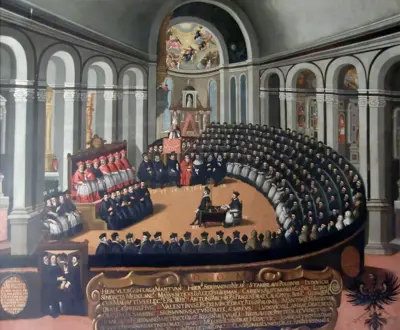
The Council of Trent (Latin: Concilium Tridentinum), held between 1545 and 1563 in Trent (or Trento, in northern Italy), was the 19th ecumenical council of the Catholic Church. Prompted by the Protestant Reformation, it has been described as the embodiment of the Counter-Reformation.
