Henry IV of France Quotes
We also forbid all our subjects, of whatever quality and condition, from carrying off by force or persuasion, against the will of their parents, the children of the said religion, in order to cause them to be baptized or confirmed in the Catholic Apostolic and Roman Church; and the same is forbidden to those of the said religion pretended Reformed, upon penalty of being punished with especial severity.
Henry of Navarre. The practice of kidnapping children from parents of the other faith and baptizing them was rampant.
Henry IV, 1553-1610, King of France, Edict of Nantes, 1598
Sourced by: Eigen's Political and Historical Quotations


Quintus Septimius Florens Tertullianus

It was uttered in the King’s name by soldiers and officials throughout the land. It is not certain that the exact words of choice were created by Louis but they were uttered in his name. Protestants had been given the right to practice their religion in France by the King’s grandfather (the Edict of Nantes {617664}), but Louis XIV rescinded that {617765} and gave Protestants this choice. Some converted. Some were murdered. Some escaped to other countries.

Prior to Vatican II, freedom of conscience was not explicit in Catholic Doctrine. The controlling view had been that of Pope Pius IX a hundred years earlier. See {612299}.


At first this clause appears to be very enlightened and establishing freedom of conscience. This clause allowed Catholics to practice freely whereas in other colonies they could not. However, as one reads on, it becomes clear that the “tolerance” is limited to Christians only. Then if one examines the exception within the parentheses and refer to the rest of the act—see {611994}—, one finds that even Christians who have certain theological beliefs are to be put to death—those for example who deny the holiness of the Trinity such as Unitarians who were a major group in the New England Colonies. It was a significant step at the time however to protect Roman Catholics.

It is an error to say that He was the last Pope to hold temporal power. 101 years later, the Vatican rejected this view and accepted Protestantism at Vatican II.

Jews were forced to convert to Catholicism under penalty of death. While the archbishop did not approve, he did not describe the murders in moral terms or used his great religious power to stop the practice.


Henry of Navarre. This edict made the Huguenots and other Protestants legal in France whereas only 26 years earlier 50,000 of them had been slaughtered in France by the Catholics. It wasn’t a century before the Catholics reneged. See {617765}.
The Protestants had been given the right to practice their religion free from harm by the King’s grandfather. See {617664}. The inter-religious animosity continued and the Catholics again tried to make France an exclusively Catholic country.


There were times and places where the Ottoman Turks forced Islam upon conquered peoples. However, much of the time, they operated with a pragmatic tolerance so that they could govern smoothly. The non-Muslims were always second class citizens however. See {635095} for another example.

The boycott had been triggered by a breakup of a mixed marriage where the Protestant wife took her two children to Belfast and would only reunite with her husband if he agreed to bring up the children as Protestants. This brought Catholic accusations of a Protestant conspiracy and plot to kidnap Catholic Children and take them to Northern Island to be brought up as Protestants. The boycott soon ended as it was too unfair for all but the most rabid Anti-protestants.


While most of the Council of Trent was very conservative in that they were dealing with the threat of Reformation and the Protestants, this particular Cannon is profoundly liberal. Women, who had virtually no rights had often been “sent” to a convent by a father or guardian, the local priest or bishop, and in some cases even a husband. This established for the first time that women could not be forced to take vows—a major step in the evolution of the freedom of women in Western society.
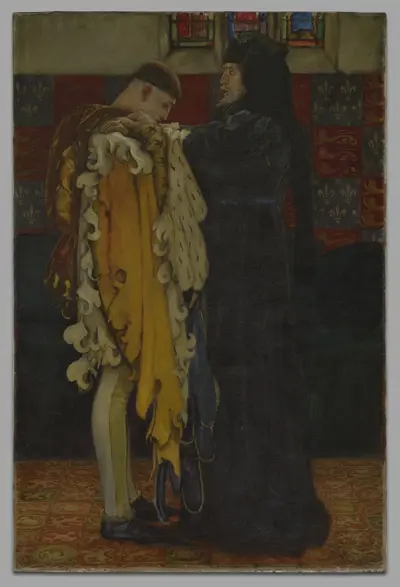
Henry IV (French: Henri IV; 13 December 1553 – 14 May 1610), also known by the epithets Good King Henry or Henry the Great, was King of Navarre (as Henry III) from 1572 and King of France from 1589 to 1610. He was the first monarch of France from the House of Bourbon, a cadet branch of the Capetian dynasty. He was assassinated in 1610 by François Ravaillac, a Catholic zealot, and was succeeded by his son Louis XIII.
