Louis XIV Quotes
Be it known that for these causes and others us hereunto moving, and of our certain knowledge, full power, and royal authority, we have, by this present perpetual and irrevocable edict, suppressed and revoked, and do suppress and revoke, the edict of our said grandfather, given at Nantes in April, 1598, in its whole extent, together with the particular articles agreed upon in the month of May following, and the letters patent issued upon the same date; and also the edict given at Nimes in July, 1629; we declare them null and void, together with all concessions, of whatever nature they may be, made by them as well as by other edicts, declarations, and orders, in favor of the said persons of the R.P.R., the which shall remain in like manner as if they had never been granted; and in consequence we desire, and it is our pleasure, that all the temples of those of the said R.P.R. situate in our kingdom, countries, territories, and the lordships under our crown, shall be demolished without delay. We forbid our subjects of the R.P.R. to meet any more for the exercise of the said religion in any place or private house, under any pretext whatever, ...
The Protestants had been given the right to practice their religion free from harm by the King’s grandfather. See {617664}. The inter-religious animosity continued and the Catholics again tried to make France an exclusively Catholic country.
Louis XIV, 1638-1715, King of France, Revocation of the Edict of Nantes, October 22, 1685
Sourced by: Eigen's Political and Historical Quotations

Henry of Navarre. This edict made the Huguenots and other Protestants legal in France whereas only 26 years earlier 50,000 of them had been slaughtered in France by the Catholics. It wasn’t a century before the Catholics reneged. See {617765}.

It was uttered in the King’s name by soldiers and officials throughout the land. It is not certain that the exact words of choice were created by Louis but they were uttered in his name. Protestants had been given the right to practice their religion in France by the King’s grandfather (the Edict of Nantes {617664}), but Louis XIV rescinded that {617765} and gave Protestants this choice. Some converted. Some were murdered. Some escaped to other countries.
The King Outlawed Protestant Worship.

Louisiana was then a possession of France


It was not until 1780 that Catholics were allowed to even be members of Town Corporations.


He had been an eye-witness to the Massacre of the Parisian Protestants as a young man.

What the historian did not know was how similarly the Protestants would behave against the Catholics when they had the power. Since the Catholics were the established church, and the Protestants the new “heretics” the Protestants were on the receiving end of most of the atrocities at the beginning. However, as if they had been scholled by their horrible experiences, they repeated them just exchanging the perpetrators and the victims.
Henry of Navarre. The practice of kidnapping children from parents of the other faith and baptizing them was rampant.

The letter was in response to the King’s letter commanding him and all the other governors to massacre all the Protestants in his district. Montmorrin, a Catholic, died suddenly and shortly thereafter. It is supposed he and one other objector (Viscount Orthez) were poisoned by order of King Charles. All the other governors obeyed and 50,000 Protestants were murdered in the Massacre of Saint Bartholomew.


It took only 10 days after the First Continental Congress met for religious bigotry to arise. After hundreds of years of Catholic/Protestant strife, each sect looked upon the other, not only as theologically wrong, but dangerous to the liberty of the other. Unfortunately, the organied religions had acted so badly towards other religions, that everyone was justified in fearing the other religions. This quotation illustrates a then typical attitude of many American Protestants that the Catholic Church was a threat to national security. Ironically, in modern times, anti-Catholic bigots use this quotation to demonstrate that the United States was founded as a Christian Protestant nation—not a general Christian nation. A small, vicious anti-Catholic sentiment still exists, usually by a minority of right wing Protestant religious fundamentalists. Protestant England had just repealed the laws making Catholicism illegal, but this was regarded at that time as intolerable for the new America. This was one of the disputes which that the Founding Fathers were faced with later and one of the reasons that they were so absolute in the need for the 1st Amendment.


It is this verse that for some Muslims justifies terrorism against non-Muslims. See {584354} for a specific example. There are similar provisions in the Old Testament which a few extremely conservative Jews and Christians have used to advocate for blasphemy being a capital crime. Note that if an unbeliever repents and becomes a Muslim, he should be spared.

Kennedy was being hurt be fears that as a Catholic, he would be beholden to the Pope and the Catholic Bishops. There were many protestants who believed that the Catholic Church was antithetical to democracy and some who even believed that Catholicism was the religion of Satan. Kennedy decided to confront the issue head on.
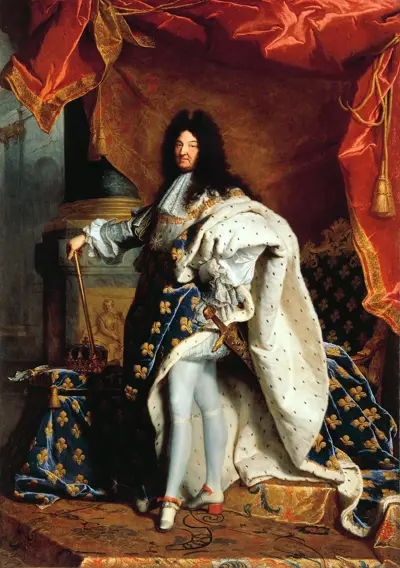
- Born: September 5, 1638
- Died: September 1, 1715
- Nationality: French
- Profession: Royalty
Louis XIV, also known as Louis the Great (Louis le Grand) or the Sun King (le Roi Soleil), was King of France from 14 May 1643 until his death in 1715. His reign of 72 years and 110 days is the longest recorded of any monarch of a sovereign country in European history. Louis XIV's France was emblematic of the age of absolutism in Europe. The King surrounded himself with a variety of significant political, military, and cultural figures, such as Mazarin, Colbert, Louvois, the Grand Condé, Turenne, Vauban, Boulle, Molière, Racine, Boileau, La Fontaine, Lully, Charpentier, Marais, Le Brun, Rigaud, Bossuet, Le Vau, Mansart, Charles Perrault, Claude Perrault, and Le Nôtre.
