Louis XV Quotes
[This law] forbids the exercise of any other religion than the Catholic…. all Jews who may have established their religion there [shall] be expelled within three months, under penalty of confiscation of body and property
Louisiana was then a possession of France
Louis XV, 1710-1774, King of France, The "Black Code" [Laws] Of Louisiana, March, 1724
Sourced by: Eigen's Political and Historical Quotations


The King Outlawed Protestant Worship.

Toleration is a relative term. The Muslim Moors made Christians (and Jews) pay a special tax. At times they were forced to wear special clothing so that they could be readily identified. And they could not build churches larger or taller than the smallest mosque in the community. At times, their occupations were restricted but at other times Christians and Jews were appointed to the highest positions like Vizier. The Inquisition, in contrast, forced all Muslims (and Jews) to leave the country without any of their property or money or be tortured and killed—usually by burning at the stake unless of course that they converted to Christianity.


This sura has unfortunately been used by some Serbians and other Christians to justify ethnic cleansing against Muslims.
It was uttered in the King’s name by soldiers and officials throughout the land. It is not certain that the exact words of choice were created by Louis but they were uttered in his name. Protestants had been given the right to practice their religion in France by the King’s grandfather (the Edict of Nantes {617664}), but Louis XIV rescinded that {617765} and gave Protestants this choice. Some converted. Some were murdered. Some escaped to other countries.

The origins of the extreme religious intolerance of Spain occurred centuries before the excesses of the Spanish Inquisition. Before the Conference the Visigoths and their king had been converted to Christianity but not all cared for the new religion.
It is this verse that for some Muslims justifies terrorism against non-Muslims. See {584354} for a specific example. There are similar provisions in the Old Testament which a few extremely conservative Jews and Christians have used to advocate for blasphemy being a capital crime. Note that if an unbeliever repents and becomes a Muslim, he should be spared.
Ethnic cleansing was a basic component of early Islam. The contemporary seeming hysteria over American troops in Arab nations, has in addition to the usual problems of soldiers from another land this background. The same is true about the presence of Israel. From some points of view, the presence of Christians and Jew in the Middle East is wrong per se because it undermines the work and intention of the Prophet.

It was not until 1780 that Catholics were allowed to even be members of Town Corporations.


He had been an eye-witness to the Massacre of the Parisian Protestants as a young man.

What the historian did not know was how similarly the Protestants would behave against the Catholics when they had the power. Since the Catholics were the established church, and the Protestants the new “heretics” the Protestants were on the receiving end of most of the atrocities at the beginning. However, as if they had been scholled by their horrible experiences, they repeated them just exchanging the perpetrators and the victims.


See {586039} for a quotation that goes further and seeks to punish and humiliate the non believers. This sura is often used by those wishing to illustrate the intolerance of Islam—especially of other religions. They fail to put this into the context of the Old Testament which proscribed death for heretics or the history of Christianity regarding the murder of nonbelievers. The difference is however, that a very small proportion of Jews or Christians today believe in following Biblical instructions in this respect while the proportion of Muslims who believe in the literal interpretation of scripture on these points is much larger. However there are Islamic modernists and moderates throughout the world who reject this notion of warring on all other religions and there is a struggle going on within Islam itself.

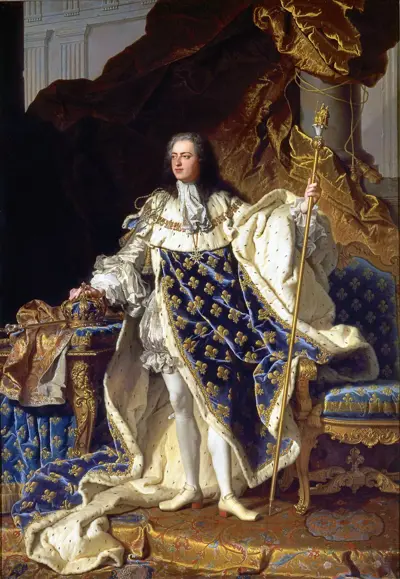
Louis XV, known as Louis the Beloved (French: le Bien-Aimé), was King of France from 1 September 1715 until his death in 1774. He succeeded his great-grandfather Louis XIV at the age of five. Until he reached maturity (then defined as his 13th birthday) on 15 February 1723, the kingdom was ruled by Philippe II, Duke of Orléans, as Regent of France. Cardinal Fleury was chief minister from 1726 until his death in 1743, at which time the king took sole control of the kingdom.
