Frederick the Great Quotes
Catholics, Lutherans, Reformed, Jews and other Christian sects live in this state, and live together in peace. If the sovereign, actuated by a mistaken zeal, declares himself for one religion or another, parties spring up, heated disputes ensue, little by little persecutions will commence and, in the end, the religion persecuted will leave the fatherland, and millions of subjects will enrich our neighbors by their skill and industry.
Frederick II, 1712-1786, [The Great], King of Prussia, Political Testament, 1752
Sourced by: Eigen's Political and Historical Quotations

Toleration is a relative term. The Muslim Moors made Christians (and Jews) pay a special tax. At times they were forced to wear special clothing so that they could be readily identified. And they could not build churches larger or taller than the smallest mosque in the community. At times, their occupations were restricted but at other times Christians and Jews were appointed to the highest positions like Vizier. The Inquisition, in contrast, forced all Muslims (and Jews) to leave the country without any of their property or money or be tortured and killed—usually by burning at the stake unless of course that they converted to Christianity.

Locke wrote the Charter of South Carolina in which any 7 people could assemble and form a church including:

Wesley had been to Island several times and was interested in affairs there. He was a strong advocate of freedom of religion but the violence of the earlier religious conflict made him very wary of the Irish Roman Catholics who seemed to him particularly prone to religious violence.

Samuel Langhorne Clemens, 1835-1910

He is a Greek Orthodox Christian, and he correctly observes that the Islamic world was considerably more tolerant than the Christian until the 18th century when Islam had become less tolerant in the Middle East while the Christians were modernizing and going through a cultural and intellectual enlightenment and societal modernization while the Muslims, became less tolerant than they were in earlier years leading to the modern situation.


While not in the Koran, this attributed statement is the basis for the ban on non-Muslims going on a Hajj and going to the most holy Muslim places—Mecca, Mina, Muzdalifa, and Arafat as well as the anti-religious hostility to all religions but Islam which is present in some Muslim countries.

In one of the historical ironies of the 12th century, a Christian sect preferred the rule of the Muslims than their Christian brethren—on the grounds of religious tolerance. It illustrates the changes that take place over time. By the 21st century, it was the Christians who were thought of as tolerant and the Muslims as the opposite.


This was the beginning of the inquisition.

Henry of Navarre


The origins of the extreme religious intolerance of Spain occurred centuries before the excesses of the Spanish Inquisition. Before the Conference the Visigoths and their king had been converted to Christianity but not all cared for the new religion.

Despite the fact that the statues were holy symbols to Buddhists, they were offensive to Muslims who say statues as “graven images” prohibited by the Koran. See Wakil Ahmad Muttawakil {608419} and Jamal’s other quotation {604665}.

Louisiana was then a possession of France
In the early stages of Islam, Muhammad had hoped to convert the Jews and others on the Arabian Peninsula. When they refused to be converted, he warred against them usually killing the men, and taking the women and children as slaves. The result was that non-believing tribes were “cleansed” from the Arabian Peninsula. The Muslims at the time preferred children as slaves. For then they could convert the children against their will. Adults in Islam must accept Islam in order to convert. Children are regarded as having no such maturity of decision making and therefore opposition to conversion may be ignored and they may be forced. Critics of Islam and those who argue that Islam is at odds with all other religions point to this quotation. They claim that it is the only religion whose founder and fundamental scriptures demand war against others for no other reason than that they believe in a different religion. The Catholic Church during the Crusades and the Inquisition had a similar philosophy as did Christian missionaries colonizing Africa later. One difference is that most Christians today repudiate the doctrine as against the true spirit and teachings of Christ and view it as historical error, while very few modern Muslims repudiate this quotation of the Prophet.
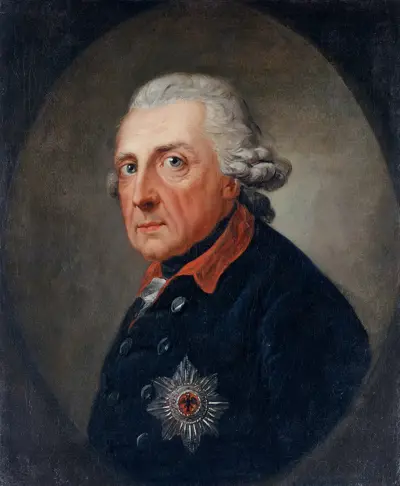
Frederick II was a Prussian king and military leader who ruled the Kingdom of Prussia from 1740 until 1786, reigning longer than any other Hohenzollern king. His most significant accomplishments during his reign included his reorganization of Prussian armies, his military successes in the Silesian wars and the Partitions of Poland, and his patronage of the arts and the Enlightenment. Frederick was the last Hohenzollern monarch titled King in Prussia and declared himself King of Prussia after annexing strategic parts of the Polish–Lithuanian Commonwealth in 1772. Prussia greatly increased its territories and became a leading military power in Europe under his rule. He became known as Frederick the Great (German: Friedrich der Große) and was nicknamed "The Old Fritz" (German: "Der Alte Fritz") by the Prussian people and eventually the rest of Germany.
