Louis XIV Quotes
We forbid our subjects .... to meet any more for the exercise of the said religion in any place or private house, under any pretext whatever, .... We enjoin all [Protestant] ministers … who do not choose to become converts and to embrace the Catholic, apostolic, and Roman religion, to leave our kingdom and the territories subject to us within a fortnight of the publication of our present edict, without leave to reside therein beyond that period, or, during the said fortnight, to engage in any preaching, exhortation, or any other function, on pain of being sent to the galleys... .
The King Outlawed Protestant Worship.
Louis XIV, 1638-1715, King of France, Revocation of the Edict of Nantes, October 22, 1685
Sourced by: Eigen's Political and Historical Quotations

Louisiana was then a possession of France

The origins of the extreme religious intolerance of Spain occurred centuries before the excesses of the Spanish Inquisition. Before the Conference the Visigoths and their king had been converted to Christianity but not all cared for the new religion.

The boycott had been triggered by a breakup of a mixed marriage where the Protestant wife took her two children to Belfast and would only reunite with her husband if he agreed to bring up the children as Protestants. This brought Catholic accusations of a Protestant conspiracy and plot to kidnap Catholic Children and take them to Northern Island to be brought up as Protestants. The boycott soon ended as it was too unfair for all but the most rabid Anti-protestants.

The Protestants had been given the right to practice their religion free from harm by the King’s grandfather. See {617664}. The inter-religious animosity continued and the Catholics again tried to make France an exclusively Catholic country.
The letter was in response to the King’s letter commanding him and all the other governors to massacre all the Protestants in his district. Montmorrin, a Catholic, died suddenly and shortly thereafter. It is supposed he and one other objector (Viscount Orthez) were poisoned by order of King Charles. All the other governors obeyed and 50,000 Protestants were murdered in the Massacre of Saint Bartholomew.

He had been an eye-witness to the Massacre of the Parisian Protestants as a young man.

It was not until 1780 that Catholics were allowed to even be members of Town Corporations.
It was uttered in the King’s name by soldiers and officials throughout the land. It is not certain that the exact words of choice were created by Louis but they were uttered in his name. Protestants had been given the right to practice their religion in France by the King’s grandfather (the Edict of Nantes {617664}), but Louis XIV rescinded that {617765} and gave Protestants this choice. Some converted. Some were murdered. Some escaped to other countries.


New Ross was under siege by Cromwell and his English Parliamentarian troops. After two days, the town tried to negotiate terms of surrender and one of the main things they asked for was freedom of religion to practice Roman Catholicism. This famous response set the stage for religious bigotry over the next years. Cromwell’s reasons for not allowing Catholicism to be practiced was not only one of religious zeal. At the time, the Roman Catholic Church was a major geopolitical power under a Pope who commonly supported or even dispatched troops for geopolitical and religious ends. The Vatican was particularly resentful of England for separating from the Church and asserting that the King of England was the head of the Church and not the Pope. Therefore Cromwell and many Englishmen had to deal with the reality that every practicing Catholic in the realm was a potential spy, traitor, and/or rebel. This fear of control of countries by the Pope strongly affected America, and was responsible for the defeat of the first Catholic Presidential Candidate, Al Smith. It was also a major factor in the election of John F. Kennedy so he dealt with it head on.


The King, a religious exremist fanatic, was a great supporter of the Inquisition whose excesses were horrible during his reign.

These kinds of inflammatory sermons are delivered with the approval of the king and royal family who crack down on any cleric who preaches what they do not approve of.
Toleration is a relative term. The Muslim Moors made Christians (and Jews) pay a special tax. At times they were forced to wear special clothing so that they could be readily identified. And they could not build churches larger or taller than the smallest mosque in the community. At times, their occupations were restricted but at other times Christians and Jews were appointed to the highest positions like Vizier. The Inquisition, in contrast, forced all Muslims (and Jews) to leave the country without any of their property or money or be tortured and killed—usually by burning at the stake unless of course that they converted to Christianity.

[This was the first Abolition appeal written by a Black Man. It was published in Boston and despite the fact that it was very critical of whites, was very popular going through two more printings within the next two years.]
Anabaptists from all over Germany and Europe had been called with their arms to Munster, where whey gained control of the city, and then by force began to expel all the Catholics and pressure the Protests to be re-Baptized and join the Anabaptists. Some did to keep their homes and property. However Mathias, with this quotation, became as bad as the Roman Catholic Church had been regarding the killing of dissenters. His logic is exactly the same as that of the Catholics and the Protestants who were killing the Anabaptists.
In August of 1572 Catholics in Paris led by the Marshall and his soldiers attacked the homes of all known Huguenots, murdering the inhabitants. Tavannes rode through the streets of Paris on his horse shouting the first quotation to his troops who would murder the helpless Protestants. The frenzy spread to the countryside. When it was over 50,000 innocent, unsuspecting Protestants had been murdered. When asked how he, a military marshal felt about such a one sided action against unarmed civilians he responded with the second quotation. The event came to be known as the Massacre of Saint Bartholomew as it commenced on that Saint’s day.

It took only 10 days after the First Continental Congress met for religious bigotry to arise. After hundreds of years of Catholic/Protestant strife, each sect looked upon the other, not only as theologically wrong, but dangerous to the liberty of the other. Unfortunately, the organied religions had acted so badly towards other religions, that everyone was justified in fearing the other religions. This quotation illustrates a then typical attitude of many American Protestants that the Catholic Church was a threat to national security. Ironically, in modern times, anti-Catholic bigots use this quotation to demonstrate that the United States was founded as a Christian Protestant nation—not a general Christian nation. A small, vicious anti-Catholic sentiment still exists, usually by a minority of right wing Protestant religious fundamentalists. Protestant England had just repealed the laws making Catholicism illegal, but this was regarded at that time as intolerable for the new America. This was one of the disputes which that the Founding Fathers were faced with later and one of the reasons that they were so absolute in the need for the 1st Amendment.

This was the beginning of the inquisition.
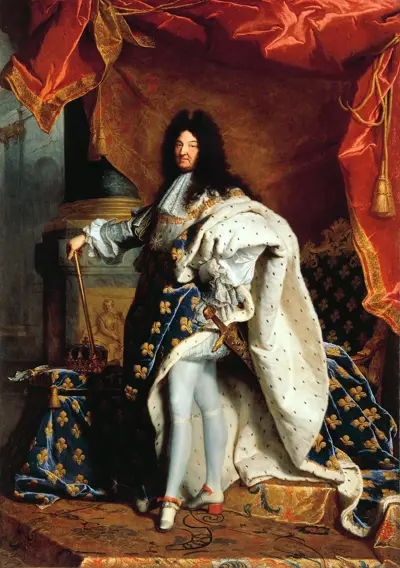
Louis XIV, also known as Louis the Great (Louis le Grand) or the Sun King (le Roi Soleil), was King of France from 14 May 1643 until his death in 1715. His reign of 72 years and 110 days is the longest recorded of any monarch of a sovereign country in European history. Louis XIV's France was emblematic of the age of absolutism in Europe. The King surrounded himself with a variety of significant political, military, and cultural figures, such as Mazarin, Colbert, Louvois, the Grand Condé, Turenne, Vauban, Boulle, Molière, Racine, Boileau, La Fontaine, Lully, Charpentier, Marais, Le Brun, Rigaud, Bossuet, Le Vau, Mansart, Charles Perrault, Claude Perrault, and Le Nôtre.
