Maryland Quotes
And whereas the inforceing of the conscience in matters of Religion hath frequently fallen out to be of dangerous Consequence in those commonwealthes where it hath been practised, And for the more quiett and peaceable governement of this Province, and the better to preserve mutuall Love and amity amongst the Inhabitants thereof, Be it Therefore also by the Lord Proprietary with the advise and consent of this Assembly Ordeyned and enacted (except as in this present Act is before Declared and sett forth) that noe person or persons whatsoever within this Province, or the Islands, Ports, Harbors, Creekes, or havens thereunto belonging professing to beleive in Jesus Christ, shall from henceforth bee any waies troubled, Molested or discountenanced for or in respect of his or her religion nor in the free exercise thereof within this Province
At first this clause appears to be very enlightened and establishing freedom of conscience. This clause allowed Catholics to practice freely whereas in other colonies they could not. However, as one reads on, it becomes clear that the “tolerance” is limited to Christians only. Then if one examines the exception within the parentheses and refer to the rest of the act—see {611994}—, one finds that even Christians who have certain theological beliefs are to be put to death—those for example who deny the holiness of the Trinity such as Unitarians who were a major group in the New England Colonies. It was a significant step at the time however to protect Roman Catholics.
Maryland Toleration Act of 1649, September 21, 1649
Sourced by: Eigen's Political and Historical Quotations

This quotation illustrates two interesting facets of colonial politics. First, as in modern times, the title of an act often was inconsistent with the substance, and in many cases, this act among them, the act itself completely contradicts the implication of the title. The draconian intolerance exhibited by this clause was typical of the targets of the framers of the Constitution in erecting the separation of church and state. The fascinating thing about this act is another clause which acknowledged the difficulty of enforcing a common religion, and allowed that no one should be
This is the first American ordinance of freedom of conscience. Note that it only provided freedom of religion for Christians. However, that was an important first step as different sects of Christianity had been persecuting each other whenever the opportunity arose.

Henry of Navarre. This edict made the Huguenots and other Protestants legal in France whereas only 26 years earlier 50,000 of them had been slaughtered in France by the Catholics. It wasn’t a century before the Catholics reneged. See {617765}.
Henry of Navarre


Toleration is a relative term. The Muslim Moors made Christians (and Jews) pay a special tax. At times they were forced to wear special clothing so that they could be readily identified. And they could not build churches larger or taller than the smallest mosque in the community. At times, their occupations were restricted but at other times Christians and Jews were appointed to the highest positions like Vizier. The Inquisition, in contrast, forced all Muslims (and Jews) to leave the country without any of their property or money or be tortured and killed—usually by burning at the stake unless of course that they converted to Christianity.


In one of the historical ironies of the 12th century, a Christian sect preferred the rule of the Muslims than their Christian brethren—on the grounds of religious tolerance. It illustrates the changes that take place over time. By the 21st century, it was the Christians who were thought of as tolerant and the Muslims as the opposite.
Williams was the first theologian who not only advocated religious toleration but argued that Christianity demanded it and the separation of church and state.

Abdul Rahman, Afghan citizen, had converted from Islam to Christianity 16 years before. Conversion from Islam is a capital crime under Sharia Law which was the law of Afghanistan even after the Taliban had been overthrown. He was jailed and threatened with death. Statements like this and others made directly to the government persuaded the Afghan politicians to go against their mullahs who demanded the death penalty as is proscribed by Islamic Law—Sharia. The judges tried to get Rahman to recant and he would not (see {589518}). So they finally decided that he must be mentally insane and therefore could not be tried, and the problem was solved that way.


Quintus Septimius Florens Tertullianus


Wesley had been to Island several times and was interested in affairs there. He was a strong advocate of freedom of religion but the violence of the earlier religious conflict made him very wary of the Irish Roman Catholics who seemed to him particularly prone to religious violence.

It was drafted by John Adams. Note that there was freedom of religion for Christians and not others. Of all the colonies, Massachusetts had the worst record of religious intolerance with Puritans controlling everything. Rhode Island and Connecticut were created by religious dissenters from Massachusetts. Adams had all he could do to get the Christian sects on an equal footing ratified. The other colonies however, insisted to a total freedom of religion clause which became the First Amendment to the national Constitution. Adams himself was a kind of secular, cultural Christian who did not believe in the divinity of Christ and other Christian doctrine. See {592695} to illustrate this.

Those who claim that the founding fathers contemplated religion as a critical component of government often point to this article of the South Carolina Constitution. However, they ignore the almost simultaneous passage of the New York constitution as in {612166}. When the framers of the Constitution met in 1787 in Philadelphia the separation of church and state issue was not really resolved and awaited the Bill of Rights where the separatists won out.


This law governed the territories outside of the original 13 colonies. This is the first chance that Congress had to legislate on religious freedom, and they guaranteed that there would be no territory that would be founded by or unilaterally controlled by any particular religion at the expense of the religious freedom of other people.


The first Jewish Publication in the United States
Henry of Navarre. The practice of kidnapping children from parents of the other faith and baptizing them was rampant.

Despite this clear statement, later the Colonial legislature withdrew the franchise from Roman Catholics. See {624149}. Despite this temporary restriction of religious freedom, Rhode Island and Connecticut were far ahead of the other New England colonies in freedom of conscience.
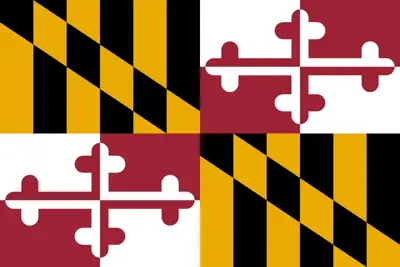
Maryland (US: /ˈmɛrələnd/ (listen) MERR-ə-lənd) is a state in the Mid-Atlantic region of the United States, bordering Virginia, West Virginia, and the District of Columbia to its south and west; Pennsylvania to its north; and Delaware and the Atlantic Ocean to its east. Baltimore is the largest city in the state and the capital is Annapolis. Among its occasional nicknames are Old Line State, the Free State, and the Chesapeake Bay State. It is named after the English Queen Henrietta Maria, known in England as Queen Mary, who was the wife of King Charles I.
