Roger Williams Quotes
God requireth not a uniformity of religion to be enacted and enforced in any civil state; which enforced uniformity (sooner or later) is the greatest occasion of civil war, ravishing of conscience, persecution of Christ Jesus in his servants, and of the hypocrisy and destruction of millions of souls.
Roger Williams, c. 1603-1683, Clergyman and founder of Rhode Island, The Bloudy Tenent, 1644
Sourced by: Eigen's Political and Historical Quotations

Williams was the first theologian who not only advocated religious toleration but argued that Christianity demanded it and the separation of church and state.

At first this clause appears to be very enlightened and establishing freedom of conscience. This clause allowed Catholics to practice freely whereas in other colonies they could not. However, as one reads on, it becomes clear that the “tolerance” is limited to Christians only. Then if one examines the exception within the parentheses and refer to the rest of the act—see {611994}—, one finds that even Christians who have certain theological beliefs are to be put to death—those for example who deny the holiness of the Trinity such as Unitarians who were a major group in the New England Colonies. It was a significant step at the time however to protect Roman Catholics.

This is a particularly interesting historical quotation because it succinctly gives a history of the various horrors of religious strife in British history—a history that was very well known to the American Founding Fathers and the general American Colonial population. This history was the major driver behind the public insistence for the Bill of Rights and the 1st Amendment which erected a wall of separation between church and state with government never favoring or abetting any particular religion.


Catholics were blamed by some for the defeat of Henry Clay in 1844. Anti catholic sentiment was high:. Johnson was then a Congressman representing a district where there were few Catholics and strong anti-Catholic feeling.


He is a Greek Orthodox Christian, and he correctly observes that the Islamic world was considerably more tolerant than the Christian until the 18th century when Islam had become less tolerant in the Middle East while the Christians were modernizing and going through a cultural and intellectual enlightenment and societal modernization while the Muslims, became less tolerant than they were in earlier years leading to the modern situation.


This is the first American ordinance of freedom of conscience. Note that it only provided freedom of religion for Christians. However, that was an important first step as different sects of Christianity had been persecuting each other whenever the opportunity arose.


This appears to be one of the first religious groups to withdraw and separate from a state church.


Wesley had been to Island several times and was interested in affairs there. He was a strong advocate of freedom of religion but the violence of the earlier religious conflict made him very wary of the Irish Roman Catholics who seemed to him particularly prone to religious violence.
In one of the historical ironies of the 12th century, a Christian sect preferred the rule of the Muslims than their Christian brethren—on the grounds of religious tolerance. It illustrates the changes that take place over time. By the 21st century, it was the Christians who were thought of as tolerant and the Muslims as the opposite.

Samuel Langhorne Clemens, 1835-1910
Historically, when Christian Europe was torturing and butchering people over differences of religious opinion, Islam was for the time, in most places, a model of tolerance. Suhrawardy died before Islam degenerated into an intolerance that almost rivaled in brutality that of the Christians centuries ago. And while his statement about the invention and initiation of brutal intolerance is correct, he would be shocked at the behavior of 21st century Iran, Pakistan and some other Islamic nations who from a traditional Islamic perspective had degenerated.

In the early stages of Islam, Muhammad had hoped to convert the Jews and others on the Arabian Peninsula. When they refused to be converted, he warred against them usually killing the men, and taking the women and children as slaves. The result was that non-believing tribes were “cleansed” from the Arabian Peninsula. The Muslims at the time preferred children as slaves. For then they could convert the children against their will. Adults in Islam must accept Islam in order to convert. Children are regarded as having no such maturity of decision making and therefore opposition to conversion may be ignored and they may be forced. Critics of Islam and those who argue that Islam is at odds with all other religions point to this quotation. They claim that it is the only religion whose founder and fundamental scriptures demand war against others for no other reason than that they believe in a different religion. The Catholic Church during the Crusades and the Inquisition had a similar philosophy as did Christian missionaries colonizing Africa later. One difference is that most Christians today repudiate the doctrine as against the true spirit and teachings of Christ and view it as historical error, while very few modern Muslims repudiate this quotation of the Prophet.

The wording was rejected and the delegates insisted upon the original proposed language: “Well aware that Almighty God hath created the mind free …” This is a very important historical quotation because it shows that Henry and a few others wanted to make the society Christian centric, However, the majority insisted that it be non-sectarian. Many of the delegates rejecting the “Jesus Christ” language were themselves practicing Christians, but they were aware of the terrible religious wars and strife in Europe and between Christians and Muslims as well as the persecution of Jews, Quakers, and other sects; they did not want that in America so they rejected the idea of an established Christian Church or culture.
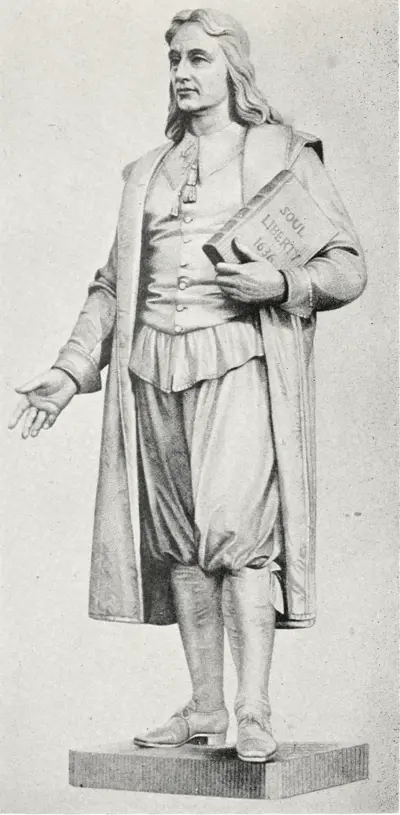
Roger Williams was a Puritan minister, theologian, and author who founded Providence Plantations, which became the Colony of Rhode Island and later the U.S. state of Rhode Island. He was a staunch advocate for religious freedom, separation of church and state, and fair dealings with Native Americans.
